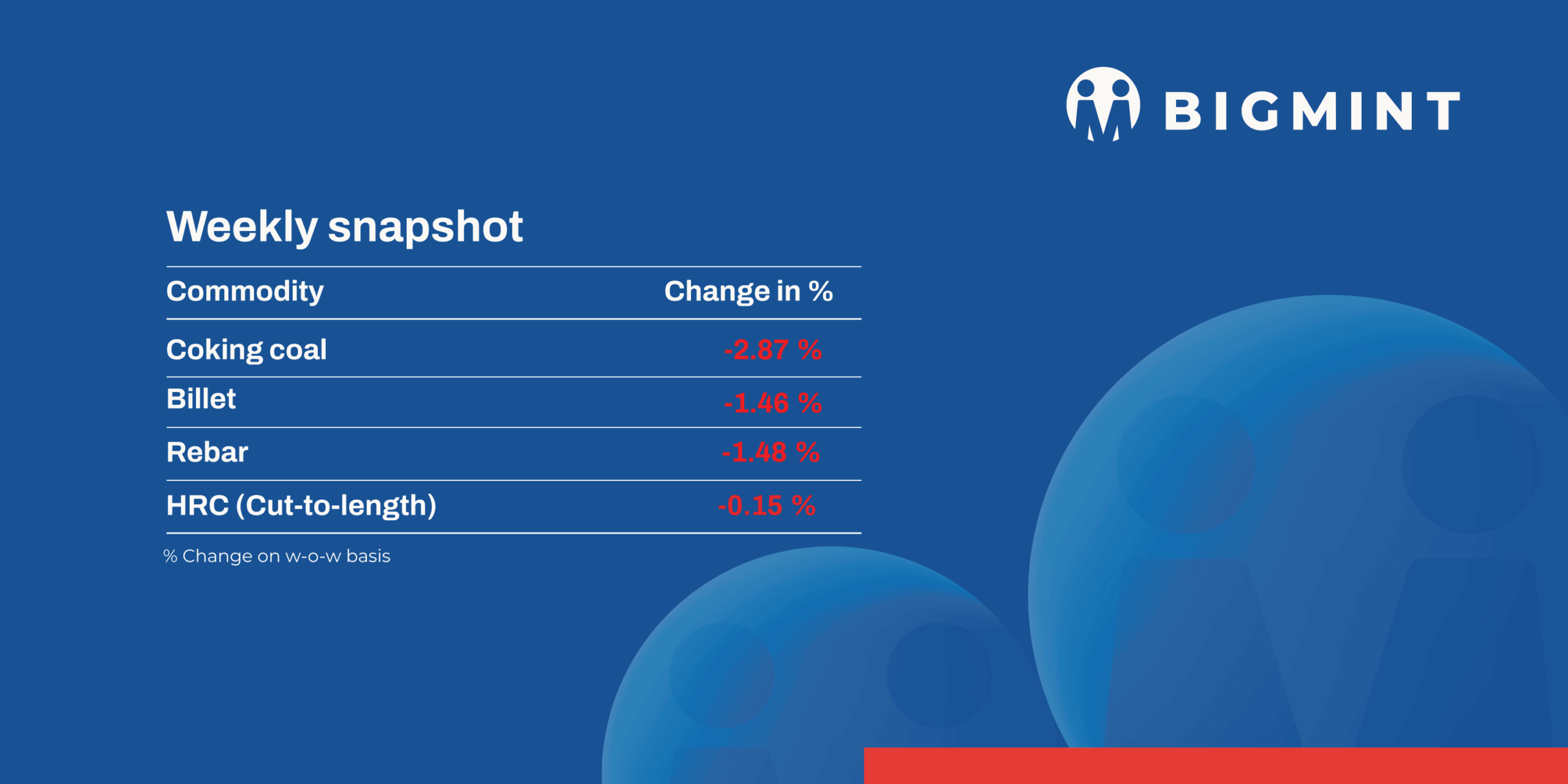
- Ferro alloys, domestic coal gain on tighter availability
- BF rebar prices continue to surge on low mill inventories
Indian steel markets saw broad corrections in billets, sponge iron, and IF-rebar in the week ended 26 September 2026, while BF rebar and ferro alloys strengthened and flat steel markets remained mixed amid selective buying.
Iron ore and pellet
PELLEX, BigMint’s bi-weekly domestic pellet (Fe 63% ± 0.5%) index for Raipur, declined by INR 250/t w-o-w to INR 11,000/t DAP Raipur on 25 September 2026. Weak buying interest, softer steel realisations, and falling sponge iron and billet prices pressured prices, while rain-related logistics disruptions and limited transactions added to the correction.
Chowgule and Company has commenced operations at the Pale iron ore dump in Goa, the first under the Goa Policy for Regulating Iron Ore Dump Handling, 2023. The move marks the implementation of a regulated framework for utilising iron ore remaining in dumps from earlier mining operations.
Indian low-grade iron ore fines (Fe 57%) export prices rose by around $3.5/t w-o-w to $57.5/t FOB east coast in the week ended 24 September 2026, recovering from a one-month low. The increase was supported by tighter vessel availability and port constraints, although subdued enquiries and resistance from Chinese buyers limited gains. The price equates to around $72.5/t CFR China.
NMDC sold 96,300 t of iron ore in its Chhattisgarh auctions on 22 September, up sharply from 14,600 t in the previous auction. At Bacheli, 6,000 t of Baila lumps (10-20 mm, Fe 65.5%) were sold at INR 6,250/t ($65/t), INR 700/t above the base price. Meanwhile, 64,500 t of FOR fines at Bacheli and 25,800 t at Kirandul were sold at base prices of INR 4,090/t ($43/t) and INR 4,540/t ($47/t), respectively. However, 46,000 t of FOT fines remained unsold amid selective demand.
Ferrous scrap
The imported scrap market remained subdued during the week, with mills adopting need-based buying amid weak domestic steel and DRI prices. HMS 80:20 offers were mostly around $360-375/t CFR, while shredded scrap was offered at $410-425/t. Buying interest remained limited, although a European HMS 80:20 cargo was booked at $375/t CFR Mundra.
Activity stayed thin through the week, with domestic scrap and DRI remaining more competitive than imports. African HMS 80:20 was offered around $380-382/t CFR Nhava Sheva, while Australian and UK-origin material saw mixed offers. By the end of the week, containerised HMS prices had corrected to around $365-368/t levels, despite bulk offers rising to $410/t on stronger regional demand and higher freights.
Near-term buying may remain cautious, though tighter scrap supply and firmer steel sales could support demand, while high freights may keep offers firm. In the last seven days, around 2,000-3,000 t of imported scrap were tracked, including 1,000-1,500 t of EU-origin HMS 80:20, 500-1,000t t of UK shredded and HMS 60:40.
Coal
South African thermal coal prices remained firm but softened towards the end of the week. Ex-Paradip RB2 (5,500 NAR) fell INR 100/t w-o-w to INR 13,500/t, while RB3 declined INR 100/t to INR 11,500/t. Ex-Vizag, RB2 dropped INR 200/t to INR 13,400/t, and RB3 fell INR 200/t to INR 11,400/t. Slower Indian buying and weaker sponge iron demand weighed on prices, while limited cargo availability and firm overseas demand provided support.
Domestic coal prices continued to strengthen as availability remained tight and demand stayed firm. Ex-Bilaspur 4,500 GCV coal rose INR 100/t w-o-w to INR 6,500/t, while 5,000 GCV coal increased INR 200/t to INR 8,300/t as of 26 September. Lower SECL auction frequency during the monsoon restricted supply, while high imported coal prices shifted some consumers towards domestic material, further supporting demand and prices.
Domestic met coke prices remained elevated during the week, with BF-grade coke in eastern India holding at INR 42,000/t ex-Jajpur, while western India declined INR 200/t w-o-w to INR 38,000/t ex-Gandhidham. Foundry-grade coke at Rajkot remained at INR 39,000/t. Tight domestic and imported coke availability, with Indonesian supplies reportedly booked through mid-November, supported prices, while softer coking coal costs and weak steel demand limited further gains
Ferro alloys
Silico manganese: Silico manganese prices increased by INR 1,850/t to INR 79,200-79,900/t ($788-798/t) across key regions, while export offers for 65-16 grades rose by $17/t to $952/t FOB Vizag/Haldia. Prices rose as production curtailments, reduced spot availability, and higher input costs strengthened producer offers. Limited fresh material allowed sellers to resist discounts despite measured downstream buying activity.
Ferro manganese: Ferro manganese prices rose by INR 2,200/t ($22/t) w-o-w to INR 84,800/t ($846/t) exw Durgapur, while Raipur prices increased by INR 1,900/t ($20/t) to INR 85,000/t ($887/t). Prices rose on tighter spot availability, higher production costs, and improved steel-sector demand, while elevated coke and manganese ore costs limited sellers’ willingness to reduce offers.
Ferro silicon: Ferro silicon prices rose by INR 2,300/t ($23/t) w-o-w to INR 93,300/t ($934/t) in Guwahati, while Bhutan prices increased by INR 2,200/t ($22/t) to INR 93,700/t ($929/t). The rise was supported by limited market availability and higher input costs, prompting sellers to maintain elevated offers.
Ferro chrome: Ferro chrome prices stayed unchanged at INR 118,600/t ($1,247/t). Regular trades in the market helped to keep prices steady over the last week. Additionally, Odisha Mining Corporation (OMC) has scheduled an auction for 2,050 t of high-carbon ferro chrome across multiple grades and sizes (Cr: 53-64%, 0-100 mm) on 28 September. The base price for the primary 100 t lot of HC ferro chrome (Cr: 60-64%, 10-100 mm) has been set at INR 118,600/t ($1,237/t) exw.
Semi finished
Billet
Indian semi-finished steel prices declined sharply this week as weak demand and cautious buying weighed on market activity. Slower bookings and increased availability intensified competition among sellers across regional and neighbouring markets.
As per BigMint’s assessment, domestic billet prices declined by INR 650-1,900/t ($7-20/t) w-o-w. The steepest corrections of INR 1,000-1,900/t ($10-20/t) were recorded in Gujarat, Mumbai, Mandi Gobindgarh, Raigarh, Rourkela, Ramgarh and Hyderabad. In contrast, billet prices in Chennai and Goa increased marginally by around INR 200-800/t during the week.
Sponge iron
Indian sponge iron prices declined by INR 800-1,700/t ($8-17/t) w-o-w across various regions. Buying interest remained under pressure, triggering sharp corrections in spot prices. Despite the price reductions, buyers remained cautious, and bookings were limited, resulting in modest trade volumes recorded during the week.
Indian sponge iron export offers declined $7-10/t w-o-w as softer domestic prices and competitive seller offers encouraged buying activity this week. Pellet-based DRI to Nepal fell $10/t to $320/t CPT Raxaul, while CDRI mix declined $7/t to $346/t. Bangladesh offers fell $10/t to $360/t CPT Benapole. Approximately 13,200 t of deals were concluded towards both destinations.
Finished long steel
IF-rebar: India’s IF-route rebar prices declined during the week. Buying activity remained low to moderate as buyers resisted higher prices and stayed cautious. Trading was further impacted by the festive week and heavy rainfall in several regions.
In Raipur, Raigarh and Durgapur, price parity increased by around INR 500/t for 10-25 mm and INR 1,000/t for 8, 6 and 32 mm rebar. A correction in raw material prices also weighed on finished steel prices.
The market is expected to remain volatile in the near term, with the September 28–30 bank strike likely to disrupt payments and limit fresh buying. Price movement will depend on raw material trends and demand recovery.
W-o-w, rebar prices dropped by INR 500-1,400/t across key regions, with the steepest fall of INR 1,400/t seen in the Mandi Gobindgarh market, according to BigMint’s assessment.
Trade reference prices of Fe 500-grade rebars manufactured via the IF route (10-25 mm size) were assessed at INR 46,500-47,900/t exw Raipur and INR 50,400–51,000/t exw Jalna.
Structural steel: Trade reference prices of heavy structural steel for the base size 150 mm channel stood at INR 49,000-49,700/t exw Raipur.
Wire rods: Trade reference prices of wire rodS stood at INR 47,700-48,500/t exw Raipur.
BF rebar: BF-route rebar prices were at INR 62,100/t ex-Mumbai, tight supply supported prices. Project prices were at INR 61,000-63,000/t landed, steady amid stronger project enquiries.
Mills’ list prices increased by INR 500-1,250/t, reflecting limited prompt availability. The BF-IF spread widened to around INR 10,700/t in Mumbai.
Flat steel
Indian HRC and CRC markets showed mixed trends during the week, with buying activity remaining moderate and largely need-based across key markets.
BigMint’s bi-weekly benchmark assessment for Mumbai HRC (IS2062, Grade E250, 2.5-8 mm/CTL) declined by INR 200/t w-o-w to INR 63,700/t exy-Mumbai as on 25 September, compared with INR 63,900/t a week earlier. Meanwhile, Mumbai CRC (IS513, Grade 1, 0.9 mm/CTL) increased by INR 300/t w-o-w to INR 73,800/t from INR 73,500/t on 18 September.
In the western market, CRC demand remained relatively strong, with buyers continuing to procure material despite higher price levels. In the northern market, buying remained largely need-based, with buyers cautious about inventory accumulation at current price levels. Southern demand improved somewhat, particularly from the OEM segment, although overall buying remained selective.
Meanwhile, major Indian steel producers have raised their HRC prices by around INR 500-1,300/t and CRC prices by INR 500-1,750/t, with further hikes expected during the coming weeks. Expectations of additional price increases encouraged some buyers to advance purchases, although overall buying remained selective. Inventory levels remained moderate across key markets, with no significant build-up or shortage reported.
Import volumes: India’s bulk HRC imports stood at 83,684 tonnes (t) as of 18 September 2026, with a further 83,260 t expected to arrive by the end of September. A significant portion of these imports is being undertaken under long-term agreements between Indian companies and their parent entities in South Korea and Japan.
Export volumes: India’s bulk HRC exports stood at 277,476 t as of 18 September 2026, with another 84,950 t expected to be shipped by the end of this week.
Indian HRC export offers showed mixed trends w-o-w across key destinations. EU offers moved higher, supported by stronger domestic realisations and levels achieved in recent bookings, which allowed mills to raise their price expectations. Meanwhile, offers to the Middle East and Vietnam remained on hold as mills continued to prioritise domestic sales, while existing export allocations were already committed.

;
Leave a Reply