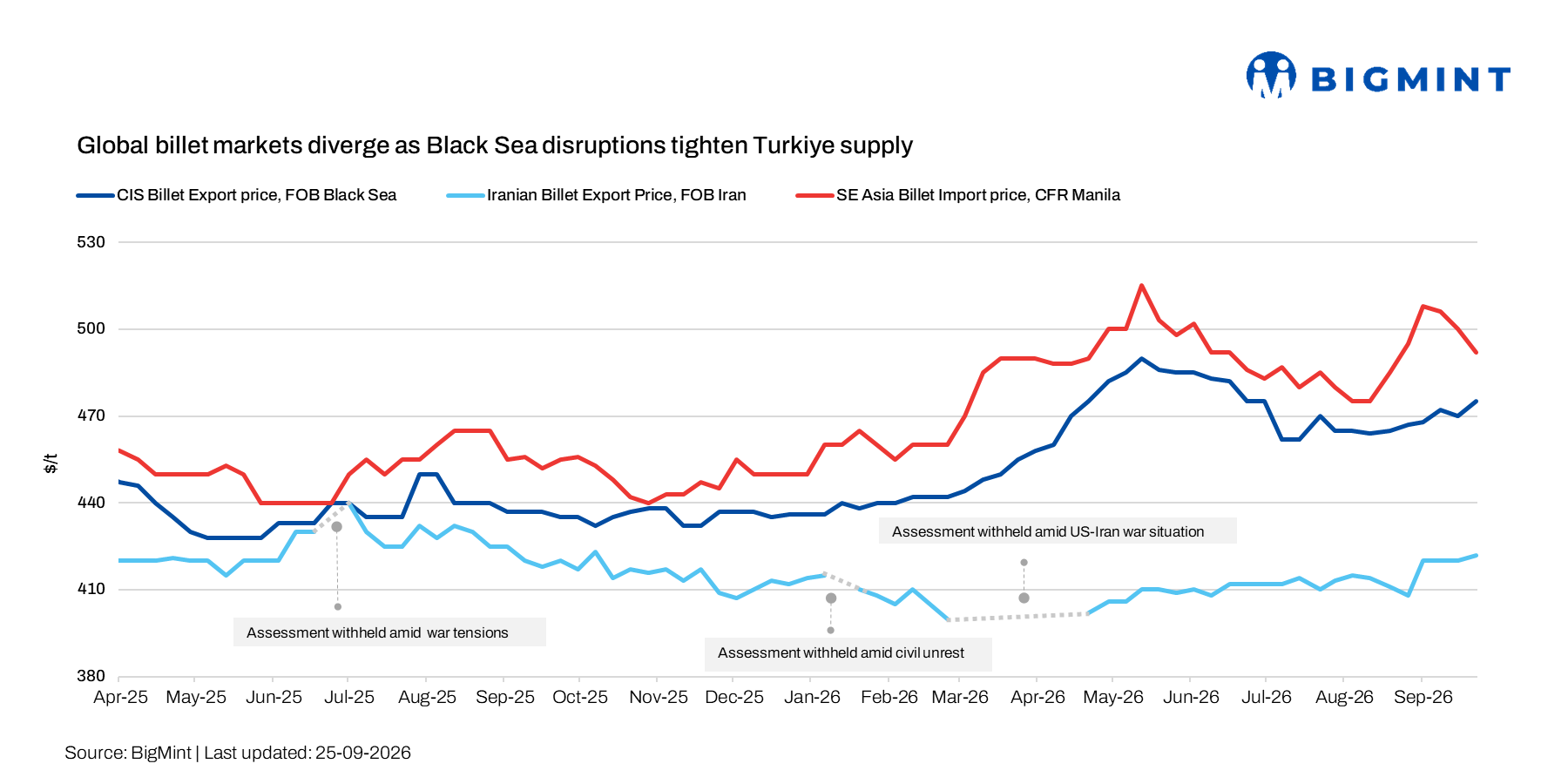
- Iranian supply tightness contrasts with softer UAE rebar demand
- Chinese billet market supported by pre-holiday stocking
Global billet markets remained mixed during the week ended 26 September, as cautious buying, limited spot activity, and subdued downstream demand restricted price movements across major regions. Asian markets found support from pre-holiday stocking and firm mill costs, while Russian suppliers increased offers despite ongoing logistical constraints. In the Middle East, elevated production costs supported seller indications, although ample rebar availability and cautious buying limited further gains.
Turkiye’s billet market remained tight as Black Sea disruptions restricted Russian supplies, while higher freight and scrap collection costs supported prices. Domestic billet offers in Iskenderun increased to $570-575/t exw, while Chinese billet was heard at $520-530/t CFR. Despite firm billet demand, weak rebar sales, cautious buying, and limited import availability kept the broader steel market subdued. Market participants said more than 200,000 t of incoming semis could be required to materially influence scrap prices.
Asian billet market
Asian billet prices remained largely stable in the week ended 26 September, with the Chinese National Day holiday limiting spot activity. Pre-holiday stocking and balanced supply-demand conditions provided some support, while softer raw-material costs and subdued downstream demand capped gains.
Chinese domestic billet prices were unchanged w-o-w, with Tangshan Qian’an standard billet at RMB 3,000/t ($447/t). SHFE rebar futures settled at RMB 3,118/t ($465/t), up RMB 7/t ($1/t) w-o-w, while daily rebar trading volumes eased to around 90,000-110,000 t ahead of the holiday.
Chinese billet export offers were heard around $465/t FOB, with mills offering 3SP billet at $468-470/t FOB for November shipment. Firm mill base prices and higher freight costs supported offers, although weaker coking coal prices limited the upside.
A Southeast Asian trader said 3SP billet from Bayuquan and Jiangyin was offered around $465-470/t FOB, while Tianjin-origin material was above $470/t FOB. In the Philippines, Chinese offers were around $485-490/t CFR Manila, with one buyer reportedly booking 3SP cargoes at $483-485/t CFR. Smaller-lot offers to Taiwan were around $490-495/t.
In Southeast Asia, open-origin 5SP billet offers remained around $495-505/t CFR, while Philippine buyers were targeting below $490-492/t CFR amid weak long-steel demand. Chinese 3SP offers to Indonesia were heard at $480-485/t CFR, with bids below $480/t CFR.
Indonesian billet offers were around $478-480/t FOB for January shipment, although spot demand remained limited. One major mill reduced its offer by $2/t w-o-w after selling 30,000 t at $475/t FOB the previous week. Drought-related disruptions in Morowali also affected production and shipments.
Chinese billet exports to Turkiye were heard at $515-520/t CFR, while Taiwan offers remained around $490-495/t. Indian suppliers were also heard offering billets into the GCC at around $505-510/t CFR.
CIS billet market
Russian square billet suppliers continued to face limited export opportunities, although fresh offers increased during the week. Despite firm billet demand in Turkiye, actual trading remained subdued as loading-port availability and payment terms continued to constrain transactions.
November shipment offers from Russian mills declined to $510-520/t CFR Turkiye, compared with $530-535/t CFR a week earlier. A 20,000 t parcel was reportedly offered at $510-515/t CFR Northern Turkiye, while other suppliers indicated levels of $515-520/t CFR Marmara.
Market participants said some Russian mills were willing to reduce prices to secure partial payments after cargo accumulated at the loading port and the forwarder’s cargo receipt (FCR) was issued, reflecting working-capital requirements. On an FOB basis, Russian billet was theoretically valued at around $470-475/t.
Initial offers for Baltic Sea shipments were heard at around $545/t CFR Turkiye, with room for negotiation on larger volumes. Market participants also questioned reports of completed deals, noting that although traders had started seeking Russian billet, actual availability would largely depend on the loading port and shipment size.
Middle East billet market
Middle Eastern billet markets remained largely stable during the week, with Iranian prices holding steady while UAE buyers remained cautious amid ample rebar supply and limited spot activity. Higher production costs supported offers, while subdued demand capped gains.
Iranian billet export prices stood at $400-410/t FCA at the borders, unchanged w-o-w, with some deals heard at $410-412/t FCA. Port-based offers declined by $10-15/t to $415-420/t FOB, while the latest assessment for 130×130 mm, 3SP billet at Bandar Imam Khomeini was $422/t FOB. Buyers targeted the lower end, with some bids at $390-395/t FCA. Rebar exports remained at $430-440/t exw.
A major Iran-based steelmaker said demand for billet remains very strong, while supply is significantly tighter than demand. The source noted that many buyers have already booked production capacity for the next two to two-and-a-half months.
“Given the current market situation, it is not fair to conclude billet deals at $415/t or below,” the source said, indicating that limited availability could support higher prices.
The producer also highlighted a freight and logistics premium for cargoes loaded from Imam Khomeini port, where KSC operates. Prices from the port are typically $5-8/t higher than Bandar Abbas due to transportation costs.
According to the source, the current situation at both ports, including safety considerations, provides additional room for Imam Khomeini-origin billet prices to move higher. Iranian prices remained sensitive to political and supply developments, while disruption to Strait of Hormuz traffic continued to affect export logistics. Bardsir Mashiz Steel Company also offered 10,000 t of billet through a tender closing on 29 September.
In the UAE, GCC billet indications were heard at $650-660/t CPT Jebel Ali, while Chinese-origin billet was offered at $590-600/t CPT. No major deals were reported.
UAE rebar prices faced downward pressure from ample supply and cautious buying. October offers were heard at AED 2,820-2,840/t ($768-773/t), while traders targeted AED 2,790-2,800/t ($760-762/t). Retail offers declined to around AED 2,900/t ($790/t) from AED 2,940-2,950/t ($801-803/t) previously.
Overall, the Middle Eastern billet market remained rangebound as cost pressures supported sellers, while subdued demand limited upward movement.


Leave a Reply