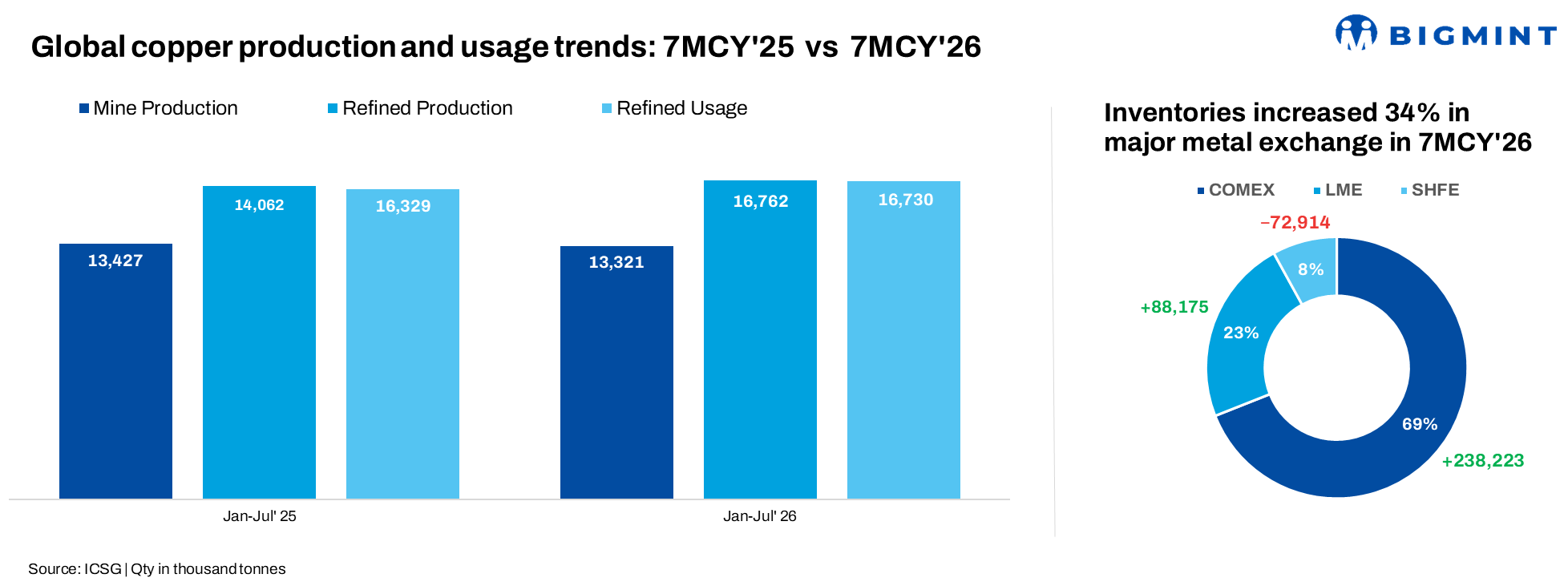
- Global refined copper output up 2% y-o-y as secondary production grows 4%
- World mine production declines by 1% y-o-y, concentrate output falls by 2%
Global refined copper market recorded a preliminary 32,000 t surplus during January-July 2026, sharply lower than the 157,000 t surplus in the same period last year, according to the International Copper Study Group (ICSG). After adjusting for estimated changes in Chinese bonded stocks, the market showed a 5,000 t deficit, indicating tighter underlying availability.
Production increased 1.7% y-o-y in the first seven months of 2026, supported by higher output in China and the DRC. New refining capacity in India also supported growth. However, smelter maintenance and operational disruptions in Chile, along with lower output in parts of Asia, limited the increase.
Mine supply remains under pressure
World copper mine production declined 1% y-o-y in the first seven months of 2026. Concentrate production fell 2%, more than offsetting a 3.6% increase in SX-EW output. Growth from projects ramping up in several countries was insufficient to offset major disruptions in Chile, Indonesia and the DRC.
Chile’s mine output declined 7%, mainly due to lower production at El Teniente, Escondida and Spence. Concentrate production fell 8.8%, while SX-EW output declined 0.5%.
In Indonesia, concentrate production dropped 29% as operations at Grasberg remained constrained following the severe mud-rush incident in September 2025. DRC mine production was broadly unchanged, as a 30% decline in concentrate output linked to Kamoa offset around 6% growth in SX-EW production.
Despite weaker mine supply, global refined copper production increased 1.7% y-o-y during January-July. Primary refined production rose 1%, while secondary production from scrap increased 4.3%.
China and the DRC remained the main sources of refined production growth, with combined output rising 4.8%. The two countries account for around 59% of global refined copper production.
India’s refined copper output increased an estimated 22%, supported by improved operating rates and the ramp-up of the Adani refinery. In contrast, Chilean refined production declined 12.5%, with electrolytic production from concentrates falling sharply amid smelter maintenance and operational constraints.
Demand growth narrows market surplus
World apparent refined copper usage increased 2.4% y-o-y in the first seven months of 2026. Chinese apparent demand rose 3.5%, while usage outside China increased 1%. At the same time, China’s net refined copper imports declined 10%.
The faster increase in refined usage helped reduce the market surplus substantially from last year’s level. However, refined production still exceeded apparent demand on an unadjusted basis.
After accounting for an estimated 37,000 t decline in Chinese bonded stocks from end-2025 levels, the balance shifted into a small deficit.
Exchange stocks reach highest since 2003
Visible copper inventories continued to rise despite the much smaller refined market surplus. Combined stocks across the LME, COMEX and SHFE reached 997,600 t at end-August. This was the highest level since June 2003. Stocks were up 253,480 t, or 34%, from end-December 2025. COMEX recorded the largest increase, followed by the LME, while SHFE stocks declined.
LME inventories fell during the first half of August before recovering later in the month. Stocks declined from 244,025 t on 3 August to 204,975 t on 14 August. They then rose to 235,575 t by 31 August. Based on the supplied data, LME stocks climbed further to 252,500 t by 25 September. This represents a 7.2% increase from end-August.
Copper prices remain firm despite higher stocks
Copper prices have remained resilient alongside the inventory build-up. ICSG reported an average LME cash price of $14,353/t in August, up 6% m-o-m from July’s $13,525/t. The 2026 high through 22 September stood at $14,850/t, while the year-to-date average was $13,395/t, around 35% above the 2025 annual average.
LME data shows copper averaging around $14,167/t in August and $14,423/t during 1-25 September. Prices climbed to $14,768/t on 10 September before correcting to $14,066/t on 15 September. The market subsequently recovered to $14,621/t on 25 September.
The divergence between higher exchange stocks and resilient prices suggests that visible inventory growth has not fully translated into weaker market sentiment. At the same time, the narrowing refined balance and decline in Chinese bonded stocks point to tighter underlying conditions than headline exchange inventories alone indicate.
Outlook
The global refined copper market is likely to remain relatively well supplied in the near term as refined production continues to grow. However, the sharp narrowing of the surplus, lower mine output, and declining Chinese bonded stocks could limit the downside for prices. Rising exchange inventories remain a key counterweight, while sustained demand growth in China and other end-use sectors will remain important for the market balance.
Leave a Reply