- Middle East energy disruption keeps pressure on non-ferrous production costs
- US can-stock tariff changes reshape aluminium import economics
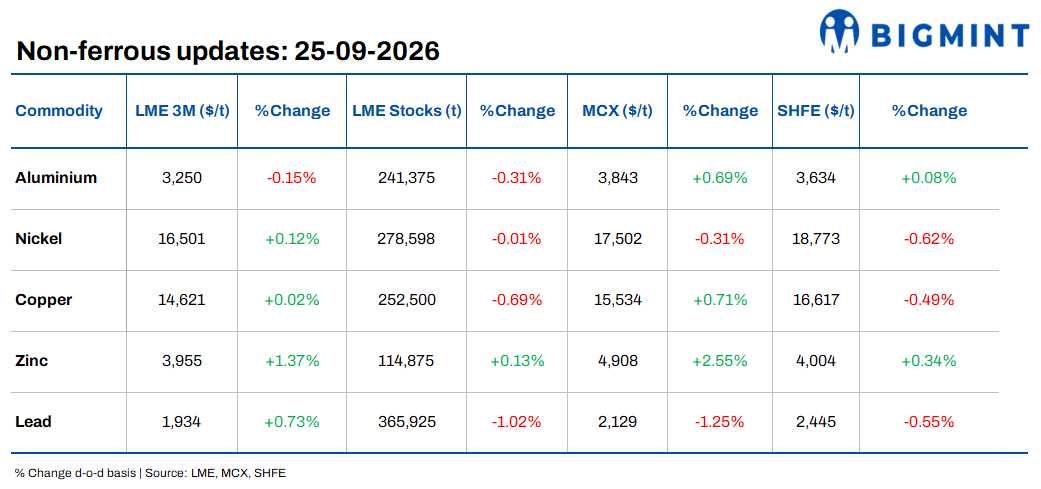
LME base metals traded mixed on 24 September. Zinc posted the strongest gain, rising 1.37% d-o-d to $3,955/t. Lead followed with a 0.73% gain to $1,934/t. Meanwhile, aluminium slipped 0.15% to $3,250/t. Nickel edged higher by 0.12% to $16,501/t, while copper gained 0.02% to $14,621/t.
LME inventories recorded mixed trends d-o-d. Lead stocks posted the steepest decline, falling 1.02% to 365,925 t. Copper stocks declined 0.69% to 252,500 t, while aluminium stocks fell 0.31% to 241,375 t. Meanwhile, zinc inventories edged higher by 0.13% to 114,875 t. Nickel stocks slipped 0.01% to 278,598 t.
Domestic market overview
India’s non-ferrous scrap market witnessed lower prices across the assessed grades. The move followed an earlier correction in domestic and global benchmarks. Aluminium tense scrap (loose), ex-Delhi, declined by INR 2,000/t (0.8%) d-o-d to INR 250,000/t. Ex-Chennai prices fell by INR 1,000/t (0.4%) to INR 249,000/t.
Aluminium P1020 also eased by INR 1,000/t (0.3%) to INR 355,000/t. Meanwhile, MCX aluminium rose 0.69% d-o-d to $3,843/t. However, prices remained under pressure amid adequate stock availability following pre-holiday buying.
Meanwhile, copper armature scrap (Cu 99%) declined by INR 5,000/t (0.4%) d-o-d to INR 1,345,000/t from INR 1,350,000/t. MCX copper gained 0.71% d-o-d to $15,534/t. Domestic prices continued to reflect the earlier correction in domestic and global benchmarks. Adequate availability after pre-holiday buying also limited fresh buying interest.

Other updates
Middle East energy disruption remains key cross-metal driver
Middle East oil disruption remained the key near-term cross-metal driver on September 25. Traders weighed possible US-Iran negotiations against continued Houthi attacks on Saudi Arabia. Brent stood at $105.25/bbl, while WTI was $94.61/bbl. Higher energy, diesel and freight costs remain relevant for aluminium smelting and logistics across copper, zinc and other metals. Meanwhile, an oil-driven shift toward electric vehicles could lift copper demand.
US removes AD/CVD duties on qualifying aluminium can stock
The US Department of Commerce partially revoked AD/CVD orders on September 24. The change covers qualifying aluminium can stock from China and Bahrain. It applies to material used for beverage cans, lids and tabs. The measure also covers qualifying unliquidated entries retroactively. Chinese beverage can-sheet imports had already more than doubled year on year through May. Consequently, the decision could improve import economics and alter regional sourcing. However, the 50% Section 232 aluminium tariff remains in place.
Zambia reiterates 3 mnt copper production target
Zambia reiterated its target of lifting copper production to 3 mnt annually by 2031. Production stood at about 890,000 t in 2025. The expansion would require investment in mines, power and transport infrastructure. Zambia’s mining sector estimates that around 2,000 MW of additional generation will be needed. Meanwhile, the 2,400 MW Batoka Gorge hydro project remains part of the broader power strategy. Therefore, the announcement is mainly a long-term supply signal. It does not materially change near-term copper availability.
China copper buying ahead of holidays supports physical market
Copper demand in China has received support from buying ahead of planned smelter shutdowns during the September 25–27 and October 1–7 holidays. The Yangshan copper premium remained elevated at $117/t, despite easing from earlier levels. Meanwhile, Chinese buyers had increased purchases in preparation for the holiday period. However, the stronger US dollar and concerns over potential US tariffs have limited the upside in copper prices. The buying trend remains relevant for physical copper demand and regional premiums.
Leave a Reply