- Coal availability tightens as CIL’s output drops over 3%
- Coal prices surge, higher input costs hit DRI producers
- DRI prices hit two-year high in end-Aug before correction
Morning Brief: India’s sponge iron industry entered FY’’27 facing a more challenging operating environment, with coal availability and input costs emerging as key constraints despite continued growth in steel production. DRI producers are grappling with tighter domestic coal supplies, elevated imported coal prices and periodic logistics disruptions.
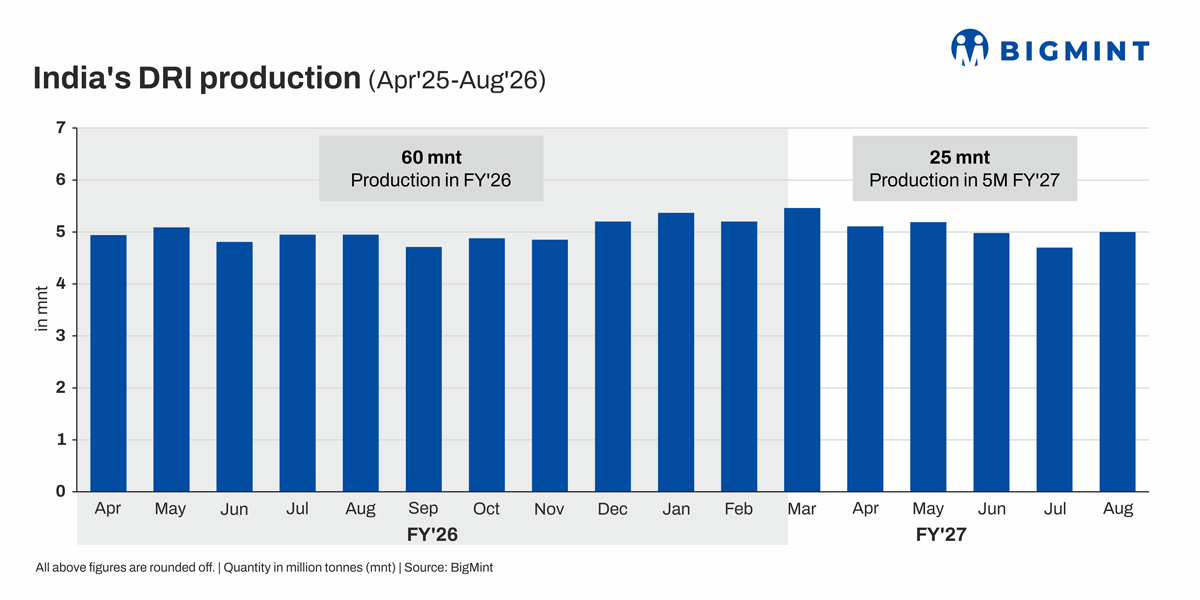
India’s sponge iron production reached 24.98 million tonnes (mnt) during April-August 2026 (5MFY’27), according to provisional data with BigMint, compared with 24.74 mnt in the corresponding period last fiscal, reflecting a modest 2% y-o-y increase.
The moderation witnessed thus far in FY’’27 follows an exceptionally strong FY’’26. India’s DRI production reached a record 60.36 mnt in FY’26, according to the Sponge Iron Manufacturers Association (SIMA), compared with 55.65 mnt in FY’25, representing growth of approximately 8.5% y-o-y.
The slowdown in DRI output growth comes even as steel demand fundamentals remain supportive. The divergence between steel demand growth and sponge iron production suggests that supply side impediments, rather than demand weakness, were the primary limiting factors for the DRI sector.
Key factors affecting DRI market
Coal availability tightens
Coal availability has been at the centre of the challenges facing DRI producers. Non-coking coal shortages in several regions, coupled with higher imported coal costs, have increased production costs for coal-based sponge iron units. At the same time, intermittent monsoon-related logistical disruptions affected the movement of both coal and finished products during the period.
Coal availability tightened as Coal India’s (CIL) production edged down y-o-y, although dispatches increased. BigMint data show that CIL subsidiaries produced less than 370 mnt of coal in April-August 2026, a decrease of over 3% y-o-y. Sources informed BigMint that recent railway prioritisation of coal movement to the power sector further constrained availability for the non-regulated sponge iron sector. Delays in supplies under spot e-auctions and Fuel Supply Agreements (FSAs) have forced producers to rely on imported coal despite elevated prices.
Faced with volatile international coal prices, weak steel margins and improved domestic coal availability, DRI producers have steadily replaced imported South African non-coking coal with domestic supplies. Domestic coal now accounts for roughly 60-75% of the fuel mix across most clusters, compared with only 25-35% in FY’22. Imported coal, once contributing nearly three-quarters of fuel requirements, has gradually declined to about 25-40%, remaining an essential blending component because of its superior calorific value, lower ash content and better kiln stability.
However, the industry’s growing dependence on domestic coal has also increased its exposure to India’s railway logistics network. And at a time of surging power demand and diminishing stocks at power plants, prioritisation of supplies to utilities have hit other industries hard. Delayed rake placement and longer delivery cycles have made inventory planning more difficult. The situation is particularly stark in eastern and central India. Iron ore availability, on the other hand, also tightened, especially of high-grade ore in different markets despite overall growth in production. Pellet supply remained constrained due to suspension of production at major facilities in central India.
Coal prices surge
Coal prices surged during the review period, adding further pressure on producers and contributing to the moderation in output growth. Imported non-coking coal prices at Paradip port rose from around INR 10,300-10,400/t in July 2026 to above INR 13,000/t by September, while domestic washed non-coking coal prices in Raipur increased from approximately INR 6,000/t in June to INR 8,400/t in September. The simultaneous rise in imported and domestic coal prices significantly increased production costs for coal-based DRI producers.
Monsoon-related disruptions to mining operations and transportation in key coal-producing regions tightened availability for sponge iron producers. This had a direct impact on CIL auction prices. High-grade coal (6100-6400 GCV, G4) prices almost doubled in CIL auctions between early April and September.
Sponge iron prices at 2-year high
As a result of surging coal prices, sponge iron prices strengthened considerably. According to BigMint assessment, sponge iron prices (pellet-based) in the key Raipur market climbed to around INR 29,700/t in end-August, an increase of over 7% compared with April levels and also the highest level in nearly two years. The rally was driven by escalating coal costs and supply tightness. Despite stronger growth in scrap consumption, sponge iron continues to dominate India’s metallic mix owing to its ample availability, competitive pricing and widespread use in the country’s induction furnace sector.
Procurement patterns, however, shifted through the second quarter as pellet price volatility, raw-material shortages and fluctuating downstream demand influenced metallic selection. Capacity utilisation remained at around 65-75%, with production largely aligned to billet demand.
Sponge iron production today is increasingly defined by raw material availability and cost pressures, particularly in coal. With FY’26 production reaching a record 60.36 mnt, the industry’s structural capacity remains strong. However, future growth is likely to depend less on installed capacity and more on factors such as coal supply, imported coal prices, pellet economics, and the relative competitiveness of DRI versus scrap as a metallic feedstock.
Outlook
DRI production growth moderated to just 2% y-o-y in 5MFY’27 from 7% in January-June 2026. Prices too are correcting fast: sponge iron prices in key markets dropped over 5% since the beginning of September due to rampant cuts in billet production in central India where producers are reportedly selling surplus power.
Sharp cuts in semis production have shielded producers from rapid price erosion but sponge iron demand has taken a hit, and prices are on a downward trajectory. If domestic coal availability improves and imported coal prices soften, sponge iron production growth could accelerate during the second half of the fiscal year. Conversely, prolonged coal tightness could continue to restrict output growth.
The performance of the sponge iron industry in FY’27 is likely to be determined less by demand and capacity constraints and more by the industry’s ability to secure affordable and reliable coal supplies.

Leave a Reply