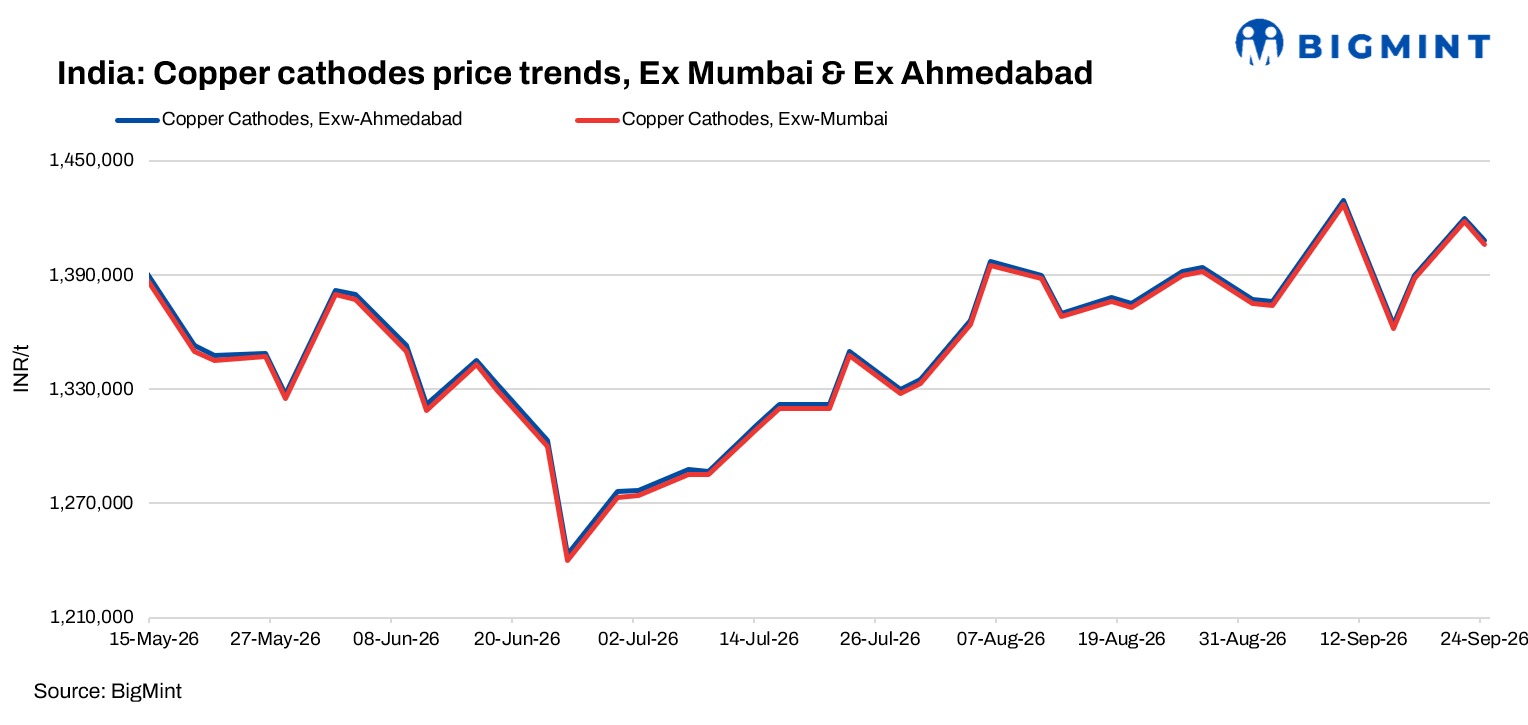
- Improved buying interest, elevated import premiums lift prices
- Domestic refined copper production rises 12.5% m-o-m in Jul’26
India’s copper cathode market remained firm w-o-w as higher global benchmarks and strong domestic demand supported prices. London Metal Exchange (LME) copper rose 2.7% to $14,618/tonne (t), as the market continued to absorb strong physical demand and supply-chain distortions even as stocks increased 2.0% w-o-w to 254,250 t from 249,225 t.
According to BigMint’s assessment, ex-Ahmedabad cathode prices rose by INR 18,000/t, or 1.3%, w-o-w to INR 1,408,000/t from INR 1,390,000/t. Ex-Mumbai prices increased by the same amount to INR 1,406,000/t from INR 1,388,000/t.
Meanwhile, India’s refined copper production hit an all-time monthly high of 72,000 t in July, supported by higher smelter output and Kutch Copper’s ramp-up.
Domestic prices remain firm amid pre-festive demand
Market participants reported firm buying interest in India, particularly ahead of the festive season. However, buyers remained selective at current price levels and are largely covering immediate requirements.
Higher LME prices have lifted domestic replacement costs and encouraged producers to maintain firm offers. At the same time, consumers remain cautious about building large inventories after the recent copper rally.
The combination of elevated global benchmarks and improving physical demand is therefore supporting cathode prices, while high absolute prices are limiting aggressive spot buying.
India’s underlying copper consumption outlook also remains strong. The International Copper Association India has estimated that domestic copper demand could grow around 9-10% annually, driven by infrastructure, electrification, renewable energy and industrial applications.
Domestic copper production reaches 2026 high
India’s refined copper production increased 12.5% m-o-m to 72,000 t in July 2026, the highest monthly output recorded so far in 2026. The increase was mainly supported by higher output from Hindalco and Sesa Sterlite, while Kutch Copper continued to ramp up its Mundra operations.
Hindalco’s production rose 32% m-o-m in July, providing the largest contribution to the monthly increase. Meanwhile, Kutch Copper’s expanding operations are becoming increasingly important to India’s refined copper supply.
Adani Enterprises reported copper sales of 64,700 t in Q1FY’27, sharply higher than 11,500 t in Q1FY’26, reflecting the ramp-up of its Mundra copper operations. The facility has an annual production capacity of 500,000 t.
In July, Kutch Copper’s “Adani Copper” Grade-A cathodes received LME Good Delivery brand registration, making the material eligible for delivery against LME copper futures contracts from 10 July. This could improve the marketability of its cathode output.
Rising domestic production should gradually reduce India’s dependence on imported refined copper. However, the pace of capacity ramp-up and access to copper concentrate will determine how quickly additional supply reaches the domestic market.

Import premiums remain elevated
Imported copper continues to command a strong premium in India despite rising domestic production. Japanese cathode premiums are currently assessed around $350-380/t CIF India, indicating that imported units remain valuable for consumers requiring specific cathode brands and consistent availability.
Japan remains an important source of refined copper for India. India’s import dependency is still significant because domestic copper consumption continues to expand faster than locally available refined metal.
India is also seeking to secure additional upstream supply. In August, Hindustan Copper planned to sell Chilean copper concentrate to Hindalco and Adani to support India’s growing copper requirements.
As domestic smelting capacity expands, imports could gradually shift from refined cathodes towards concentrates and other feedstocks. However, strong demand and elevated premiums are likely to keep imported copper relevant in the near term.
Global concentrate shortage and trade uncertainty support copper
The global copper market remains tight as smelting capacity expands faster than mine supply. China commissioned two new copper smelters this year with combined capacity of 600,000 t/year. Market participants estimate a global copper concentrate deficit of more than 600,000 t in 2026, highlighting growing pressure on smelters.
The shortage has pushed treatment and refining charges to historically low levels. Meanwhile, US tariff uncertainty continues to redirect copper towards the US, contributing to regional inventory imbalances. Although LME stocks have risen recently, physical availability remains closely watched.
China’s expanding smelting capacity is sustaining concentrate demand, while limited mine-supply growth keeps the market tight. For Indian refiners, tighter global feedstock could increase competition for concentrates and encourage greater use of scrap and secondary materials.
Outlook
Indian copper cathode prices are likely to remain firm but volatile in the near term. Elevated global copper prices, stronger pre-festive buying and firm import premiums continue to support domestic replacement costs.
Meanwhile, rising domestic production and Kutch Copper’s ramp-up are improving supply availability. However, tight global concentrate supplies and low TC/RCs could keep raw-material costs elevated.
The market is therefore seeing both supply expansion and robust consumption, which should support prices. However, high price levels may keep buyers cautious and limit further gains in the short term.
Leave a Reply