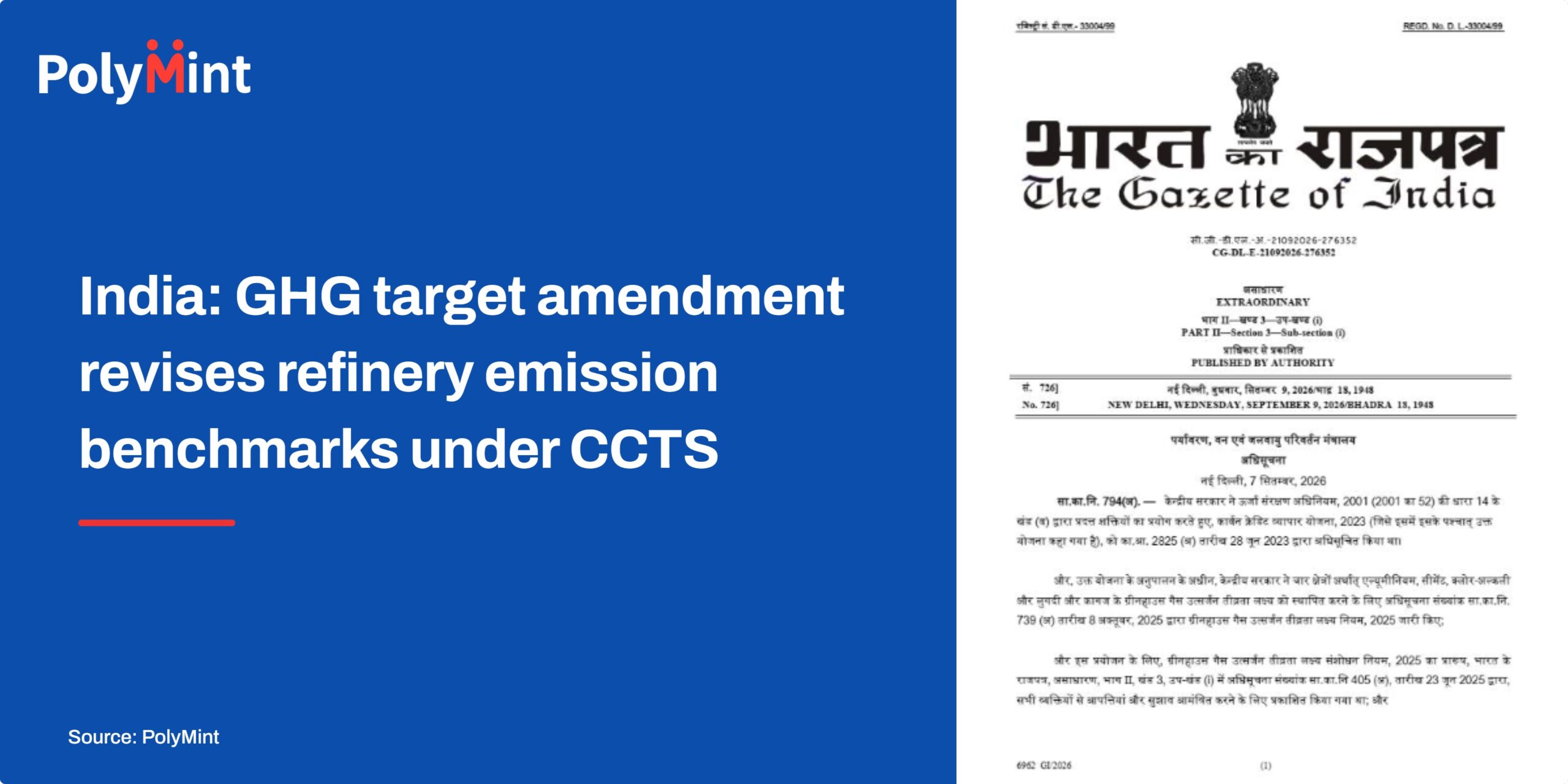
- Plant-specific GHG intensity targets updated for FY2025-26 and FY2026-27
- Amendment replaces January 2026 schedules for refineries and textiles
India’s Ministry of Environment, Forest and Climate Change has notified the Greenhouse Gases Emission Intensity Target (Amendment) Rules, 2026, replacing the existing emission intensity schedules for the petroleum refinery and textile sectors under the Carbon Credit Trading Scheme (CCTS). Effective immediately, the amendment prescribes revised, refinery-specific greenhouse gas (GHG) emission intensity targets for FY2025-26 and FY2026-27, based on FY2023-24 baseline operational data.
The revised schedule covers 21 obligated refinery units, assigning each facility an individual compliance benchmark instead of a uniform sector-wide target. The amendment does not alter the compliance framework for petrochemical plants, although the petrochemical sector continues to remain covered under the broader CCTS notified earlier.

Across all refinery units, the FY2026-27 compliance targets are lower than those prescribed for FY2025-26, indicating a progressively tighter compliance trajectory. The amendment also retains a plant-specific approach by linking targets to each refinery’s FY2023-24 baseline crude throughput, Normalised Refinery Generation Factor (NRGF) and GHG emission intensity.
For the polymer industry, the impact is indirect but noteworthy. Integrated refinery-petrochemical complexes are major suppliers of naphtha and other feedstocks used to produce olefins and polymers. While the notification introduces no new obligations for polymer producers and does not indicate any immediate effect on polymer pricing or feedstock availability, refiners may continue investing in energy efficiency, process optimisation and low-carbon technologies to meet the revised benchmarks under the evolving carbon market framework.
The amendment reinforces India’s phased implementation of the CCTS, under which obligated entities meeting or outperforming their notified emission intensity targets may participate in the carbon credit market, further embedding carbon performance into refinery operations and, over time, the wider petrochemical value chain.
Leave a Reply