- India, Malaysia and Thailand face potential export restrictions
- Alternative suppliers could face stronger competition for Asian demand
- European recyclers may face additional domestic supply pressure
The Bureau of International Recycling (BIR) has raised concerns over the European Commission’s draft delegated act under the EU Waste Shipment Regulation (WSR), which proposes a list of non-OECD countries authorised to receive certain non-hazardous waste from the EU.
The draft excludes major Asian destinations, including India, Malaysia and Thailand, from authorisations for certain ferrous and non-ferrous metal waste destined for recovery. BIR warned that the proposed restrictions could disrupt established recycling flows and affect businesses and supply chains in both Europe and destination markets.
BIR highlights concerns over European recycling capacity
BIR said restricting established export outlets would not automatically create sufficient European demand or processing capacity to absorb the affected grades and volumes.
The organisation warned that this could put pressure on recycled-material prices, reduce collection incentives and weaken investment in recycling infrastructure.
BIR highlighted aluminium in particular, noting that Europe generates more recycled aluminium than domestic facilities can technically process. Different grades have varying compositions, processing requirements and end-use markets, making international trade an important outlet for material that may not match domestic demand.
The organisation has called for a proportionate, evidence-based approach that considers actual recycling capabilities in destination countries.
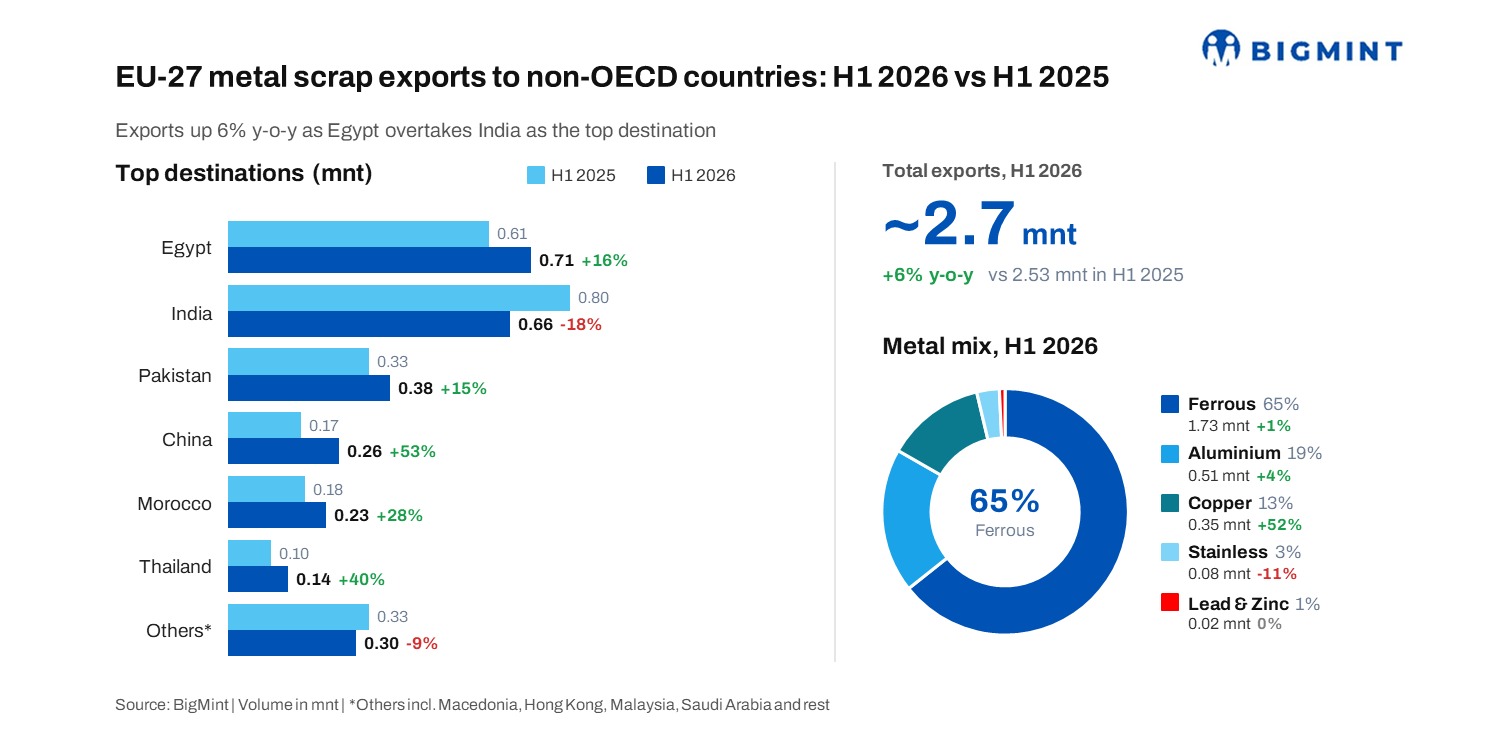
As per BigMint statistics, EU-27 metal scrap exports to non-OECD countries stood at around 2.7-2.8 mnt in H1 2026, up 5-6% y-o-y. Ferrous scrap accounted for more than 60% of total exports, followed by aluminium at around 20%, copper at approximately 15%, and stainless steel at around 3-4%. Lead and zinc scrap accounted for the remaining share.
India faces significant exposure
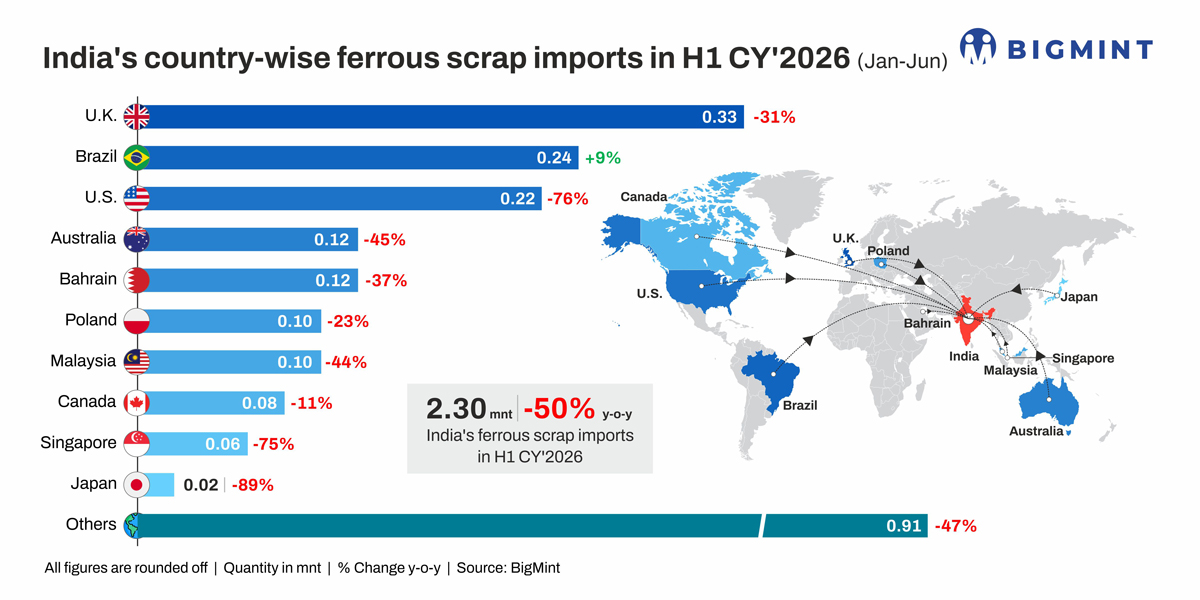
India could be among the most affected Asian markets if the current exclusions remain in the final list. India imported nearly 1.2 mnt of ferrous and non-ferrous metal scrap from Europe, including the UK, in 2026, with more than half sourced from the EU-27.
European countries exported around 2.7 mnt of metal scrap to India in 2025, including roughly 1.5 mnt from the EU-27.
MRAI said India relies significantly on EU-origin scrap, with the region accounting for around 15-20% of ferrous scrap, 20% of aluminium scrap, 22% of copper and copper alloy scrap, 20% of lead scrap and 40% of zinc scrap imports in 2025-2026.
India also sources around 20% of its aluminium scrap imports from the EU-27 and imports around 85-87% of its overall aluminium scrap requirements.
The country’s secondary aluminium capacity is estimated at around 2.5 MTPA, making imported scrap availability important for the secondary metals industry.
Around 60% of India’s secondary aluminium consumption is estimated to be linked to automotive applications, increasing the potential impact on downstream users.
The impact would extend beyond India.
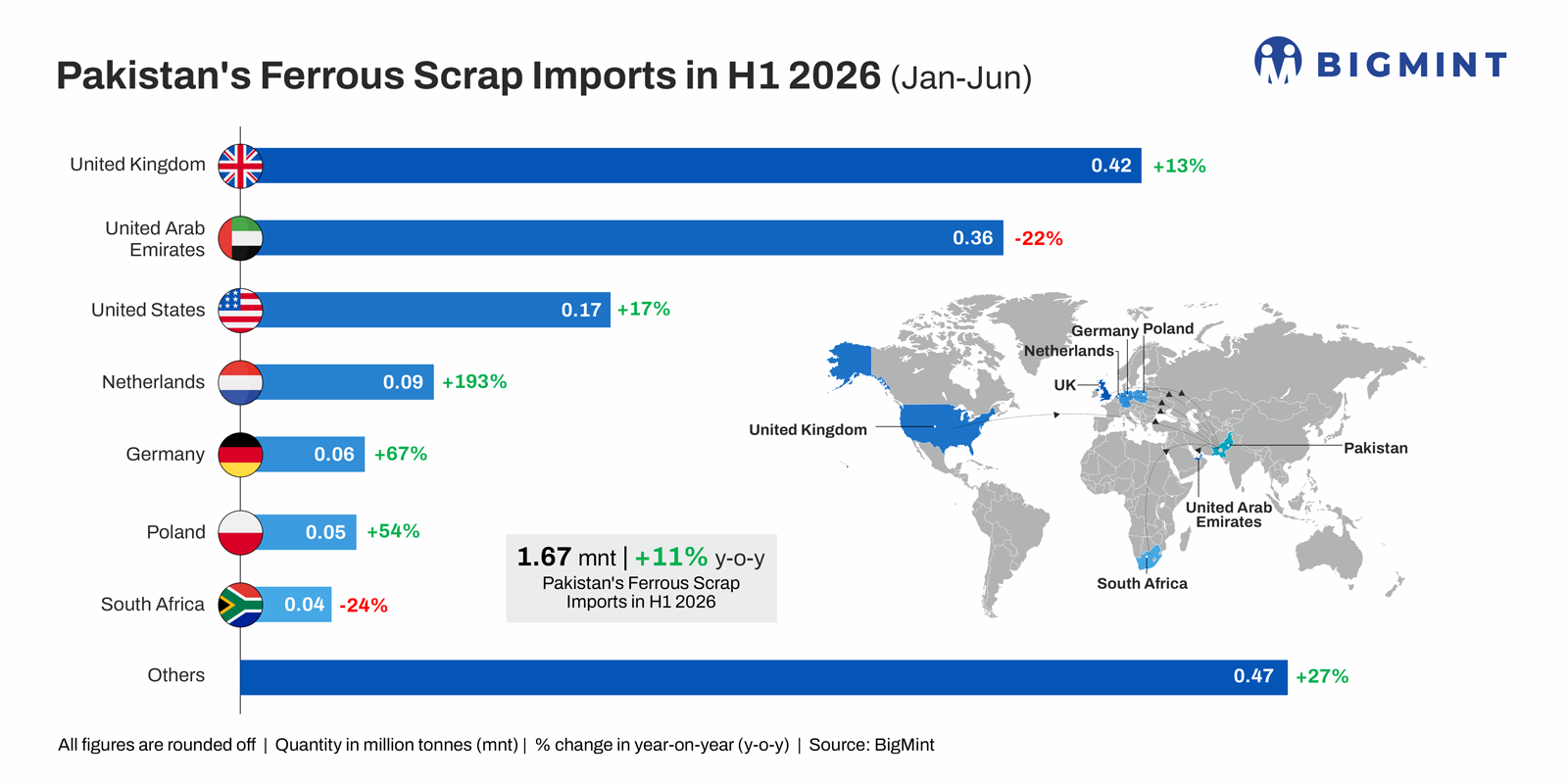
Pakistan imported nearly 1 mnt of EU steel scrap in H1 2026, up nearly 20% y-o-y, while India imported around 0.7-0.8 mnt, down about 20%.
If Indian and Pakistani buyers increase purchases from the UK, Japan, Australia, the US, and other origins, competition for available cargoes could increase across South Asia.
Bangladesh had relatively limited direct exposure to EU scrap, importing below 0.1 mnt in H1 2026. However, the country already relies heavily on other origins, including around 1 mnt from Japan and 0.5 mnt from both Australia and Singapore.
Market participants have cautioned that Japan and Australia may not have sufficient additional availability to replace substantial displaced EU volumes because much of their material is already committed.
Greater buying from India and Pakistan could therefore tighten competition for cargoes available to Bangladesh.
UK could become more important for Asian buyers
The UK could gain strategic importance for India, Pakistan and Bangladesh because it operates under a separate waste-shipment regime.
Market participants do not currently expect the UK to automatically replicate the proposed EU restrictions.
UK ferrous scrap exports to Pakistan reached around 0.45 mnt in January-June 2026, up about 10% y-o-y and India imported around 0.35 mnt of UK scrap in H1 2026, down by 30% y-o-y.
This could create an opportunity for UK exporters, particularly in containerised trade into South Asia. However, the ability of UK suppliers to replace EU volumes will depend on available material, freight economics and competition from other buyers.
EU scrap could be redirected
The proposed restrictions may ultimately redistribute scrap flows rather than remove the material from international trade.
EU metal scrap exports reached around 25 mnt in H1 2026, out of which 20 mnt is for ferrous scrap.
Turkiye, as an OECD country, would not be affected by the non-OECD restriction and is already the largest single buyer of EU scrap. Some additional European volumes could therefore move towards Turkiye and other authorised markets.
UAE restrictions add to India’s supply pressure
The proposed EU restrictions come as India is already facing another constraint on scrap availability.
The UAE has imposed a temporary four-month export restriction from June to October 2026 covering aluminium, copper and ferrous scrap.
The UAE accounts for around 8% of India’s aluminium scrap imports. Market participants estimate that, combined with potential EU restrictions, nearly 30% of India’s aluminium scrap imports could be affected.
This could increase competition among Indian buyers for alternative material and add to replacement costs.
Other Asian markets face potential sourcing pressure
End-of-Waste status could limit the impact
High-purity processed scrap could potentially fall outside the WSR restrictions if it qualifies for recognised End-of-Waste (EoW) status through an EU-accredited auditor. However, the extent of existing EoW certification among European recyclers remains unclear.
The volume of material that could qualify under this route will therefore be an important factor in determining the actual impact of the proposed restrictions.
Major market response
For India, the immediate concern is replacement supply. The combination of potential EU restrictions and the UAE export restriction could tighten the availability of aluminium and other scrap, increasing competition for alternative origins.
For Pakistan, greater reliance on the UK, the US, Canada, Japan, and other Southeast Asian origins could increase procurement competition, particularly if Indian buying also increases.
For Bangladesh, the issue is different. Its direct EU exposure is relatively limited, but greater demand from India and Pakistan could put additional pressure on origins such as Japan, Australia, and Singapore that already supply the market.
For European recyclers, the concern is whether domestic steelmakers and processors can absorb additional material that can no longer move to restricted non-OECD destinations.
The result could therefore be a reorganisation of established trade routes rather than simply a reduction in global scrap trade.
Outlook
The consultation remains open until 16 October 2026, with final adoption expected in Q4 2026. The new restrictions are scheduled to take effect from 21 May 2027.
If the current exclusions remain, India could face the most significant sourcing adjustment among the affected Asian markets, given its dependence on imported metal and aluminium scrap. Pakistan and Bangladesh could also face stronger competition for alternative cargoes.
At the same time, EU tonnes could be redirected towards European consumers, Turkiye, Egypt, Morocco and other authorised markets.
The key market question is therefore not simply how much EU scrap could lose access to non-OECD destinations, but where those tonnes will go, whether alternative suppliers can replace them, and how much competition this creates for buyers across Asia.
Leave a Reply