- Escondida labour talks remain deadlocked as September 30 contract expiry nears
- Novelis cuts Kingston workforce as US tariffs pressure Canada-US aluminium flows
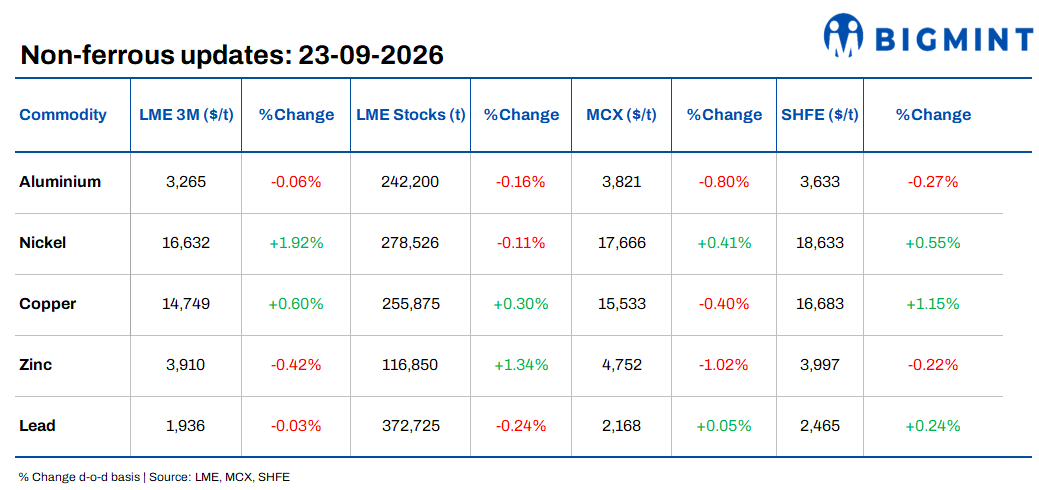
LME base metals traded mixed on 22 September, with nickel recording the strongest gain, rising 1.92% d-o-d to $16,632/t, followed by copper, which advanced 0.60% to $14,749/t. Zinc fell 0.42% to $3,910/t, while aluminium slipped 0.06% to $3,265/t and lead eased 0.03% to $1,936/t.
LME inventories recorded mixed trends. Zinc stocks posted the largest increase, rising 1.34% to 116,850 t, followed by copper, up 0.30% to 255,875 t. Meanwhile, nickel inventories declined 0.11% to 278,526 t, lead stocks fell 0.24% to 372,725 t and aluminium inventories eased 0.16% to 242,200 t.
Domestic market overview
India’s non-ferrous scrap market witnessed mixed trends d-o-d. Aluminium tense scrap remained unchanged at INR 253,000/t ex-Delhi and INR 250,000/t ex-Chennai. Aluminium P1020 ingot also held steady at INR 357,000/t, while MCX aluminium declined 0.80% d-o-d to INR 3,821/t.
Meanwhile, copper armature scrap (Cu 99%), ex-Delhi, rose by INR 13,000/t, or 0.97%, to INR 1,355,000/t from INR 1,342,000/t. The increase came despite a 0.40% decline in MCX copper, indicating firmer domestic scrap pricing.

Other updates
Lower oil prices ease some cost pressures as India shifts crude sourcing
Brent crude fell to around $98.46/bbl, while WTI declined to about $90.52/bbl, with both benchmarks extending losses for a sixth consecutive session. The decline followed the restart of Saudi Arabia’s East-West oil pipeline and expectations of improved Gulf supply. Meanwhile, India’s Russian crude imports fell 16.5% m-o-m to around 2.1 million bpd in August.
Escondida labour talks remain deadlocked ahead of contract expiry
BHP’s Escondida copper mine in Chile faces higher strike risk after negotiations with its No. 2 Supervisors and Staff Union remained deadlocked. The union has around 1,020 members, while the current contract expires on 30 September. Disputes centre on wages, benefits, job responsibilities and a proposed 14-days-on/14-days-off shift system. However, no production loss has been reported so far. Consequently, the immediate market impact is higher supply uncertainty, with the effect depending on workforce participation and BHP’s contingency measures.
Indonesia’s IMIP orders nickel pig iron production cuts amid water shortages
Indonesia’s Morowali Industrial Park has instructed nickel-processing companies to reduce nickel pig iron output as drought conditions restrict water availability for smelting operations. Sources estimate a potential reduction of around 100,000 t, although IMIP has not confirmed the figure and is still assessing tenant-level cuts. The park had previously warned that output could fall 30–40% if shortages persisted. Meanwhile, Indonesia accounts for roughly two-thirds of global mined nickel production, making the development relevant to global nickel supply.
Novelis cuts Kingston workforce as US tariffs pressure aluminium flows
Novelis is reducing production at its Kingston, Ontario, facility and cutting around 80 jobs, equivalent to roughly one-third of the plant’s workforce. The company attributed the move to the cost of US Section 232 duties on Canadian aluminium. The development highlights how tariffs are changing cross-border processing economics and could weaken regional rolled-product flows.
Leave a Reply