- Purchase bids jump 430% y-o-y; sell bids fall 45%
- Evening scarcity drives prices to INR 10,000/MWh
India’s Day-Ahead Market (DAM) tightened dramatically during the first 20 days of September 2026 compared with the same period last year, with electricity purchase bids surging more than fivefold while sell-side availability contracted sharply.
Despite the enormous increase in buying interest, scheduled DAM volumes actually declined y-o-y. The result was a steep escalation in prices, with average Market Clearing Price (MCP) more than doubling.
A closer examination of hourly trading during September 2026 reveals an even more striking development: the market is increasingly split between relatively well-supplied solar hours and acute electricity scarcity outside them, particularly after sunset.
DAM balance tightens dramatically y-o-y
The 1-20 September comparison shows the scale of the change.

During 1-20 September 2025, sell bids were substantially greater than purchase bids. The purchase-to-sell ratio was only around 0.62x. This September, purchase bids were almost six times sell bids. Yet scheduled volume declined around 7% y-o-y, from 3.31 TWh to 3.07 TWh.
This combination — far greater buying interest, fewer sell offers and slightly lower cleared volumes — explains why average DAM prices increased from around INR 3,419/MWh to INR 7,772/MWh, a rise of approximately 127% y-o-y.
The volume-weighted MCP tells essentially the same story, increasing from around INR 3,283/MWh to INR 7,722/MWh, or roughly 135%.
Higher demand drives utilities towards the market
The DAM tightening coincided with a major increase in India’s electricity requirement. Average daily maximum demand during 1-20 September increased approximately 17% y-o-y to 251.8 GW, while the period’s maximum reached 269.1 GW, compared with around 225.4 GW during the corresponding period last year.
Total electricity generation increased 14.4%, with coal generation rising 17.3% and renewable generation 26.7%. However, hydro generation fell 15.4%, reducing an important source of flexible electricity precisely when demand was substantially higher.
The DAM therefore became an increasingly important source of marginal power for buyers seeking additional electricity. But generators were simultaneously offering considerably less electricity into the exchange.
That combination produced the extraordinary shift from a sell-heavy market in September 2025 to an overwhelmingly buy-heavy market in September 2026.
Hourly data reveal two-speed electricity market
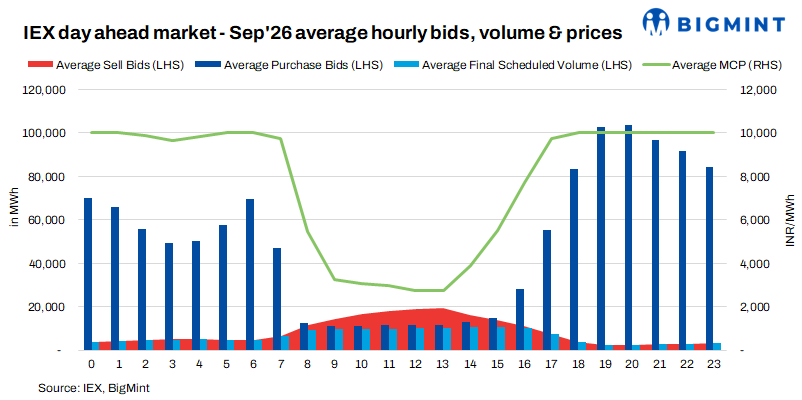
The September 2026 hourly data explain where this tightness is concentrated.

The difference is remarkable. During 08:00-15:00, average sell bids exceeded purchase bids, reflecting substantially greater electricity availability during solar-generation hours. Prices consequently averaged only around INR 3,699/MWh. Outside those hours, the market was transformed.
Between midnight and 07:00, purchase bids were almost 12 times sell bids, and the MCP averaged nearly INR 9,900/MWh. From 16:00 onwards, the market tightened rapidly as solar output retreated.
Evening sell-side liquidity virtually disappears
The most extreme imbalance occurs during 18:00-23:00. Average purchase bids during these hours reached approximately 93,701 MWh/hour, against average sell bids of only around 3,029 MWh/hour.
Buy bids therefore exceeded sell offers by more than 30 times.
More importantly, average scheduled volume during these six hours was only around 3,029 MWh/hour — effectively constrained by the electricity being offered for sale.
The average MCP for every hourly bucket from 18:00 through 23:00 was INR 10,000/MWh, the market ceiling.
At 20:00, the imbalance was particularly extreme:
Purchase bids: 103,450 MWh
Sell bids: 2,418 MWh
Scheduled: 2,418 MWh
MCP: INR 10,000/MWh
The underlying daily observations show the same pattern repeatedly: once evening sell offers become scarce, scheduled volumes converge towards available sell bids and prices reach the ceiling.
Midday tells opposite story
At 12:00, average sell bids were approximately 19,047 MWh, compared with purchase bids of only 11,626 MWh. Average MCP was just INR 2,731/MWh.
At 13:00, sell bids reached 19,226 MWh, against purchase bids of 11,669 MWh, while MCP averaged INR 2,766/MWh.
Prices then begin climbing rapidly as the solar day ends — reaching INR 5,489/MWh at 15:00, INR 7,724/MWh at 16:00 and INR 9,731/MWh at 17:00 before hitting INR 10,000/MWh from 18:00 onwards. The daily dataset demonstrates how sharply the supply-demand balance can reverse within a few hours.
What the market is signalling
The September comparison therefore reveals two connected developments.
First, India’s short-term electricity market is substantially tighter than last year: purchase bids are up 430%, sell bids are down 45%, cleared volumes are slightly lower and prices have more than doubled.
Second, the hourly data show that this scarcity is highly time-dependent.
India has considerably more electricity available during solar hours, but supply becomes extremely tight after sunset.
The DAM is therefore increasingly placing a premium not simply on additional generation, but on dispatchable and flexible electricity capable of supplying the grid when solar output falls.
That makes storage, pumped hydro, flexible thermal generation and other balancing resources increasingly important as India’s renewable generation continues to expand.
Leave a Reply