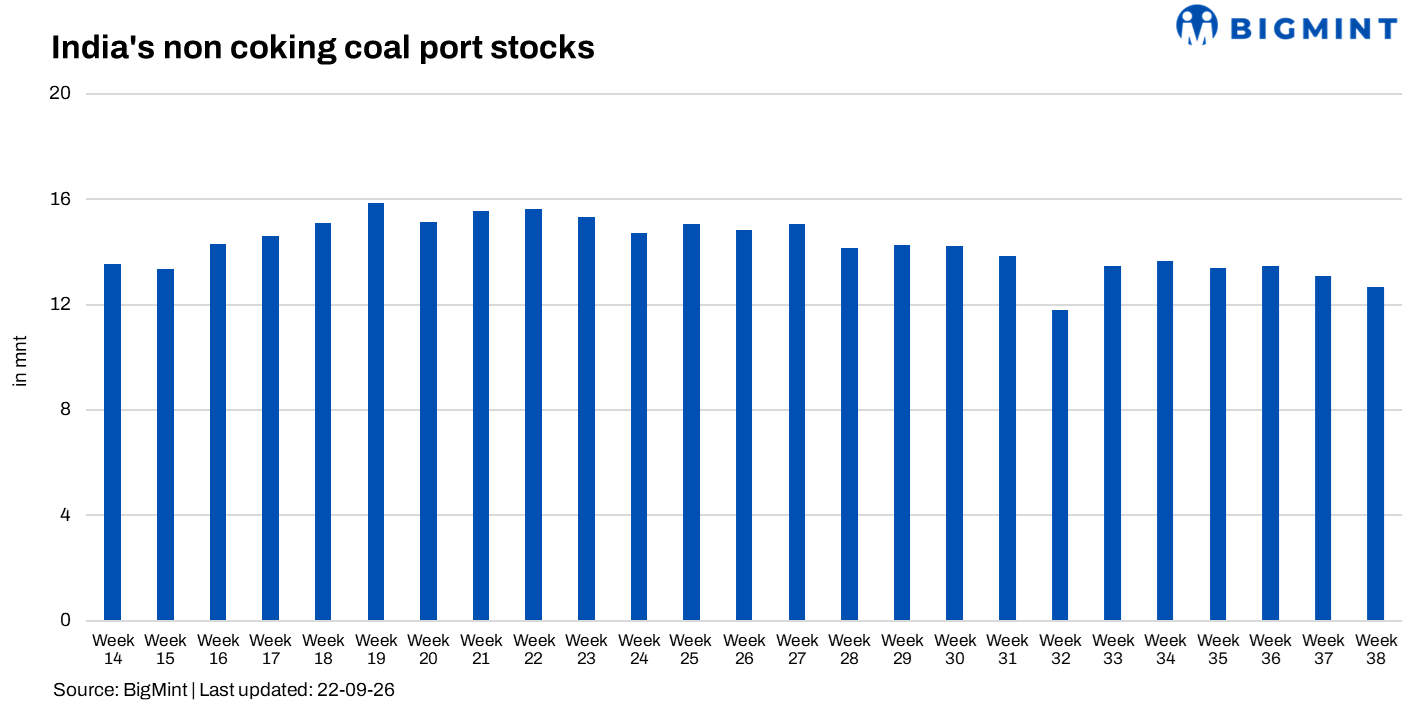
- Non-coking coal inventories fall 3%, coking coal stocks remain stable
- Mundra, Tuticorin show continuing imported coal movement into utilities
India’s coal inventories at major ports declined in Week 38 (13-19 September) despite substantial fresh cargo arrivals, pointing to continued evacuation of imported coal towards power, cement, steel and other industrial consumers.
Total stocks at major ports fell 2.05% w-o-w to 18.72 mnt during 13-19 September from 19.11 mnt in Week 37. Non-coking coal inventories declined more sharply, falling 3.05% to 12.68 mnt, while coking coal stocks remained broadly stable at 6.04 mnt.
However, inventories alone understate the underlying physical activity. BigMint’s vessel data show substantial coal arriving during the week even as aggregate stocks declined.
BigMint estimates port evacuation using: Indicative evacuation = Week 37 closing stock + identifiable Week 38 arrivals – Week 38 closing stock
The measure represents coal leaving port inventory rather than necessarily final consumption, since material can also move into trader or inland stocks. Vessel and stock cut-off dates also differ slightly, making the estimates indicative.
Major port flows during Week 38

*Identifiable coking and non-coking coal arrivals captured during the relevant period. In million tonnes (mnt). Figures are indicative because vessel-arrival and port-stock cut-offs do not align precisely.
Paradip leads evacuation
Paradip recorded the largest identifiable coal movement.
Stocks fell 0.15 mnt w-o-w to 2.44 mnt, despite around 0.50 mnt of identified arrivals, implying evacuation of approximately 0.65 mnt.
The flows reflect Paradip’s diverse industrial hinterland. Its non-coking coal inventory includes Tata Steel, JSPL, Aditya Birla, OCL India and several sponge iron and industrial users, while coking-coal stocks include SAIL, Visa Minmetal, Rawmet, JSW and other steel-linked buyers.
The data therefore point to continued coal movement into steel, sponge iron and other eastern Indian industrial consumers, rather than simply inventory accumulation.
Cement sector supports western coal evacuation
Kandla provides one of the clearest end-use signals.
Stocks dropped 13.2% w-o-w to 0.63 mnt, despite roughly 0.32 mnt of identifiable arrivals, indicating approximately 0.41 mnt of evacuation.
Cement consumers dominate identifiable stocks: UltraTech held around 340,000 t and Shree Cement 114,000 t at the end of Week 38. Both inventories fell substantially w-o-w — UltraTech by about 45,000 t and Shree Cement by around 32,000 t.
Bhavnagar presents the opposite inventory movement but reinforces the same sectoral theme. Stocks jumped nearly 50% to 262,000 t, almost entirely held by Nirma, indicating replenishment rather than evacuation during the week.
These flows are particularly relevant as expensive and constrained petcoke supplies have encouraged cement producers to broaden their fuel mix towards imported thermal coal and domestic coal.
Power-sector flows remain visible
Mundra continues to provide the strongest direct link between port flows and imported-coal power generation.
Total stocks declined to 2.10 mnt from 2.22 mnt, despite fresh arrivals of 0.08 mnt, implying around 0.21 mnt of evacuation.
The non-coking coal stock composition is heavily power-linked: Adani Power held 658,000 t and CGPL/Tata around 414,000 t, alongside 810,000 t held by Adani Enterprises. CGPL/Tata’s inventory alone declined 20% w-o-w.
Tuticorin also shows a power-sector component, with NTPL holding 370,000 t and Moxie Power Generation around 156,000 t.
The backdrop remains supportive. India’s power-sector coal imports reached a 15-month high of 5.52 mnt in August, while thermal power-plant inventories subsequently fell to around 22.9 mnt by 19 September, leaving approximately seven days of stock cover.
Steel drives eastern coking-coal flows
Coking coal shows a distinctly different geography.
Overall coking-coal inventories were virtually unchanged at 6.04 mnt, but this stability masks substantial movements between ports and steelmakers.
At Dhamra, coking-coal stocks increased 7.8% to 1.14 mnt, with Tata Steel holding 496,000 t and SAIL 388,000 t.
Vizag stocks increased nearly 10% to 1.49 mnt, driven partly by higher inventories held by JSPL and ArcelorMittal, while SAIL remained the largest holder at 786,000 t.
Conversely, Gangavaram’s coking inventory declined 8.7% to 0.83 mnt, with stocks held principally by RINL, NMDC and SAIL, pointing to continuing evacuation into the steel sector.
Goa/Mormugao provides another clear steel-linked drawdown, with JSW Steel’s coking-coal inventory falling 16.5% to 228,000 t.
Sectoral picture becomes clearer
Taken together, Week 38 port flows reveal four distinct demand channels.
Power: Mundra and Tuticorin show continuing imported-coal movement into utilities, against the backdrop of low thermal power-plant inventories.
Cement: Kandla provides the clearest signal, with substantial evacuation and falling inventories held by UltraTech and Shree Cement. Bhavnagar simultaneously shows Nirma replenishing stocks.
Steel: Paradip, Dhamra, Vizag, Gangavaram, Haldia and Goa remain the principal metallurgical-coal gateways, with SAIL, Tata Steel, JSW, JSPL, RINL and NMDC prominent among stockholders.
India’s steel-linked fuel requirement also remains firm, with strong domestic demand supporting imported metallurgical raw materials.
Sponge iron and other industry: Paradip and several western ports show flows into smaller steelmakers, sponge-iron producers, traders and industrial users, making this segment less directly identifiable but nevertheless significant.
What Week 38 tells us
The strongest signal is therefore not the 0.39 mnt decline in headline port inventory, but what happened underneath it.
Fresh coal continued arriving while inventories declined. At Paradip and Kandla alone, indicative evacuation exceeded 1 mnt, while substantial movement was also visible through Mundra, Hazira, Goa, Dhamra and other ports.
There is also an important divergence between coal types: non-coking stocks fell 3.05%, suggesting relatively rapid evacuation, while coking-coal inventories were essentially flat despite continued steel-sector flows.
This reinforces last week’s conclusion: India’s imported-coal demand is more active than headline port inventories suggest. Week 38 provides clearer evidence that this movement is being supported across several end-use sectors — power at Mundra and Tuticorin, cement through Kandla and Bhavnagar, steel through the eastern and southern metallurgical-coal ports, and broader industrial demand through Paradip and western India.
The combination of imports + inventory changes + identifiable receivers therefore provides a useful high-frequency indicator of where India’s imported coal is actually moving — and which consuming sectors are driving that movement.
Leave a Reply