- Crude steel output declines 4% y-o-y in Aug, production down 3% in Jan-Aug
- Steel exports top 10 mnt for 4th straight month amid weak domestic demand
- Property, infra, manufacturing investment contract, limiting demand recovery
Morning Brief: China’s steel industry remained under pressure in August 2026, despite stronger growth in overall industrial production. Industrial value added rose 5.2% y-o-y in August, accelerating from July, but crude steel output fell 3.7% y-o-y to 74.6 million tonnes (mnt). Finished steel production declined 5.5%, widening the contraction from July, as weak domestic demand and poor mill profitability continued to weigh on output.
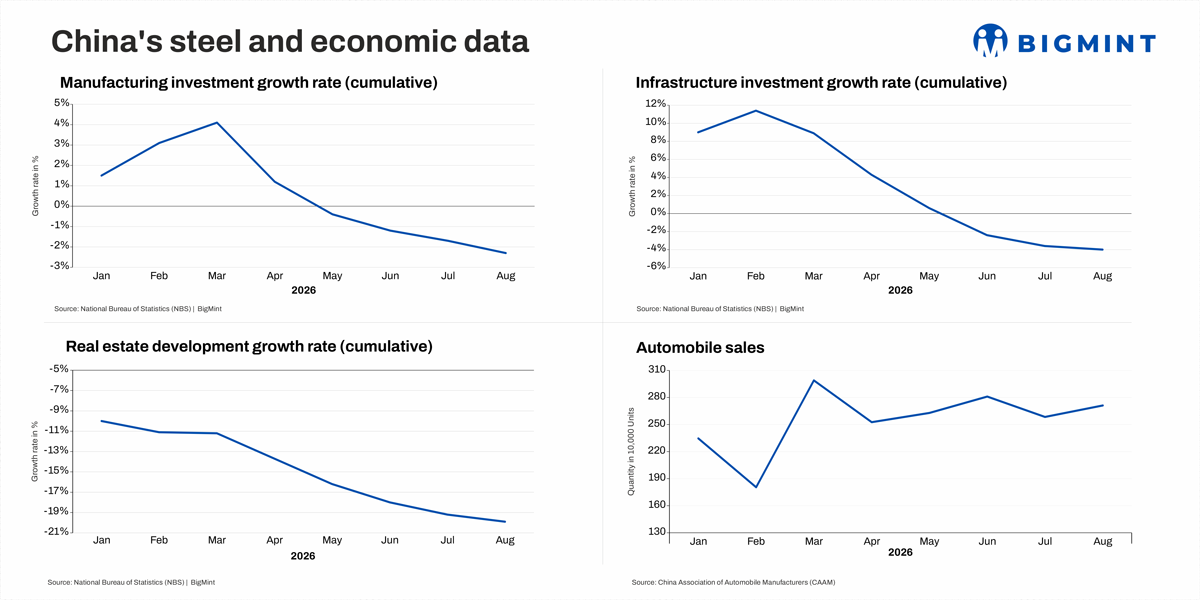
The weakness was concentrated in traditional steel-consuming sectors. Real estate development investment fell 19.9% y-o-y during January-August, infrastructure investment declined 4%, and manufacturing investment contracted 2.3%. Cement output also fell 11.7% in August and was down 9% during the first eight months, highlighting continued weakness in construction-related demand.
Overall, China’s steel sector continued to diverge from the broader growth in its industrial output. As in the previous months, growth was concentrated in sectors designated as the “new growth drivers,” such as equipment manufacturing (+12.1% y-o-y), high-tech manufacturing (+16.7%), and digital product manufacturing (+15.7%). These contributed more than 60% of the growth in industrial output, with manufacturing value added rising 6.1% y-o-y.
Highlights of China’s steel industry in August 2026
Crude steel production declines as margins remain weak
China’s crude steel output fell 3.7% y-o-y to 74.6 mnt in August, broadly in line with the 3.6% decline recorded in July. Cumulative production during January-August was down 3.1% y-o-y. Finished steel production fell more sharply, declining 5.5% y-o-y in August after a 4.1% fall in July.
Mill profitability remained a key constraint. Only around 30% of Chinese steel mills were profitable from mid-July, as higher coking coal and coke costs squeezed margins. Expectations of stronger demand during the September-October peak season provided some support to production but were not sufficient to reverse the broader decline.

Steel exports provide outlet for weak domestic demand
Chinese steel exports reached 10.16 mnt in August, up 6.8% y-o-y and remaining above 10 mnt for the fourth consecutive month, providing an outlet for mills facing weak domestic demand and mounting inventory pressure.
Chinese suppliers have continued to expand their presence in price-sensitive emerging economies markets such as South America, Southeast Asia, and Africa to cushion the impact of declining construction and investment activity at home.
Trade restrictions on China, while increasing, have so far been unable to significantly reduce China’s export volumes in H2CY’26. To illustrate, China’s steel exports were down only 3% in January-August compared to 4.4% in January-July.
Iron ore imports rise despite lower steel output
China’s iron ore imports increased 3.3% y-o-y to 108.54 mnt in August, while January-August imports rose 5.5% to 845.27 mnt.
Higher imports were supported by improved seaborne availability and the clearance of cargoes delayed by typhoon-related disruptions in July. Despite lower steel production, iron ore imports increased as domestic run-of-mine output fell 8.7% y-o-y to 536.1 mnt during January-July.
Moreover, iron ore inventories at 34 major Chinese ports were around 159 mnt in August, about 26 mnt, or nearly 20%, above year-earlier levels.
Coal supply improves but safety curbs remain constraint
China’s raw coal output fell 7.7% y-o-y to 361.82 mnt in August, while cumulative output reached 3.06 billion tonnes during January-August, down 3.3% y-o-y.
The annual decline reflects stringent mine-safety inspections, temporary mine suspensions, and tighter regulatory controls following mining accidents. However, production increased 5.4% m-o-m from July, suggesting that some capacity has resumed, but the pace of restarts remains gradual.
Notably, China’s July raw coal production had fallen to 343.21 mnt, the lowest monthly level since September 2021 outside the January-February holiday period.
Coal imports also eased in August, falling 1.5% y-o-y to 42.09 mnt after strong growth in June and July. Nevertheless, January-August imports increased around 3% y-o-y to about 310 mnt, indicating that imports continued to help offset constraints in domestic supply.
Coke production fell 6% y-o-y to 39.92 mnt in August, reflecting continued gaps in domestic coking coal supply.
Property continues to drag down steel demand
China’s property sector continued to weigh heavily on steel consumption. Real estate development investment fell 19.9% y-o-y during January-August, while the floor area of buildings under construction declined 12.8%. Funds available for property development fell 21% during the same period.
However, there were some signs of stabilisation in the existing home market. Registered second-hand home transactions rose 10.6% y-o-y during January-August, while unsold residential floor space also declined 4.2% y-o-y for homes that had been on the market for less than three years.
Nonetheless, the improvement in existing-home transactions has yet to translate into a meaningful recovery in new construction. Cement output fell 11.7% y-o-y in August and 9% during January-August, reinforcing evidence that construction activity remains weak.
Manufacturing activity picks up but investment shrinks
Manufacturing activity improved in August, with the RatingDog China General Manufacturing PMI rising to 51.5 from 50.9 in July. The official manufacturing PMI also increased to 49.8 from 49.2, although it remained below the 50-point threshold separating contraction from expansion.
The improvement was driven increasingly by export-oriented and high-tech industries. Investment in high-tech industries increased 5.2% y-o-y, while exports rose 18.6% in August, marking the fourth consecutive month of double-digit growth. Mechanical and electrical product exports increased 21.9% during January-August, while integrated circuit exports surged 95.4%.
However, manufacturing investment as a whole declined 2.3% in January-August, indicating that stronger production and exports have not yet translated into a broader investment recovery. This limits the extent to which manufacturing can offset the continuing decline in property-related steel demand.
Automotive exports highlight shift towards external demand
The automotive sector showed the same divergence between domestic and overseas markets. Passenger vehicle exports rose 77.5% y-o-y to 894,000 units in August, while domestic sales fell 23.7% to 1.55 million units.
New energy vehicle (NEV) production increased 21.9% y-o-y in August and 11.3% during January-August. NEV exports rose 130% y-o-y in August, while January-August exports reached 3.44 million units, up 120%. In contrast, domestic NEV sales declined 10.8% during the first eight months.
The trend is relevant for steel demand because China’s manufacturing growth is increasingly being supported by exports rather than domestic investment. While automotive and high-tech industries continue to generate demand for higher-value steel products, they cannot fully replace the volumes historically consumed by property and infrastructure.
Outlook
BigMint expects China’s steel production to remain under pressure through the rest of the year, despite a possible seasonal improvement in demand during September-October.
Early September production data already point to continued supply discipline, according to analysis from the Centre for Research on Energy and Clean Air (CREA). Daily pig iron and crude steel output fell to their lowest levels for the same period since 2021, while daily steel product output declined 8% y-o-y.
The main constraint is likely to remain poor profitability. Only around 7-8% of steel mills were able to secure profits in September, pressured by elevated coke and iron ore prices. As such, given that steel inventories remain higher y-o-y, mills are likely to curb output.
Moreover, property investment was down 19.9% during January-August, infrastructure investment fell 4%, and manufacturing investment was also negative. Even if policy support begins to lift infrastructure activity later in the year, the scale of the property sector contraction means that any recovery in steel demand is likely to remain limited. Overall, the gap between China’s broader industrial growth and steel production growth is likely to continue widening.
Leave a Reply