- Decrease in GCC, African production offsets growth in China, Europe
- LME prices surge by 30% y-o-y as inventories decline throughout year
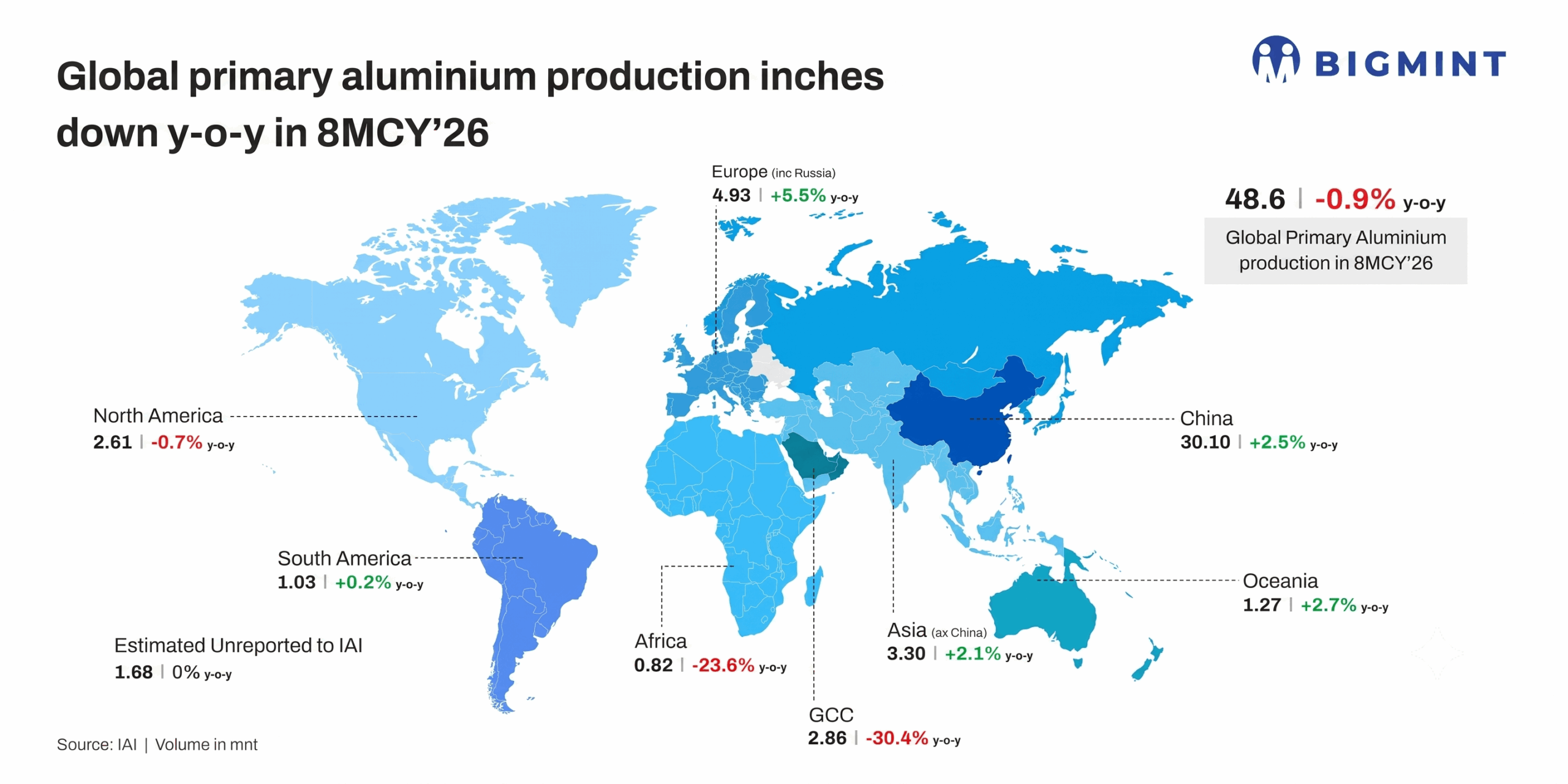
Global primary aluminium production stood at 48.60 million tonnes (mnt) in January-August (8MCY’26), down 0.9% y-o-y from 49.03 mnt last year, according to the International Aluminium Institute (IAI) data.
Production trends remained mixed across regions. Gulf Cooperation Council (GCC) and African output declined sharply and weighed on global supply. Higher output from China, Europe, Asia ex-China and Oceania partly offset these losses. Gulf smelter disruptions and logistics issues drove much of the decline.
Regional drivers shaping global output in 8MCY’26
The GCC recorded the sharpest decline, with aluminium production falling 30.4% y-o-y to 2.86 mnt. Middle East disruptions hit smelter operations and shipments through the Strait of Hormuz. EGA’s cast metal output fell 29% y-o-y in H1CY’26. Alba’s net finished production declined 14% in Q1 and 61% in Q2, while Al Taweelah has restarted 25% of its reduction cells. Alba now operates at around 80% of pre-war production levels.
African production declined 23.6% y-o-y to 0.82 mnt from 1.07 mnt. The decline mainly reflected South32’s Mozal Aluminium shutdown in Mozambique. The smelter entered care and maintenance on 15 March after power supply issues. Drought-related electricity constraints added to the pressure.
China’s estimated primary aluminium production rose 2.5% y-o-y to 30.09 mnt from 29.38 mnt. High operating rates supported the increase despite capacity constraints. China’s primary aluminium output reached a record 3.98 mnt in August, up 4.7% y-o-y. Exports of unwrought aluminium and products rose 16.7% y-o-y to 4.66 mnt during January-August.
Europe, including Russia, increased production by 5.5% y-o-y to 4.93 mnt from 4.67 mnt. Smelter restarts and improved operations supported the increase. European output rose 4.9% y-o-y in H1CY’26. Hydro’s Slovalco also agreed to restart 75,000 t of annual capacity in Q4CY’26.
Asia ex-China production rose 2.1% y-o-y to 3.30 mnt from 3.23 mnt. Oceania increased 2.7% to 1.27 mnt from 1.24 mnt. South American output held steady at 1.03 mnt. North American production slipped 0.7% to 2.61 mnt from 2.63 mnt. Stable output across most regions partly offset losses in the GCC and Africa.
Overall, higher output from China, Europe, Asia ex-China and Oceania could not offset losses in the GCC and Africa. Global primary aluminium production therefore fell 0.9% y-o-y in 8MCY’26.
Prices surge as exchange stocks tighten
The average LME aluminium cash price stood at around $3,317/t in 8MCY’26. This marked a roughly 30% y-o-y increase from around $2,557/t in 8MCY’25. Prices remained particularly strong in the second quarter. Monthly averages exceeded $3,600/t in April and May before easing in June and July.
Meanwhile, LME aluminium inventories declined steadily during the first eight months. Average monthly stocks fell from 498,670 t in January to 251,215 t in August. The estimated 8MCY’26 average stood at around 376,000 t. This was about 19% below the 467,000-t average in 8MCY’25. Tighter exchange availability and changing trade flows drove the decline. Middle East disruptions accelerated the drawdown.
Higher Chinese production and exports have added metal to global markets. However, the pace of replenishment remains uncertain. EGA’s Al Taweelah restart also remains gradual, with full recovery expected in early 2027.
Outlook
The global aluminium market is likely to remain supply-sensitive through the rest of 2026.
Meanwhile, a gradual recovery in Gulf production should improve supply, but the pace of restarts remains uncertain. At the same time, higher Chinese output and exports should provide some relief. However, sharp declines in GCC and African production continue to limit global availability.
Moreover, average LME aluminium prices remain around 30% higher y-o-y, while inventories are about 19% lower. As a result, the market remains vulnerable to fresh supply disruptions. Therefore, until Gulf production normalises, aluminium prices are likely to retain a firm underlying bias, keeping input costs elevated for downstream consumers.
Leave a Reply