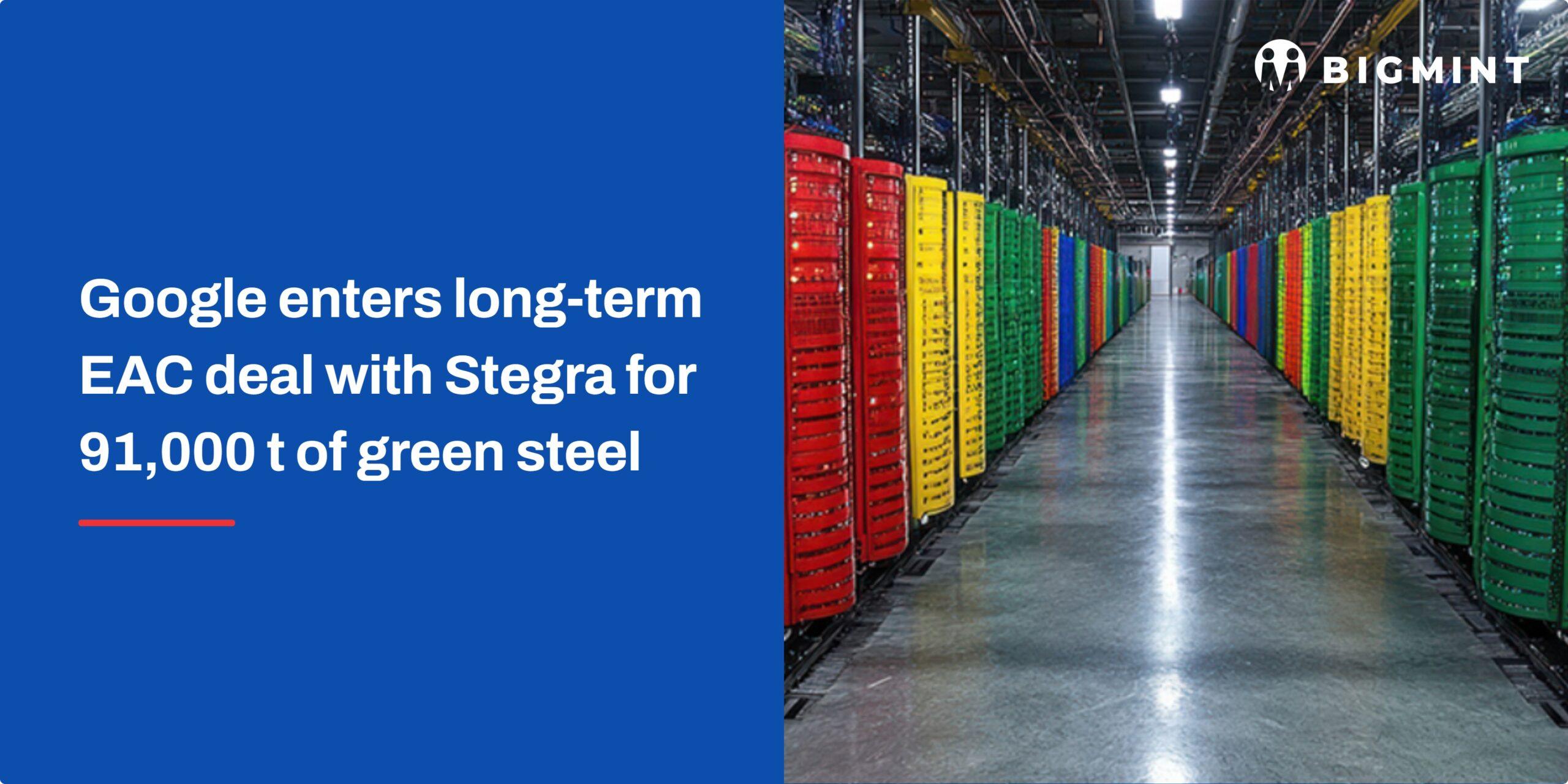
- Once operational, Stegra will produce 5 mnt low-emissions steel annually
- Google’s Scope 3 emissions jumped 25% in CY’25 on AI-related investments
Google has entered into a long-term arrangement with Swedish green steel producer Stegra to purchase environmental attribute certificates (EACs) linked to low-emission steel production. The agreement is designed to support the commercialisation of near-zero emissions steel while helping Google reduce the carbon footprint associated with its own operations and infrastructure expansion.
Stegra, established in 2020, is developing a large-scale green steel facility in Boden, Sweden. Once fully operational, the plant is expected to produce around 5 million tonnes (mnt) of steel annually. Unlike conventional steelmaking, the project will use hydrogen generated from renewable electricity to reduce iron ore, significantly lowering carbon emissions from the ironmaking process. The facility will also rely entirely on renewable power for its manufacturing energy needs.
The announcement comes shortly after Stegra secured EUR 1.4 billion (over $1.6 billion) in fresh funding, a crucial step that allows the company to complete construction of the project. The financing follows a period during which development activities had been slowed as the company awaited the outcome of its capital-raising efforts.
Early demand signal
As part of the agreement, Google will acquire EACs corresponding to as much as 91,000 t of steel produced during Stegra’s inaugural year of operations. Both parties have indicated an intention to expand the volumes covered under the arrangement over time.
Commenting on the partnership, Stegra Chief Executive Officer Henrik Henriksson noted that large global corporations have a unique ability to accelerate demand for low-carbon industrial materials. He added that Google’s decision to support Stegra during the early years of production sends an important signal to the market and contributes to the broader transition toward decarbonised steelmaking.
The agreement aligns with Google’s ongoing efforts to address emissions across its value chain. The company recently reported that achieving its climate ambitions, including its target of reaching net-zero emissions by 2030, has become increasingly challenging. In 2025, Google’s Scope 3 emissions rose by 25%, largely due to rapid investment in AI-related infrastructure and the construction of new data centres.
Google said the certificates obtained through the partnership could help address emissions associated with steel consumption in its own operations, particularly in data centre development. The company also views the mechanism as a way to support the financing and scaling of emerging clean industrial technologies by creating demand signals for low-carbon products.
Adam Elman, Google’s Director of Sustainability for Europe, the Middle East and Africa, emphasised that reducing emissions in hard-to-abate industries requires multiple complementary approaches. He noted that, alongside direct procurement of lower-carbon materials, environmental attribute certificates can play an important role in accelerating the deployment of cleaner technologies.
According to Elman, Google has already applied similar market-based mechanisms in areas such as renewable electricity and sustainable aviation fuel, and sees green steel certificates as another tool to help drive industrial decarbonisation while supporting innovation in sustainable manufacturing.
Leave a Reply