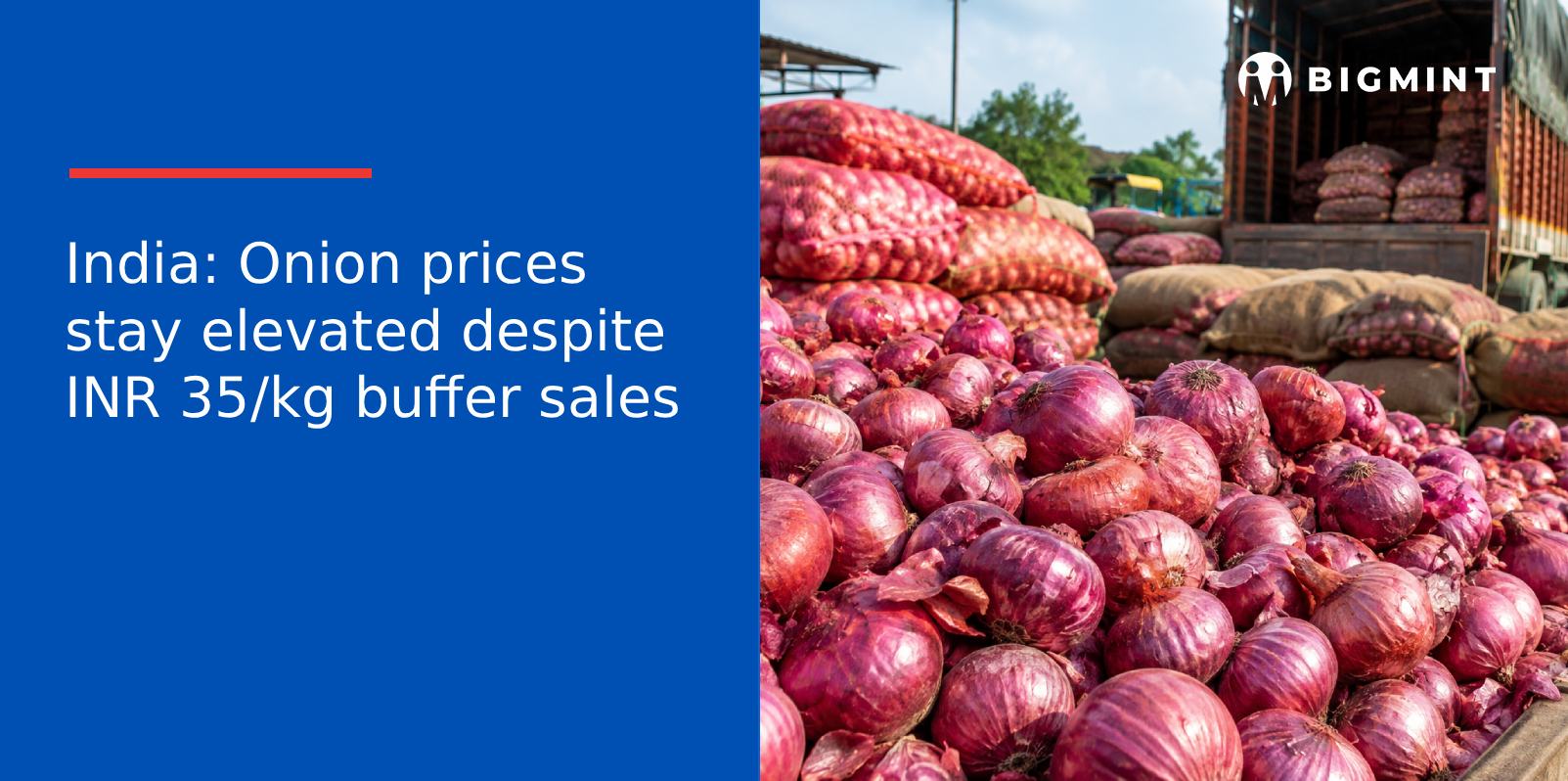
- Retail onion prices remain above INR 50/kg despite government intervention at INR 35/kg
- Delayed kharif arrivals, declining rabi stocks and uneven distribution keep market prices firm
The government’s release of buffer onions at INR 35/kg has not fully translated into lower prices across the open market, with onion prices remaining elevated in several consumption centres. According to the Department of Consumer Affairs (DCA), the all-India average retail onion price stood at INR 53.84/kg on September 16, nearly 94% higher than INR 27.71/kg a year earlier, while the average wholesale price was INR 45.65/kg.
Buffer supplies expand, but price gap remains
According to news reports, the government began releasing onions from its Price Stabilisation Fund buffer on August 24 at INR 35/kg through NCCF, NAFED, Kendriya Bhandar and mobile vans. The intervention has since expanded to more consumption centres, with railway rakes and trucks being used to move onions from producing regions to deficit markets.
The government has described the intervention as calibrated and targeted rather than a blanket market release. According to the Ministry of Consumer Affairs, Food & Public Distribution, Kanda Express and road transport are being used to direct supplies based on prevailing market conditions, while retail sales are being conducted through NCCF, NAFED, Kendriya Bhandar and mobile vans.
Despite these measures, the difference between the subsidised INR 35/kg price and open-market prices remains significant. According to news reports, consumers in several locations continue to pay around INR 60–70/kg, highlighting the challenge of ensuring sufficient buffer supplies reach consumers across markets.
Overall production remains broadly adequate
The government maintains that India does not face an overall onion shortage. According to the Ministry of Consumer Affairs, Food & Public Distribution, 2025-26 onion production was estimated at 307.37 lakh tonnes, compared with 307.67 lakh tonnes in 2024-25. The government had targeted procurement of 2 lakh tonnes for the 2026-27 buffer and had procured around 1.21 lakh tonnes.
The government also raised the procurement price for onions entering the Price Stabilisation Buffer by 13%, from INR 1,875 to INR 2,125/quintal, effective July 4, 2026. According to the Ministry, the higher procurement price was intended to provide better returns to farmers while strengthening buffer procurement.
The situation therefore reflects a gap between overall availability and market-level availability. While production and buffer stocks provide a broader supply cushion, the timing and distribution of supplies remain important for prices in individual consumption centres.
Outlook
Onion prices are likely to remain firm in the near term while stored rabi supplies decline and kharif arrivals remain delayed. According to news reports, the next major test will be the scale and timing of fresh kharif arrivals. Larger arrivals could improve market availability and moderate prices, while further delays could prolong regional price pressure.
Leave a Reply