- PSIC issues continue to constrain Indian imports
- October restocking supports Turkish scrap demand
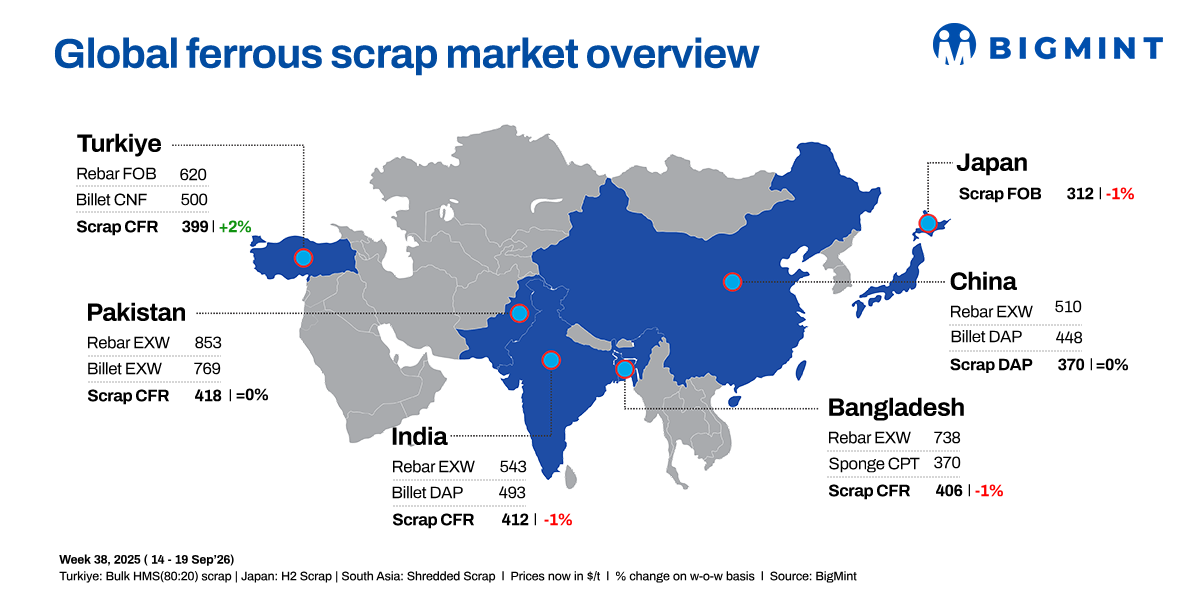
Global ferrous scrap markets remained largely firm across major markets as of 19 September, supported by higher freight costs, limited supply and firm seller expectations. Turkiye recorded the strongest gains, while India, Pakistan and Bangladesh saw firm offers but selective buying. Japan’s H2 prices also increased, while the UAE market remained subdued. US scrap prices were broadly stable, supported by firm steel demand.
Turkiye: The deep-sea imported scrap market strengthened through the week, with BigMint-assessed US HMS 80:20 rising $9/t w-o-w to $399/t CFR Turkiye from $390/t. Around 11 bulk trades were captured at $381-400/t CFR, while US offers reached $405-406/t and European/Baltic offers were around $398-400/t. A US HMS 85:15 cargo was booked at $400/t, equivalent to around $398/t for HMS 80:20.
Buying was supported by mills covering October-November requirements, limited Black Sea metallics and higher freight costs. Meanwhile, export rebar offers increased to $630-640/t FOB, with the BigMint assessment rising $12/t w-o-w to $620/t FOB. This placed the scrap-rebar spread at around $221/t, up from approximately $210/t a week earlier, giving mills some room to absorb higher scrap costs.
Overall, sentiment remained firm, although mills showed resistance above $400/t. Early-October scrap prices are expected to remain broadly stable, with rebar demand, the scrap-rebar spread and alternative metallic availability key to further price movements.
India: The imported scrap market remained firm through the week, supported by firm offers, limited competitive cargoes and steady replacement costs. African HMS 80:20 was offered at $375-380/t CFR Mundra, while South African and African cargoes were booked around $380/t. Chilean HMS 80:20 was booked at $370/t CFR Mundra, and Costa Rica HMS 60:40 at $335/t CFR Chennai for November arrival. Australian HMS was offered at $365-370/t, while shredded scrap was heard at $390-420/t CFR.
Buying interest remained selective as several mills relied on domestic scrap amid healthy inventories. New Zealand shredded cargoes were sold at $405-409/t CFR Mundra, while UK turning scrap was booked at $345/t. Israel-origin HMS 80:20 was booked at $350/t CFR Mundra with 5% impurities. Around 4,000-5,000 t of imported scrap bookings were tracked during the week, excluding additional shredded cargoes.
African supply continued to face PSIC-related issues, although market participants found ways to keep cargoes moving. DGFT’s 16 September notice provided a one-time seven-day window to clear pending PSICs and revised the regular issuance timeline to within two days.
Overall, sentiment remained firm but cautious, with prices likely to stay stable to slightly softer near term as festive-season disruptions approach.
Pakistan: The imported scrap market remained firm, although buying was limited by weak mill operations, cash-flow constraints and higher electricity costs. Brazil sheared HMS was booked at $393/t CFR Qasim, EU shredded at $419/t, and UK shredded at $417-418/t, with offers at $420/t. Philippines GI bundles were also booked at $360/t.
Most mills remained shut or operated selectively as the new SRO created different tax burdens, with mills using over 70% imported scrap paying PKR 5/unit versus PKR 30/unit for others. PSIC issues and higher freight further constrained procurement. Shredded prices are expected to remain around $417-420/t CFR Qasim through September, with activity potentially improving in October.
Bangladesh: The imported scrap market remained firm at elevated levels, with sellers holding offers high while buyers remained price-sensitive. Brazil-origin shredded was booked at $400/t CFR Chattogram, while Australian/New Zealand shredded traded at $400-410/t. UK/EU shredded offers were around $400/t, with some sellers asking $425/t, against buyer targets near $395/t. HMS 90:10 was offered at $370-395/t, while Malaysian PNS traded at $378-380/t and Singapore PNS was offered at $420/t against bids around $410/t.
A Latin American high-grade HMS 90:10 cargo was booked at $375/t CFR Chattogram, while local scrap stood at BDT 55,000-58,000/t. Overall, buying remained selective, with expensive Singapore/Malaysia cargoes and higher-priced EU shredded facing resistance.
Japan: H2 scrap market strengthened during the week, supported by higher freight, firmer Turkish scrap prices, currency movements and expectations of stronger post-monsoon demand. H2 export offers to Vietnam reached $375/t CFR, while bids were heard at $360-365/t. FOB Tokyo Bay prices rose JPY 700/t ($4/t) to JPY 49,000/t ($312/t), while H2 FAS collection prices remained at JPY 46,500/t ($296/t).
Tokyo Steel cut H2 prices by JPY 500/t ($3/t) at Tahara, while other plants raised prices by the same amount, taking purchase prices to JPY 47,500-50,000/t ($303-319/t) DAP.
US: Ferrous scrap prices remained broadly stable in September, supported by strong order books and firm finished-steel demand. Midwest shredded held at $420-425/t DAP, while busheling rose $10/t m-o-m to $465-470/t. US FOB East Coast HMS 80:20 increased $9/t w-o-w to $361/t, while shredded rose to $381/t. Suppliers remain firm, although further price gains are expected to be more moderate.
UAE: BigMint assessed processed HMS 80:20 at AED 1,021/t ($278/t) DAP Abu Dhabi, down AED 6/t ($2/t) w-o-w, with workable levels at AED 1,020-1,025/t. Buying activity remained slow, although sentiment improved as new scrap traders entered the market and export interest increased ahead of the 8 October lifting of the scrap export ban.
High grade shredded scrap was sold at AED 1,140-1,150/t ($310-313/t), while no processed HMS deals were reported. Meanwhile, the rebar market became more cash-driven as thin margins and higher fuel costs pressured traders.
Leave a Reply