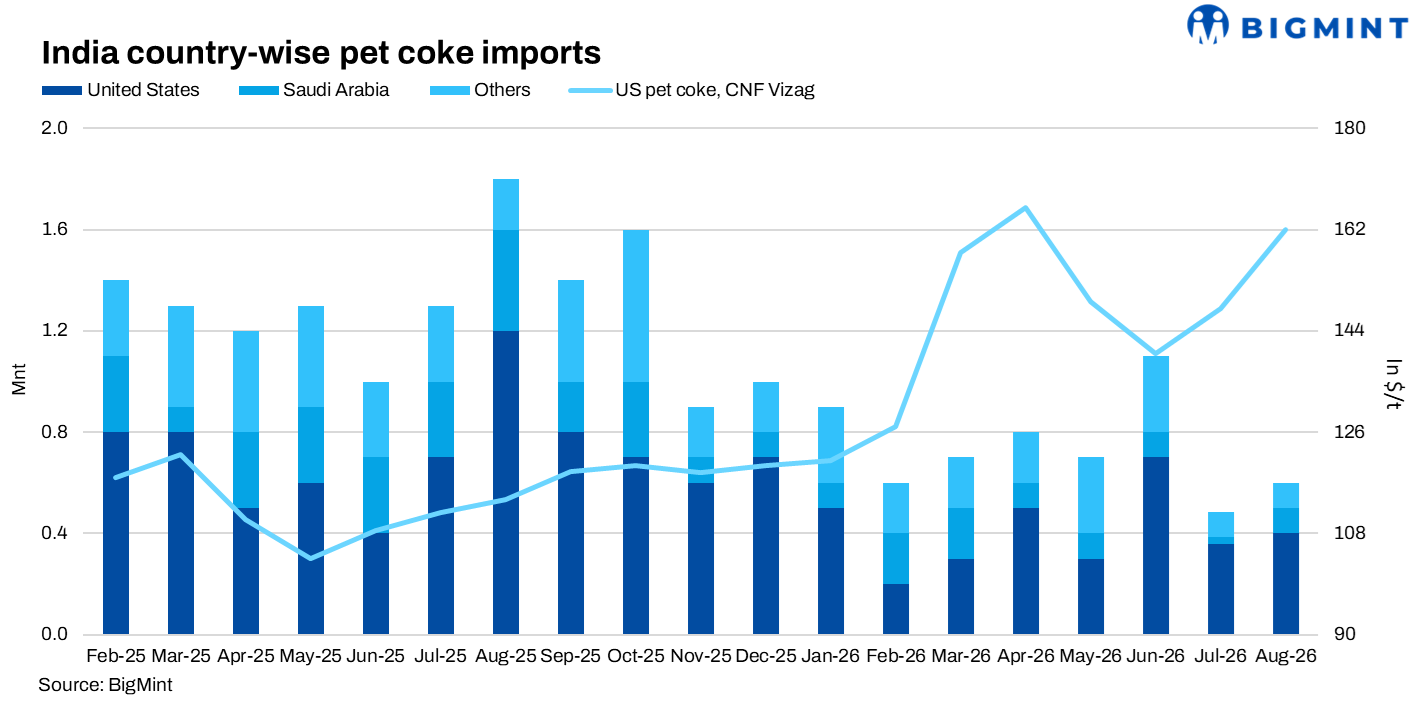
- Aug’26 imports recover to 0.6 Mnt m-o-m, but remain 67% below Aug’25
- Saudi and Omani supply disruptions reshape India’s petcoke sourcing
India’s petroleum coke imports recovered modestly in August 2026 from July’s low, but remained dramatically below year-ago levels as constrained international availability and elevated prices continued to reshape fuel procurement by the country’s cement industry.
Imports stood at 0.6 Mnt in August, up around 20% from 0.5 Mnt in July, but were 67% lower y-o-y compared with 1.8 Mnt in August 2025.
The cumulative decline is equally striking. India imported 5.8 Mnt during Jan-Aug’26, down around 45% from 10.6 Mnt in the corresponding period of 2025.
Supply disruption rather than demand weakness
The collapse in imports should not be interpreted as an indication of weaker underlying industrial or cement-sector fuel demand.
Instead, the key driver has been a tightening of international petcoke availability following disruptions associated with the West Asia conflict, particularly the loss of Saudi Arabian and Omani supplies. This has tightened the seaborne market, pushed prices sharply higher and forced Indian cement producers to increasingly look for alternative fuels.
The shift is clearly visible in the origin data.
Saudi Arabian supplies fell to around 0.9 Mnt during Jan-Aug’26 from 2.3 Mnt in the corresponding period last year — a decline of roughly 61%. Oman supplied only around 0.2 Mnt, compared with around 0.5 Mnt a year earlier.
The US retained its position as India’s largest supplier, accounting for approximately 3.3 Mnt, or 57% of Jan-Aug’26 imports. However, US shipments were also substantially below the 5.5 Mnt recorded during Jan-Aug’25.
In August alone, US-origin imports were around 0.4 Mnt, against approximately 1.1 Mnt a year earlier.
The numbers therefore point to a supply-led restructuring of India’s imported petcoke market rather than an underlying disappearance of fuel demand.
Cement sector accelerates fuel switching
The cement industry has been at the centre of this adjustment.
As imported petcoke became less readily available and substantially more expensive, producers increasingly switched towards US high-CV coal, particularly Northern Appalachian (NAPP) coal, as well as Indian domestic coal and domestic petcoke where technically and commercially feasible.
The receiver data illustrate the change. UltraTech Cement remained India’s largest identifiable petcoke receiver during Jan-Aug’26 at around 1.6 Mnt, but this was down from approximately 2.4 Mnt during Jan-Aug’25. Its August intake was only around 0.1 Mnt compared with roughly 0.3 Mnt a year earlier.
Reliance Industries received around 1.2 Mnt during Jan-Aug’26, while Rain CII accounted for approximately 0.8 Mnt, highlighting that industrial carbon users remain an important component of the reduced import market.
The broader message, however, is that India’s cement industry has changed what it burns rather than materially reduced its requirement for high-CV fuel.
Import geography reflects lower volumes
Both coasts have experienced substantial declines.
West coast India received around 3 Mnt during Jan-Aug’26, while east coast imports were approximately 2.8 Mnt. Each had received around 5.3 Mnt during the corresponding period of 2025.
Visakhapatnam was the largest discharge port during Jan-Aug’26 at around 1.6 Mnt, followed by Bedi at 1.3 Mnt and Kandla at 1 Mnt.
Kandla provides a particularly striking comparison. The port handled around 2.6 Mnt during Jan-Aug’25, reflecting the much heavier petcoke requirements of western Indian consumers last year.
August recovery does not yet signal a revival
August’s increase to 0.6 Mnt from 0.5 Mnt in July therefore needs to be viewed in perspective.
Volumes remained barely one-third of August 2025 levels, while the cumulative market has effectively lost 4.8 Mnt of imports in eight months.
More importantly, the conditions that produced the decline have not disappeared.
By mid-September, imported petcoke offers into India had climbed towards $165-175/t CFR, compared with around $149-151/t in late August. The price increase has further tested cement producers’ willingness to return aggressively to imported petcoke.
However, the alternative fuel market is now tightening as well.
US NAPP, which provided an important substitution option as petcoke became expensive, has become increasingly scarce. November-December cargoes are currently being offered around $170/t CFR India, while supply availability is understood to remain constrained into early 2027.
The cement industry’s earlier response — expensive petcoke → switch towards US coal — is therefore becoming considerably more difficult.
Outlook: fuel optionality becomes the key issue
India’s 45% decline in Jan-Aug petcoke imports represents one of the more significant changes in the country’s industrial fuel market this year.
The underlying demand for high-CV kiln fuel remains. What has changed is its source and economics.
West Asian supply disruption initially reduced petcoke availability and pushed prices higher, encouraging cement producers towards US NAPP and domestic coal. Now NAPP itself has tightened and risen towards similar delivered price levels.
This could make the remainder of 2026 increasingly about fuel security and optimisation rather than preference for any single fuel. Producers with flexibility are likely to balance imported petcoke, NAPP, domestic petcoke and domestic coal according to availability and delivered energy economics.
The modest August rebound should therefore not be mistaken for a return to 2025 import patterns. India has not lost its requirement for high-CV fuel; constrained petcoke availability and higher prices have simply forced that demand into alternative fuels.
Leave a Reply