- Festive buying shifts towards Sep amid calendar changes
- Elevated PV inventories pressure dealer working capital
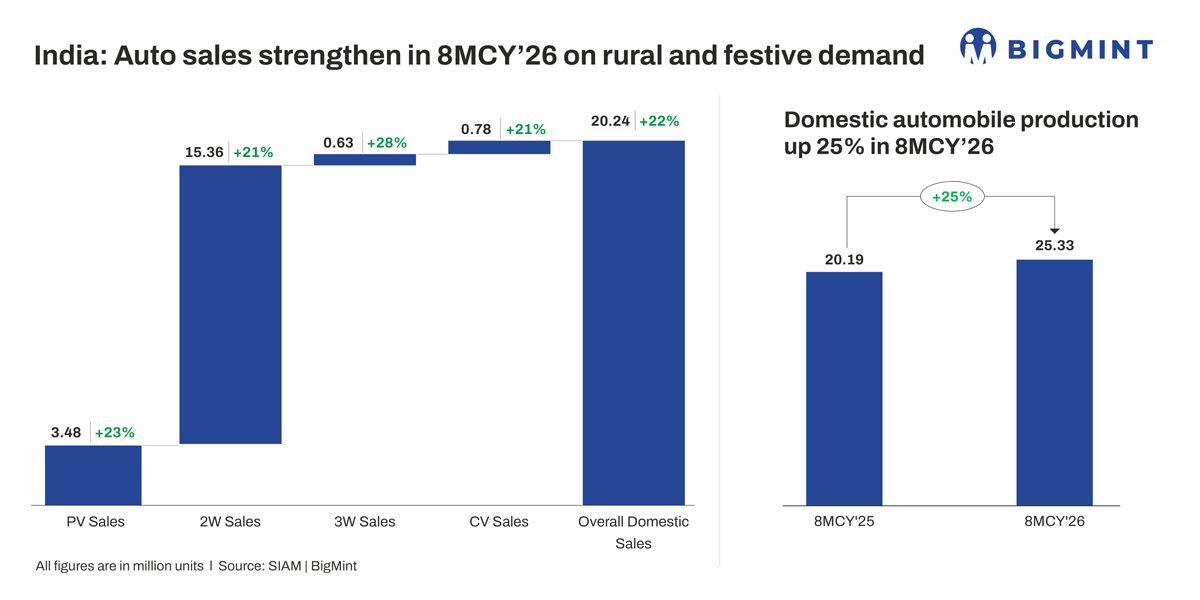
India’s automobile sector maintained strong growth in January-August 2026 (8MCY’26), according to data from the Society of Indian Automobile Manufacturers (SIAM), supported by broad-based demand across major vehicle segments. Passenger vehicle sales increased 23% y-o-y to 3.48 million units, while two-wheeler sales rose 21% to 15.36 million units. Three-wheeler sales climbed up by 28% to 0.63 million units.
Commercial vehicle sales increased 21% y-o-y to 0.78 million units. Overall domestic automobile sales rose 22% to 20.24 million units, while total automobile production grew 25% to 25.33 million units in 8MCY’26.
Retail automobile sales grow 20% y-o-y in 8MCY’26
Meanwhile, FADA’s retail data for 8MCY’26 reflected healthy y-o-y growth across all major vehicle segments. Passenger vehicle sales increased 25% y-o-y to 3.39 million units, while two-wheeler sales rose 23% to 14.63 million units. Three-wheeler sales also grew 16% to 0.95 million units.
Commercial vehicle (CV) sales increased 13% y-o-y to 0.78 million units, while tractor sales rose 21% to 0.75 million units. Overall retail automobile sales increased 20% to 20.50 million units, indicating broad-based growth across major vehicle segments.
Seasonal monsoon lull limits sequential retail momentum
According to FADA President Sai Giridhar, August 2026 marked the strongest August ever for India’s auto retail market, although retail activity softened from July’s record level. The sequential decline was attributed mainly to the seasonal monsoon lull and a shift in the festival calendar, with Ganesh Chaturthi and Onam-led buying spilling into September.
The president highlighted that growth remained broad-based, with two-wheelers, passenger vehicles, and commercial vehicles recording strong performance, while tractors remained largely flat due to the widening monsoon deficit. Despite weaker farm-linked demand, rural passenger vehicle, commercial vehicle, and three-wheeler demand continued to outperform urban markets, pointing to resilience in the non-farm rural economy.
Two-wheeler demand remained supported by GST 2.0 affordability and steady rural demand, although monsoon conditions and the Shravan/Aadi period affected showroom walk-ins. Commercial vehicle demand was supported by infrastructure activity, mining, e-commerce logistics and financing availability, while passenger vehicle demand benefited from rural consumption and improving affordability.

A key structural shift highlighted by FADA was the growing preference for alternative powertrains. Combined CNG, hybrid and EV passenger vehicle demand moved ahead of petrol/ethanol for the first time, driven by running-cost considerations and consumer concerns around the E20 transition. EV adoption also strengthened across vehicle categories, particularly in three-wheelers and commercial vehicles.
However, FADA cautioned that the headline growth should be interpreted carefully, as August 2025 had a relatively weak base following purchase deferments ahead of GST 2.0. Dealers also reported that the festive season’s initial response was below expectations. Passenger vehicle inventories remained elevated, increasing dealer working-capital pressure and prompting FADA to urge OEMs to align billing more closely with actual retail.
Impact on aluminium ADC12 alloy demand
India’s ADC12 aluminium alloy market continued its correction in August 2026, with BigMint’s bi-monthly assessments showing prices declining by INR 23,500-25,500/t across key markets. Delhi recorded the steepest decline of INR 25,500/t to INR 319,800/t, followed by Pune, where prices fell INR 25,000/t to INR 312,500/t, and Chennai, where prices declined INR 23,500/t to INR 311,000/t. The correction was driven by softer scrap prices, lower production costs and ample availability, while competitively priced duty-free imports added pressure, particularly in southern India. The scrap-ADC12 spread narrowed to around INR 66,000-73,000/t, while tighter scrap availability provided some support to northern markets.
ADC12 prices are likely to remain under pressure in the first half of September amid weak buying, cautious negotiations, and elevated inventories. However, market conditions could improve from mid-September as previously booked FTA-origin ADC12 material, particularly in southern India, depletes and buyers return for fresh purchases. The upcoming festive and marriage season could support downstream automotive demand, while firmer raw-material prices may raise production costs. Meanwhile, any tightening of EU aluminium scrap exports could constrain global availability and increase replacement costs, providing medium-term support to ADC12 prices.
Outlook
Looking ahead to September 2026, dealer sentiment remains constructive, although expectations have moderated from July’s peak. Festive demand, including the spillover from Ganesh Chaturthi and Onam and the onset of Navratri, is expected to support showroom activity. However, a widening monsoon deficit and fresh OEM price hikes could weigh on rural demand and affordability. Two-wheelers are likely to benefit from festive demand and the shift towards alternative fuels, while passenger vehicles will be supported by new launches and booking pipelines, although elevated inventories at 38-40 days remain a concern, with levels well above the FADA-recommended 21 days. Commercial vehicle demand could improve as post-monsoon freight, infrastructure and harvest-related movement picks up.
Over the September-November period, the outlook remains optimistic, supported by the festive season extending through Dhanteras and Diwali. However, festive demand falling short of expectations, weaker rural demand due to monsoon conditions, and further vehicle price increases remain key risks. Passenger vehicle inventory levels and showroom conversion will also remain important to monitor, particularly against the strong GST-led base of the previous year. Overall, festive demand conversion, rural recovery, monsoon after-effects and inventory discipline are expected to determine the pace of auto retail growth through the peak season.
Leave a Reply