- Kandla mill scale prices rise on steady buying
- Wait-and-watch approach limits fresh Raipur buying
Mill scale prices across major Indian markets continued to show an upward bias during the assessment on 16 September, with sellers increasingly holding firm on offers despite mixed demand and weaker global iron ore cues. Lower availability in select markets, firm finished steel prices and persistent buying interest provided support to domestic mill scale prices.
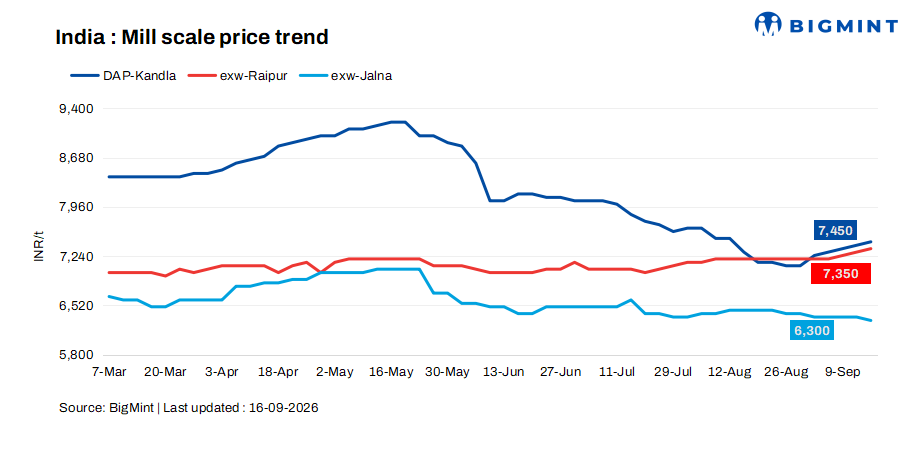
BigMint’s Fe 69% mill scale assessment at Kandla increased by INR 50/t w-o-w to INR 7,450/t DAP Kandla, while Raipur prices rose by INR 50/t to INR 7,350/t ex-works. Jalna, however, inched down by INR 50/t ($5/t) to INR 6,300/t ex-works as buyers continued to rely on earlier commitments and fresh procurement remained limited.
Kandla: Sellers hold firm despite high inventories, weak export demand
Kandla mill scale prices strengthened further, with deals increasingly being concluded at elevated levels despite relatively high inventory availability in the market. Sellers have shown limited willingness to reduce offers, arguing that domestic buying interest remains intact and material continues to move even at higher price levels. Transactions were heard at around INR 7,600/t in some instances, reinforcing sellers’ confidence in maintaining firm offers.
At the same time, global iron ore prices have weakened, limiting support for export-oriented mill scale demand. Exporters are reportedly facing subdued interest as international fines prices do not provide sufficient margins, keeping export demand relatively weak. However, this has yet to translate into meaningful downward pressure on domestic mill scale offers.
Market participants noted that sellers are largely maintaining their price levels rather than chasing buyers, while continued domestic consumption is preventing a significant slowdown in procurement. Around 4,700 t of mill scale deals were concluded during the publishing window at INR 7,400-7,500/t DAP Kandla, highlighting the market’s ability to absorb higher prices despite elevated inventory levels.
Raipur: Higher offers meet cautious buying, widening price gap
Raipur mill scale prices moved higher as sellers raised their offers in line with the broader firming trend in the finished steel market. Although material remains available, buyers have become increasingly cautious at current price levels, with some traders adopting a wait-and-watch approach before committing to fresh purchases.
Sellers, meanwhile, are capitalising on the positive market sentiment and are increasingly reluctant to release material at lower levels. This growing resistance to price negotiations has pushed the market higher, even though actual buying interest remains only moderate. The divergence between seller expectations and buyer affordability has resulted in a notably wide trading range.
Around 5,000 t of deals were reported during the assessment window at INR 7,000-7,500/t ex-works Raipur. The broad deal range reflects the significant gap between buyer and seller price expectations, with lower-priced transactions still emerging while sellers increasingly target the upper end of the market.
Jalna: Prices stable as sellers focus on pending order execution
Jalna remained the exception to the broader upward movement, with mill scale prices holding steady at INR 6,350/t ex-works. The market continues to be largely driven by the execution of previously placed orders, with sellers focused on clearing pending dispatches rather than actively pursuing fresh volumes.
Fresh purchase orders have remained limited as buyers wait for existing material to be dispatched before making new commitments. Sellers have consequently kept their offers firm and are showing little urgency to revise prices until current orders are executed and inventory positions become clearer.
Around 550 t of deals were recorded during the assessment window at INR 6,300-6,500/t ex-works Jalna. The stable price trend is therefore being supported more by limited fresh market activity and pending order execution than by strong new demand.
Leave a Reply