- Mundra sees strong coal replenishment and evacuation
- Stocks at Krishnapatnam drop despite continued imports
India’s coal stocks at major ports remained virtually unchanged at around 19.1 mnt between week 34 and week 37, but the headline masks substantial imports, stock redistribution and coal evacuation across individual ports.
BigMint analysed port stocks covering broadly the period from mid-August to mid-September, alongside identifiable vessel arrivals from late August through 11 September.
The analysis suggests that coal has been moving rapidly towards consumers even at ports where inventories increased.
Indicative evacuation = opening stock + identifiable arrivals – closing stock. This represents port offtake rather than final consumption because some material may move to trader or inland stocks.
Port inventories show sharp divergence

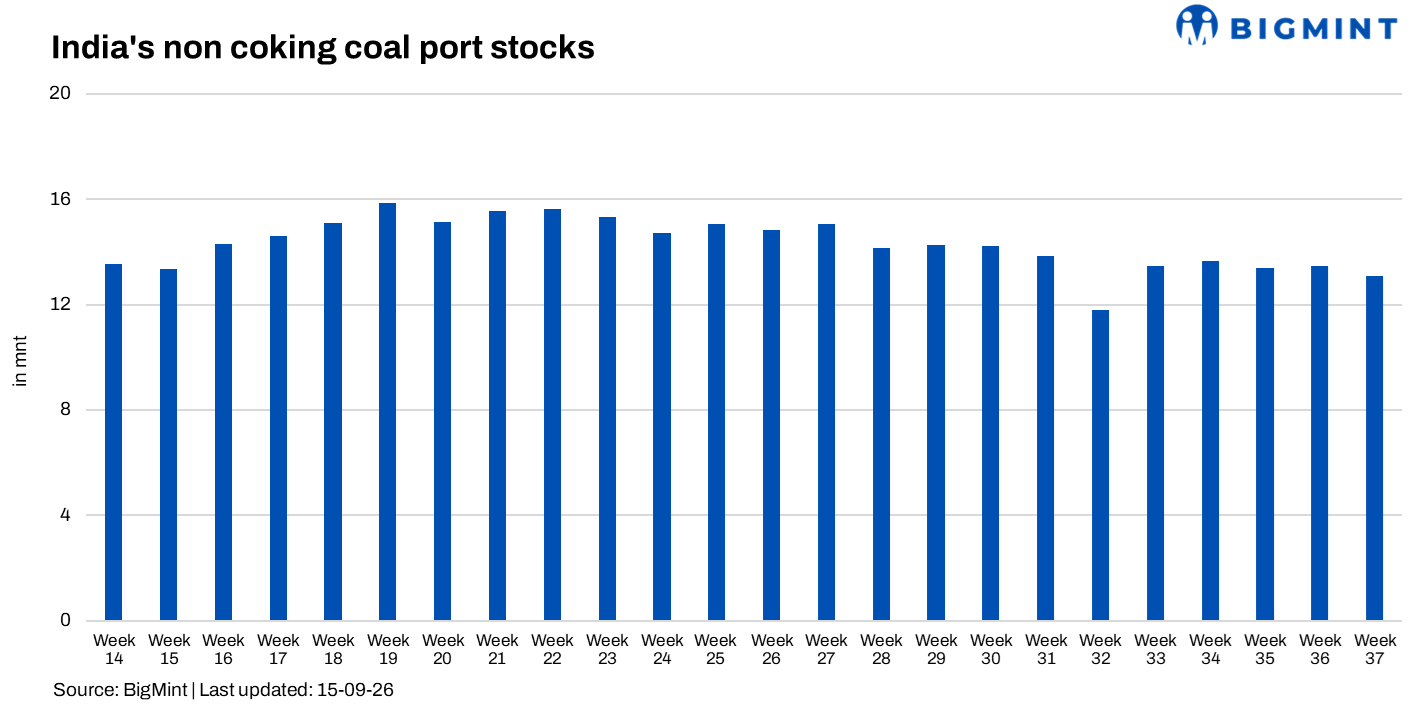
Non-coking inventories stood at 13.40 mnt compared with coking coal at 5.39 mnt.
Thermal coal: Strong evacuation hidden beneath inventories
Matching identifiable non-coking coal arrivals with inventory movements produces a very different picture.

*Indicative because vessel and weekly stock cut-offs do not align exactly.
Mundra and Krishnapatnam are the clearest examples of why stocks alone can misrepresent consumption.
Mundra accumulated nearly 0.59 mnt, but around 1.44 mnt of identifiable thermal coal arrived, implying approximately 0.85 mnt was simultaneously evacuated. Late-August arrivals included 155,650 t Indonesian coal for Adani Power and 187,405 t Mozambique-origin coal for Tata Power.
The week’s inventories reinforce the power-sector link: CGPL/Tata held 622,000 t, Adani Power 601,000 t and Adani Enterprises 601,000 t.
Mundra therefore represents high consumption coupled with even stronger replenishment.
Krishnapatnam shows the reverse. Stocks fell 0.47 mnt despite continuing imports, producing estimated evacuation of around 0.81 Mnt. Its W35 non-coking inventory included 1.26 mnt held by Adani Enterprises, alongside JSW Steel, BMM Ispat, JSPL and UltraTech.
This suggests southern consumption was running materially ahead of import replenishment.
Western India provides another important demand cluster. Hazira, Kandla, Navlakhi and Dahej together indicate roughly 1.8 mnt of apparent evacuation. Kandla is particularly linked to cement: UltraTech held 407,000 t and Shree Cement 224,000 t. Navlakhi, meanwhile, is more trader-driven, with Adani Enterprises, Agarwal Coal and other merchants feeding inland industrial consumers.
This industrial demand is significant as domestic coal availability has tightened during the monsoon. Power plants have received priority, while imported-coal costs and domestic shortages have put pressure on India’s coal-based sponge iron sector.
Coking coal: Steelmakers drive a different import geography
Coking coal tells a distinctly different story. Imports and stocks are concentrated around integrated steelmaking centres.

This explains why Vizag’s 0.33 mnt overall stock build should not be interpreted as thermal-coal accumulation. Much of its inventory is coking coal linked to steelmakers.
Similarly, Dhamra’s coking coal inventory was around 0.95 mnt supported by large Australian arrivals including a 163,000 t cargo for Tata Steel.
India’s coking coal inward traffic at major ports reached an estimated 28.4 mnt during April-August FY’27, up around 10% y-o-y, reinforcing the underlying growth in steel sector import requirements.
Outlook
The port data suggest India’s imported-coal market is considerably more active than the broadly flat 19.1 mnt headline inventory implies.
For thermal coal, Mundra reflects strong power-sector imports and consumption; Krishnapatnam points to particularly strong southern evacuation; Kandla indicates cement demand; while Hazira, Navlakhi and Dahej show substantial industrial and merchant movement.
Coking coal remains structurally different, with flows concentrated around steel-linked eastern ports and identifiable integrated steelmakers.
Tracking imports, inventory change, implied evacuation and receiver therefore provides a useful high-frequency indicator of India’s actual imported-coal demand — and could reveal changes in power, cement, sponge iron and steel consumption ahead of monthly import statistics.
Leave a Reply