- H1 crude steel output down 3% y-o-y to 499.9 mnt as construction demand weakens
- Manufacturing supports higher-value steel demand, exports absorbing surplus production
- Capacity swap programmes, ultra-low emission upgrades to shape next steel cycle
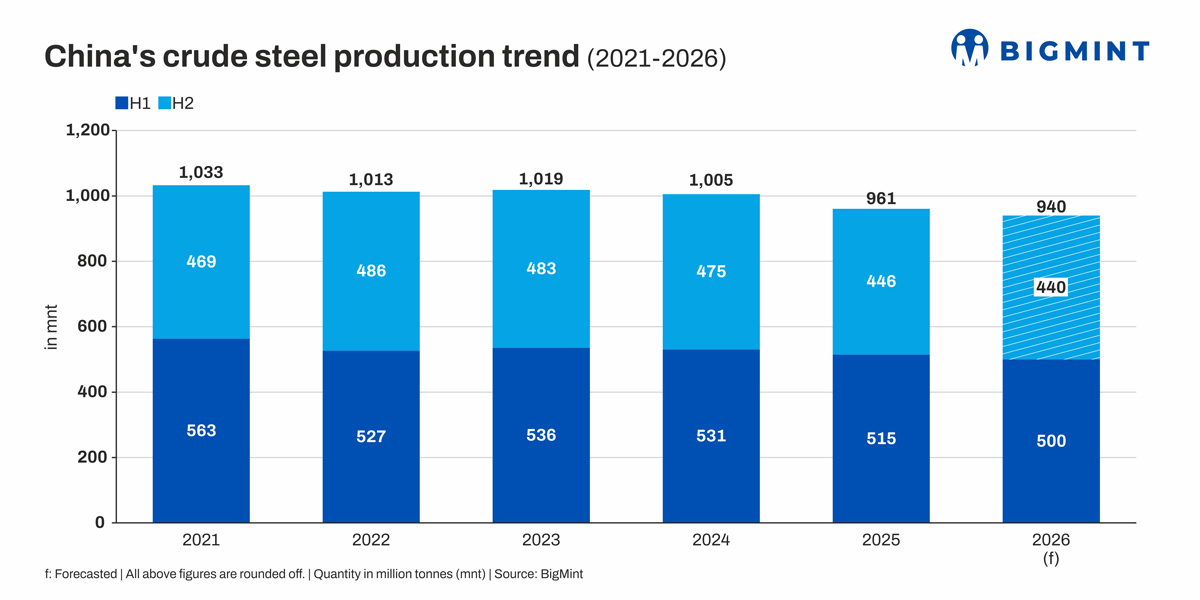
Data Deep Dive: China produced 499.9 million tonnes (mnt) of crude steel during the first half of 2026, down 3% y-o-y from 515 mnt in the corresponding period last year, according to BigMint data. Output is projected at around 440 mnt during H2, taking full-year production to approximately 940 mnt compared with 961 mnt in 2025. The moderation extends the gradual adjustment in China’s steel industry since output exceeded 1.03 billion tonnes (bnt) in 2021.
Residential construction continues to weaken, while manufacturing activity and exports have limited the decline in crude steel production by supporting demand for higher-value steel products and absorbing surplus output.
Manufacturing changing China’s steel demand profile
Residential construction generated broad-based steel consumption across reinforcing bar, wire rod, structural sections and commodity plate for almost two decades. Falling real estate investment and weaker housing activity have reduced demand across those product segments.
China’s vehicle exports exceeded 1 million units for a second consecutive month in July, while machinery, electrical equipment and technology exports remained resilient despite slowing domestic economic growth. Manufacturing PMI also returned to expansion as export-oriented factories increased production.
Automotive production consumes exposed-grade sheet, advanced high-strength steels, galvanised products and electrical steel, while machinery and engineering require specialised plate and alloy products.
Residential construction, by comparison, generated demand across almost every major steel product category but that demand is inevitably slowing. However, the total volume of manufacturing and general engineering related demand is obviously much less compared to the construction sector.
Mills supplying automotive, appliance and engineering customers have maintained stronger order books, while producers concentrated in reinforcing bar and other construction steel products remain exposed to the prolonged weakness in residential construction.
Exports balancing production, not driving growth
China exported more than 75 mnt of finished steel during January-August, including more than 10 mnt in August, as competitive pricing and seasonal restocking supported overseas demand across Southeast Asia, the Middle East and Latin America.
Trade-remedy investigations against Chinese steel have expanded steadily since 2020, extending beyond construction products into automotive, engineering and other higher-value steel grades. The Carbon Border Adjustment Mechanism (CBAM), tighter rules of origin, melt-and-pour requirements and domestic procurement policies are also reshaping market access.
Emerging markets continue purchasing primarily on price, whereas developed markets increasingly require carbon reporting, product traceability, certification and compliance with origin requirements before imports can enter. Chinese mills are consequently allocating higher-value products towards destinations where those requirements can be met alongside competitive pricing.
Industrial policy shifting alongside the market
An article published in Qiushi, the Chinese Communist Party’s principal theoretical journal, argues that foundational industries should not undergo “market-driven liquidation or passive contraction”, drawing parallels with the industrial decline of the US Rust Belt and distinguishing between eliminating obsolete capacity and preserving industrial capability.
Capacity replacement programmes, ultra-low-emission upgrades, consolidation and investment in automotive sheet, electrical steel and specialised manufacturing grades have continued even as crude steel production has moderated. Older construction-oriented facilities continue to exit, while investment is increasingly directed towards products aligned with advanced manufacturing supply chains.
Outlook
BigMint projects China’s crude steel production at around 440 mnt in H2 2026, taking full-year output to approximately 940 mnt. Continued weakness in residential construction is expected to weigh on long steel demand, while automobiles, machinery and electrical equipment should remain the principal sources of demand for higher-value flat products.
Export volumes are likely to remain elevated, although anti-dumping investigations, carbon-related import requirements and destination-specific compliance rules will increasingly determine market access for Chinese producers.
Mills supplying manufacturing value chains and export markets requiring higher-grade products are likely to sustain stronger utilisation, while producers concentrated in commodity construction steel will remain more exposed to the prolonged adjustment in the property sector. We expect manufacturing-led demand, export competitiveness and the pace of the property downturn to determine whether steel production remains close to current levels or weakens further during the second half of the year.
Leave a Reply