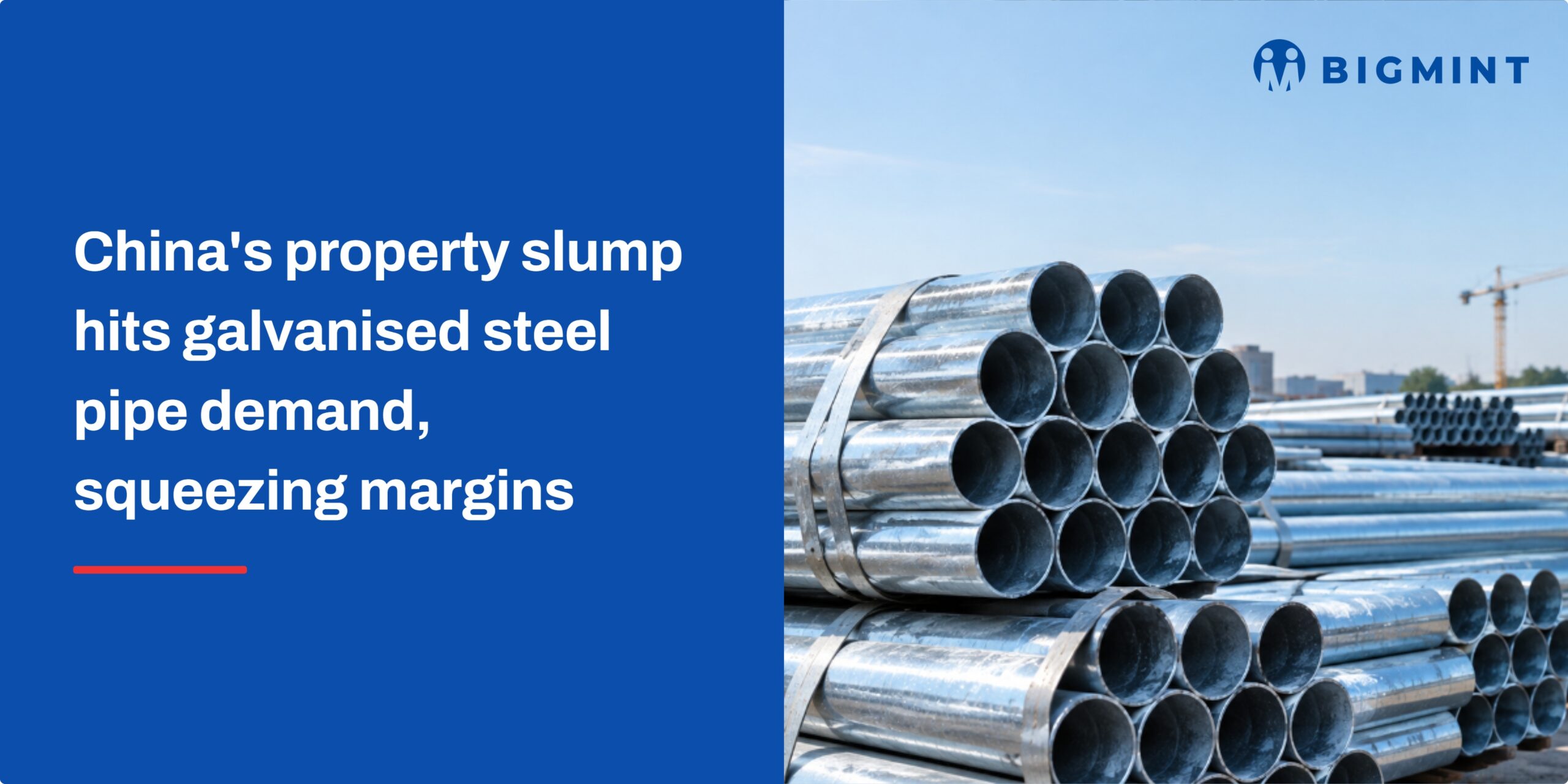
- Producers unable to pass on higher zinc costs amid sluggish demand
- Premium between galvanised, welded pipes shrinks as competition intensifies
China’s prolonged property downturn is putting pressure on the galvanised steel pipe market, with weaker new construction starts reducing demand for pipes used in fire protection, water supply and drainage, and gas systems. At the same time, rising zinc costs and tougher competition are making it harder for manufacturers to protect margins.
According to Mysteel, a Chinese market intelligence provider, the galvanised steel pipe market is shifting from a growth-driven phase to one centred on competition for market share as the property sector undergoes restructuring.
New construction decline weighs on demand
The property downturn is directly affecting galvanised steel pipe demand because the products are widely used in housing projects for fire safety systems, water supply and drainage, and gas piping.
China’s floor area of new construction starts fell 21.2% y-o-y in 2024 and another 19% in 2025. Mysteel expects the decline to continue, with new construction starts projected to fall by a further 17.5% this year.
The continued contraction in new construction is reducing the addressable market for galvanised steel pipes and shifting competition among manufacturers towards securing a larger share of shrinking demand.
Pipe premium comes under pressure
The weaker demand environment is also visible in the price differential between welded steel pipes and galvanised steel pipes. The gap in the Chinese market has recently been around RMB 550-700/tonne (t) ($82-104/t), while the average differential since the start of this year stood at RMB 581.59/t ($87/t) as of 10 September.
Galvanised steel pipes have traditionally commanded a premium over standard welded pipes because of the additional galvanising process. However, weaker end-user demand and intensified competition among manufacturers for shipments are making it harder to maintain that premium.
This is limiting manufacturers’ ability to offset higher production costs through selling prices.
Higher zinc costs squeeze profitability
At the same time, raw material costs have moved higher. China’s average zinc ingot price was RMB 1,599/t ($238/t) higher y-o-y as of 10 September, while zinc accounts for around 15-20% of galvanised steel pipe production costs.
Manufacturers have been unable to fully pass these higher zinc costs on to customers because of sluggish demand. As a result, the rise in input costs is translating into further pressure on profitability.
The combination of a narrower product premium and higher zinc costs leaves manufacturers with less room to protect margins, particularly as competition for orders intensifies.
Market restructuring likely to accelerate
Mysteel expects the Chinese galvanised steel pipe market to remain under pressure in the short term from three factors: weak demand, intensifying competition, and deteriorating profitability.
Supply pressure could ease to some extent if the expansion of new production capacity approaches its peak and manufacturers step up production cuts and output adjustments. However, this is unlikely to remove the underlying demand problem created by the decline in new property construction.
As a result, competition between manufacturers is expected to become fiercer as companies compete for a smaller market.
Mysteel expects the market to undergo rapid restructuring, with companies that have stronger cost management capabilities, established sales channels, and competitive brands better positioned to retain market share as China’s property sector continues to adjust.
Note: This article is published in accordance with a content exchange agreement between SteelDaily and BigMint.
Leave a Reply