- Sponge iron prices hit 2-year high, both non-coking, coking coal costs surge
- Rebar output falls 6% y-o-y in Jul’26 as maintenance continues at tier-1 mills
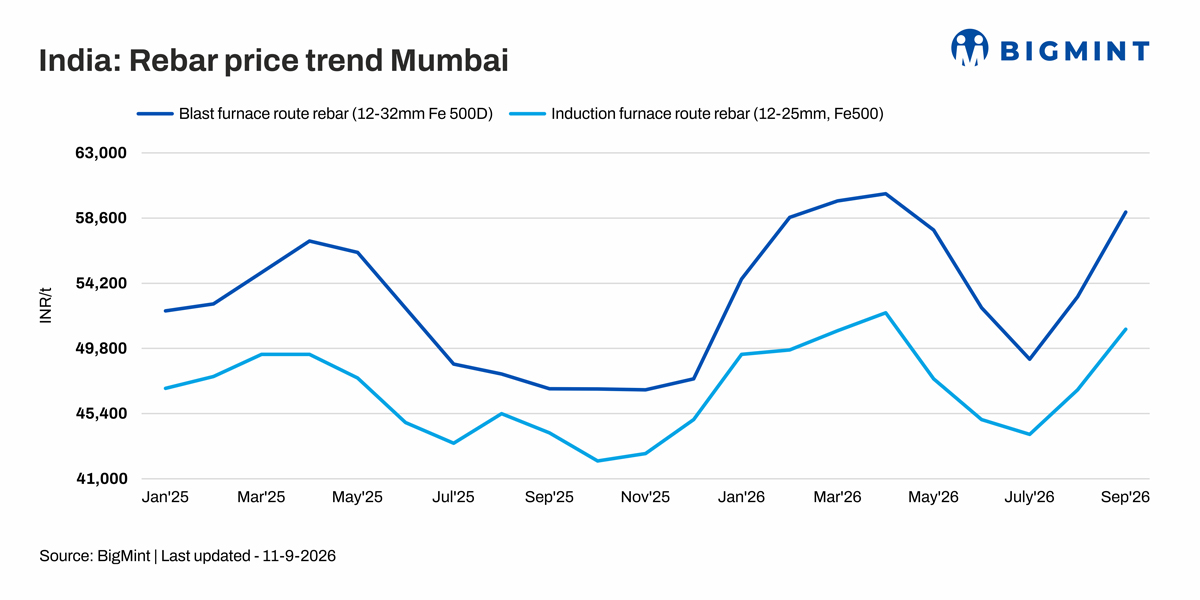
Data Deep Dive: India’s rebar prices are expected to extend their August rally in September, with blast furnace (BF)-route prices likely to rise by INR 3,000-4,000/tonne (t) and induction furnace (IF)-route prices by INR 2,000-3,000/t across regions, according to BigMint’s projections.
Tight primary steel availability, continued maintenance downtime, higher raw material costs, and the gradual resumption of construction activity after the monsoon are expected to keep the market firm in September. Notably, India’s total rebar production declined by 6% y-o-y to 4.1 million tonnes (mnt) in July, following a 2% drop in June. This marks the first time rebar production has declined y-o-y since November 2024, though the decline then had been a marginal 0.5%.
The stronger increase expected in the BF segment could widen the IF-BF price differential, while post-monsoon construction activity and retail restocking will determine how much of the producers’ higher offers can be passed through to the market.

IF-route rebar: another INR 2,000-3,000/t increase expected
Sponge iron costs have provided an additional floor. Benchmark Indian sponge iron prices reached a two-year high of INR 29,700/t exw-Raipur at the end of August, with higher imported coal costs and tight domestic coal availability pushing up production costs.
Domestic scrap economics have also remained supportive, with imports falling to a five-year low of 2.73 mnt in January-July 2026, down by 42% y-o-y. Consequently, HMS 80:20 prices at Mandi Gobindgarh averaged around INR 36,300/t DAP in August, up around INR 1,800/t m-o-m.

The widening BF-IF price differential also provides additional headroom for IF mills to raise finished steel offers. Current price gaps stand at around INR 6,700/t in Mumbai, INR 10,200/t in Raipur, and INR 10,500/t in Durgapur, providing IF mills with considerable room to increase offers while retaining a price advantage over BF-route material. Generally, the BF-IF rebar price gap stands at around INR 7,000/t in scrap-based markets and INR 8,000-10,000/t in sponge iron-based markets.
As a result, BigMint expects IF-route rebar prices to increase by INR 2,000-3,000/t in September. The expected increase is smaller than August’s move because the market has already absorbed a substantial part of the recent cost inflation, and buyers are likely to become more price-sensitive at higher levels. Additionally, a slew of festivals in September may interrupt trading activity and slow price gains.
BF-route rebar: tighter supply supports larger increase
BF-route rebar is expected to see a stronger increase of INR 3,000-4,000/t in September. The main difference from the IF segment is the extent of supply-side support currently visible in the primary market.
Several integrated steel producers have undertaken maintenance shutdowns, while some plants are only gradually returning to normal operations. This has reduced spot availability and allowed mills to maintain higher offers. Mills have increased list prices by up to INR 4,500/t for September deliveries.
According to data maintained by BigMint, RINL’s production fell 85% y-o-y to merely 23,000 t during July, shrinking even further from the already-low levels of 41,000 t and 62,000 t during June and May, respectively, due to issues with its coke oven. Earlier, in FY’26, RINL’s production had averaged 138,500 t each month. Even Tata Steel reduced production by 13% y-o-y in July, while JSW Steel’s was lower by 8%.
Consequently, mill inventories have declined sharply, at around 2-5 days in the first week of September. Some mills have also halted fresh bookings for projects amid limited inventories.
Additionally, Australian premium hard coking coal prices surged by $46/t m-o-m to an average of $300/t CNF Paradip till 10 September, the highest since February 2024. With Chinese demand strengthening amid domestic supply constraints, coking coal prices may remain elevated throughout September.
Outlook
While both IF and BF rebar prices are set to rise this month, festival-related disruptions could temporarily slow trade activity and delay the pass-through of higher mill offers. Market closures, reduced operating activity, and slower procurement around the Ganpati and Vishwakarma periods may weigh on spot transactions in some regions. However, this is unlikely to necessarily translate into a price correction, particularly if construction and retail demand strengthen after the festival period.
Beyond September, the sustainability of higher rebar prices beyond September will depend less on cost inflation alone and more on whether stronger construction activity can absorb the higher price levels. A sustained improvement in project execution and retail demand would provide a stronger foundation for prices, while a supply-led rally without corresponding demand growth could become harder to extend.

Leave a Reply