- Chinese domestic prices rise another 5-6% w-o-w
- Lower Indonesian exports push Indian portside prices to multi-year highs
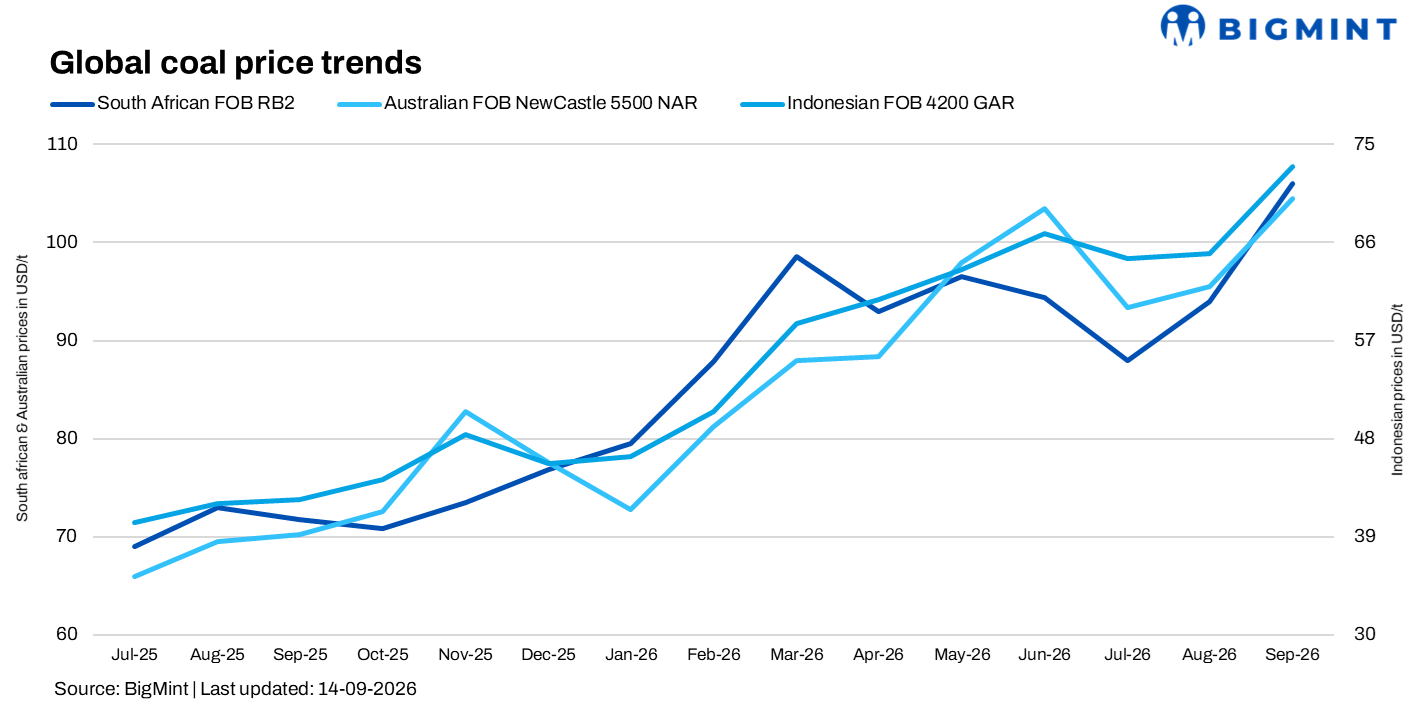
Asian thermal coal prices remained elevated in the week ended 11 September 2026, supported by Chinese domestic tightness, reduced Indonesian availability and higher energy and freight costs. However, slowing Chinese procurement and cautious Indian buying indicated that the rally was entering a more price-sensitive phase.
Key price movements

China rally continues, but buyers turn cautious
QHD prices rose across all grades, with 5,500 NAR approaching RMB 1,000/t and 6,000 NAR reaching RMB 1,088/t. Earlier restocking and domestic supply concerns supported the rally, but utilities became more cautious as seasonal consumption began easing.
Numerous import offers were recorded but no tender awards were reported for a third consecutive week. This does not establish that tenders failed, but it indicates buyer resistance and incomplete price discovery.
South China offers for Indonesian 3,800 NAR coal narrowed to RMB 678-696/t, suggesting convergence around RMB 680-690/t. However, the absence of awards leaves actual clearing values uncertain.
Chinese coastal freight declined, cushioning southern buyers from higher northern prices. QHD-Shanghai freight fell to $3.78/t from $4.63/t, while QHD-Guangzhou dropped to $6.20/t from $6.90/t. This improved domestic coal’s competitiveness against imports.
Russian cargoes provide potential price ceiling
Two Russian 6,000 NAR cargoes traded at $126/t and $128/t CFR China for October delivery, with taxes payable by the buyer.
The prices remained competitive against QHD 6,000 NAR, even after allowing for tax. Although two transactions are insufficient to classify Russia as a swing supplier, sustained Russian flows could moderate Chinese import prices and cap further gains.
Lower Indonesian exports tighten availability
Indonesian supply remained constrained by production controls, export oversight and logistics disruptions caused by low river levels and forest fires. Indonesia’s non-coking coal exports fell to 26.95 Mnt in August, down 16.1% y-o-y and 5.7% m-o-m.
Reduced availability strengthened sellers’ bargaining position. Indonesian 4,200 and 5,000 GAR coal at Indian ports reached around four-year highs, while 3,400 GAR ex-Navlakhi touched an assessment high.
India’s port inventories edged up only 0.6% w-o-w to 13.48 Mnt, while power-plant stocks fell around 7% to 25.8 Mnt as of 9 September. Nearly 59 plants reportedly held critical inventories.
Despite this, Indian buying remained need-based. Consumers preferred cost-competitive 3,400 GAR coal and resisted higher offers, limiting broader restocking.
South African coal strengthens despite Indian caution
South African RB2 prices reached around INR 13,200/t ex-Paradip and INR 13,100/t ex-Vizag. However, buyers resisted offers of approximately INR 13,500/t at Paradip.
India’s South African coal imports fell 42% m-o-m to 1.1 Mnt in August. Reduced availability supported portside prices, while stronger demand from Pakistan and South Korea diverted cargoes from India.
South African exports reached 5.49 Mnt in August, up 8.1% y-o-y, as improving rail performance supported shipments. Further logistics recovery could increase export availability, although competition from other Asian buyers should keep prices supported.
Outlook
Asian thermal coal prices should remain firm due to constrained Indonesian supply, low Indian power-plant inventories and elevated Chinese domestic prices.
However, cautious Chinese procurement, affordability concerns in India, lower Chinese coastal freight and competitive Russian cargoes could limit further gains.
BigMint assessment: The market remains supply-supported, but confirmed purchases–not seller offers–will determine whether the rally extends. Without stronger tender awards and Indian restocking, prices may consolidate near current elevated levels.
Leave a Reply