- Zinc leads LME declines; copper, aluminium also retreat
- Chinese aluminium stocks fall as seasonal demand improves
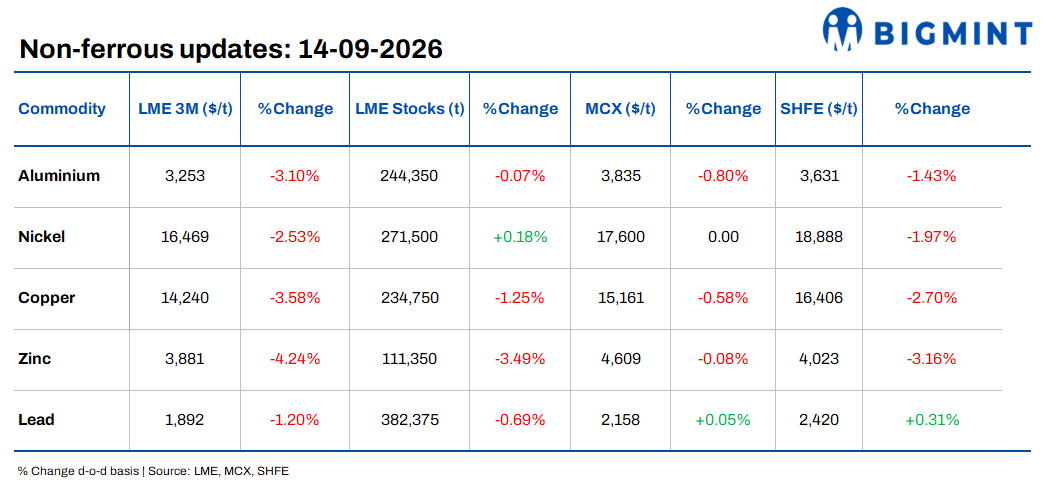
LME base metals traded lower on 11 September. Zinc recorded the sharpest decline, falling 4.24% d-o-d to $3,881/t, followed by copper, down 3.58% to $14,240/t, and aluminium, which slipped 3.10% to $3,253/t. Meanwhile, nickel eased 2.53% to $16,469/t, while lead declined 1.20% to $1,892/t.
The weaker LME performance came amid renewed concerns over energy supply disruptions in the Middle East. However, tighter aluminium availability in China and falling inventories continue to provide fundamental support, partly offsetting broader macroeconomic pressure.
LME inventories recorded mixed trends d-o-d, with most base metals posting declines. Zinc stocks recorded the steepest fall of 3.49% to 111,350 t, followed by copper, which declined 1.25% to 234,750 t. Lead inventories fell 0.69% to 382,375 t, aluminium stocks eased 0.07% to 244,350 t, while nickel inventories rose 0.18% to 271,500 t.
Domestic market overview
India’s non-ferrous scrap market was largely stable on 11 September. Aluminium tense scrap (loose) remained unchanged at INR 253,000/t ex-Delhi and INR 247,000/t ex-Chennai.
Meanwhile, aluminium P1020 ingot remained unchanged at INR 357,000/t ex-Delhi NCR. MCX aluminium declined 0.80% d-o-d to $3,835/t. However, stable domestic aluminium prices contrasted with the decline in international markets, as physical availability remained relatively steady.
Copper armature scrap (Cu 99%), ex-Delhi, declined by INR 12,000/t, or 0.9%, to INR 1,328,000/t from INR 1,340,000/t. Meanwhile, MCX copper fell 0.58% d-o-d to $15,161/t. The decline in domestic copper scrap prices tracked weaker international and futures markets.

Other updates
Middle East supply disruption pushes oil above $106/bbl
Renewed attacks on Saudi Arabia and shipping routes around the Strait of Hormuz have intensified concerns over global energy supplies, lifting Brent crude to around $106.99/bbl. Drone attacks disrupted Saudi Arabia’s East-West pipeline, which can transport about 4 million barrels/day to the Red Sea. The disruption could put up to 4% of global oil supply at risk if prolonged. Consequently, higher energy and logistics costs could raise production expenses for aluminium and other non-ferrous metals.
China aluminium market faces tighter supply, improving demand
China’s aluminium market is entering September with tighter spot availability and falling inventories. Aluminium ingot stocks in major consuming regions declined from around 1.13 mnt in early July to about 850,000 t by end-August. Meanwhile, wire and cable activity strengthened, with the purchasing managers’ index (PMI) reaching 54.5, supported by power-grid orders and pre-season stockbuilding. However, aluminium prices above RMB 24,000/t (3578 $/t) have made downstream buyers more cautious.
Odisha hands over 7,000 acres for Adani-IRH aluminium project
The Odisha government has handed over documents covering more than 7,000 acres for the proposed Adani Enterprises-International Resources Holding integrated aluminium project. The $11.5 billion development will include a 4 mnt/year alumina refinery, 2 mnt/year aluminium smelter, 4,000 MW captive power plant, and 1 mnt/year downstream manufacturing park. However, the project’s market impact is expected to remain limited in the near term because the additional smelting capacity will come online over several years.
Rio Tinto secures Indigenous consent for Winu copper-gold project
Rio Tinto has secured Indigenous consent from the Nyangumarta Warrarn Aboriginal Corporation for its Winu copper-gold project in Western Australia. The company owns 70% of the project, with Sumitomo Metal Mining holding the remaining 30%, while first production is targeted around 2030, subject to approvals and a final investment decision. The development could add new copper supply over the longer term. However, its immediate price impact is limited because production remains several years away.
Leave a Reply