- Raw material costs stay firm, limiting steel price downside
- Weak demand, inventory pressure keep sentiment cautious
Chinese finished steel prices declined w-o-w on 12 September 2026 amid slower demand and weak market activity. However, raw material prices continued to strengthen, limiting the price drop.
The China Iron and Steel Association (CISA) reported that total steel inventories at key CISA-affiliated mills stood at around 16.25 million tonnes (mnt) during late August (21-31 August 2026), marking a decrease of 2.08 mnt or 11.4% from 18.33 mnt in mid-August. Moreover, inventory levels marginally dropped by 30,000 tonnes (t) or 0.2% m-o-m from 16.28 mnt recorded in the same period last month.
However, despite the inventory reduction, operating pressure on CISA-affiliated mills remained high, as the slow recovery in domestic demand continued to restrict market activity.
Steel price trend
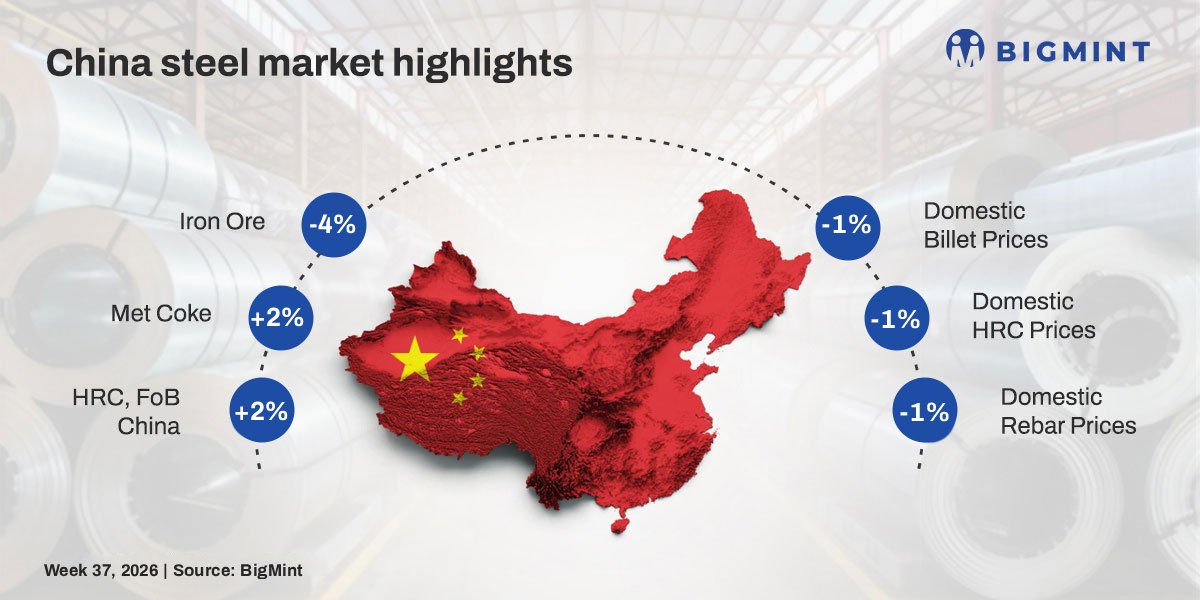
Domestic HRC prices drop: China’s domestic hot-rolled coil (HRC) prices declined by RMB 20/t ($3/t) w-o-w to around RMB 3,260/t ($486/t) as on 11 September, compared with RMB 3,280/t ($489/t) a week earlier. Furthermore, SHFE HRC futures (October 2026 contract) were down by RMB 56/t ($8/t) to RMB 3,315/t ($494/t) from RMB 3,371/t ($502/t) in the previous week.
China’s domestic HRC prices declined during the week as weaker futures, falling coking coal and coke prices, and limited demand weighed on market sentiment. Although the latest round of coking coal price increases was implemented, it could not stop the overall decline in raw material prices.
At the same time, HRC supply remained firm while demand was slow to improve, keeping inventory pressure high. In the spot market, traders became more cautious, with some offering lower prices to clear stocks. Downstream buyers continued to purchase only as needed and were unwilling to build inventory. As a result, high-priced material saw weak trading, while only lower-priced offers attracted some buying interest.
At the same time, Baosteel, the world’s leading steel producer, has increased its domestic HRC prices by RMB 200/t ($30/t) m-o-m for October 2026 sales, amid higher raw-material costs and expectations of a gradual improvement in demand during the traditional “Golden September and Silver October” period.
The increase comes amid higher coking coal costs, which have raised steelmaking expenses and provided stronger cost support to finished steel prices. With input costs rising, mills are seeking higher realisations to offset the increase in production costs.
Furthermore, Chinese HRC export offers increased by $10/t w-o-w to around $510/t FOB, compared with $500/t in the previous week.
Rebar prices decline w-o-w: China’s domestic rebar prices decreased by RMB 30/t ($4/t) w-o-w to around RMB 3,190/t ($476/t) on 11 September from RMB 3,220/t ($480/t) in the previous week. Furthermore, SHFE rebar futures (October 2026 contract) were down by RMB 58/t ($9/t) at RMB 3,044 /t ($454/t) from RMB 3,102/t ($463/t) in the previous week.
China’s rebar prices declined this week amid weak demand, rising costs and continued inventory pressure. Blast furnace operating rates edged lower as mills brought forward maintenance and reduced output to limit losses.
The fifth round of coking coal price increases further raised production costs, while subdued construction demand limited mills’ ability to pass on higher costs. Despite a slight decline in social inventories, steel mill stocks remained elevated. Pressure on futures prices also added to the weak market sentiment.
China’s Shagang Steel has raised its long steel prices by RMB 50-150/t ($7-22/t) for sales during 11-20 September 2026. The producer increased its rebar (16-25 mm) price by RMB 50/t ($7/t) to RMB 3,300/t ($492/t), while coiled rebar (8-10 mm) and wire rod (6-10 mm) prices were raised by RMB 150/t ($22/t) each to RMB 3,430/t ($511/t) and RMB 3,340/t ($498/t), respectively.
Wider mill losses have prompted some producers to undertake blast-furnace maintenance and reduce output.

Raw materials prices
Iron ore spot prices drop w-o-w: Iron ore fines benchmark prices of Fe 61% inched lower by $4/t w-o-w to $96/dmt CFR China on 11 September 2026. Prices fell amid geopolitical uncertainty, which raised crude oil prices and freights.
Buyers mostly adopted a wait-and-watch approach, with mills not yet starting large-scale restocking for upcoming holidays. Most participants procured on immediate need basis, avoiding any aggressive buying.
Moreover, rising coke costs too may compell industry for production cuts to sustain working margins.
a) Spot pellet premium stable w-o-w: The spot pellet premium for Fe 65% grade pellet remained firm w-o-w at $25.85/t CFR China on 9 September.
b) Spot lump premium softens w-o-w: The spot lump premium edged lower by $0.0025/t w-o-w to $0.2450/t CFR China on 11 September.
Seaborne coal strength, tight coke supply keep market firm: China’s coking coal and met coke markets remained firm, supported by tight raw-material availability, recovering mine output, low coke inventories, and steady steel demand. Domestic met coke prices rose by RMB 100-110/t following the fifth round of price hikes, providing some relief to producers amid elevated input costs. However, maintenance-related steel production cuts and weaker mill margins may limit further price gains, keeping the near-term market outlook firm but measured.
Australian PHCC FOB prices increased by $9/t w-o-w to around $285/t, while BigMint’s PHCC index rose $7/t w-o-w to $306/t CNF Paradip on 11 September. Elevated seaborne coal costs, strong Chinese buying, higher freight rates and tight Indonesian met coke availability are expected to keep replacement costs elevated, although steel-mill maintenance and weaker margins may limit further price gains.
Billet prices ease w-o-w as demand remains subdued: Chinese billet prices declined w-o-w amid subdued demand and weaker market sentiment, while firm raw-material costs provided some downside support. Export offers, meanwhile, increased as mills remained reluctant to lower prices amid rising logistics costs.
Standard billet prices at Tangshan Qian’an fell to RMB 3,000/t ($446/t) on 11 September from RMB 3,040/t ($453/t) on 4 September, down RMB 40/t ($7/t) w-o-w.
Firm raw-material costs and an uncertain October demand outlook continued to pressure mill margins.
Billet export offers rose to $470/t FOB from $466/t FOB on 4 September. Export activity remained subdued, while port congestion and higher freight costs supported firmer seller offers despite limited overseas buying interest.
Outlook
Chinese steel prices are expected to remain weak and volatile next week. While cost and macroeconomic support persist, the expected peak-season demand recovery has yet to improve the supply-demand balance. Rising inventories and cautious downstream buying may continue to weigh on prices.
Escalating geopolitical tensions in the Middle East and rising risks to Red Sea shipping is also expected to pressure the domestic steel market next week. While China’s release of the “15th Five-Year Plan” for building a strong financial nation and continued policy-driven financial support are likely to provide some stability to investment, market transactions remain mixed. At the same time, supply growth is showing signs of weakening, while firm raw material costs continue to provide support to steel prices.
If output cuts intensify, supply pressure could ease; otherwise, elevated inventories and weaker raw material demand may further limit steel prices.
Leave a Reply