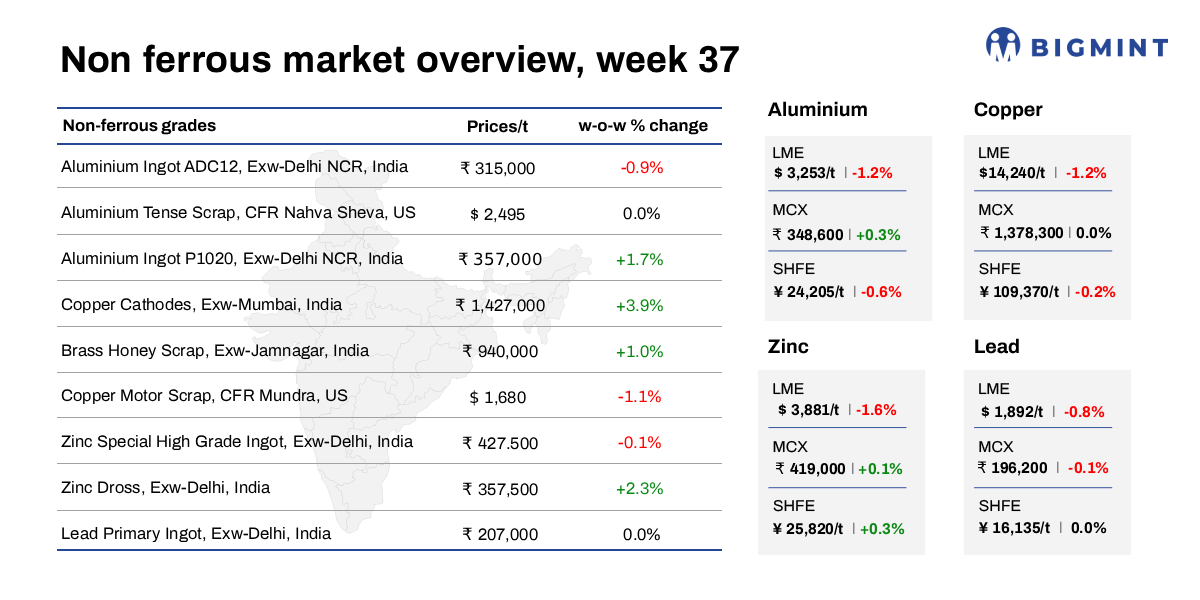
- LME base metals declined, led by zinc and aluminium
- Domestic base metals strengthened, indicating firm demand
LME base metals traded lower during the week ended 11 September, with zinc recording the steepest decline of 1.6% w-o-w to $3,881/t. Aluminium and copper prices fell 1.2% each to $3,253/t and $14,240/t, respectively, while lead declined 0.8% to $1,892/t.
LME base metals declined amid a firmer dollar, rising bond yields and broad risk-off sentiment as the Middle East conflict pushed oil prices above $100/bbl and revived inflation concerns. Profit-taking after recent rallies in copper and zinc, coupled with concerns over weak Chinese domestic demand and uncertainty around US copper tariffs, added to the downward pressure.
LME inventories showed a mixed trend. Lead stocks recorded the sharpest decline, falling 3.6% to 382,375 t. Aluminium inventories decreased 0.7% to 244,350 t, while copper stocks were broadly stable at 234,750 t. In contrast, zinc inventories increased 0.8% to 111,350 t.
Aluminium
India’s aluminium market strengthened during the week, with domestic primary and imported scrap prices increasing despite weaker LME aluminium prices.
According to BigMint’s assessment, UK-origin Zorba 95-5 scrap prices increased by $15/t (0.5%) w-o-w to $2,800/t. P1020 aluminium ingot prices in Delhi NCR rose by INR 6,000/t (1.7%) w-o-w to INR 357,000/t.
The divergence between domestic and LME prices reflects firmer Indian market conditions. Despite the 1.2% decline in LME aluminium to $3,253/t, low LME stocks and continued tightness in global availability limited downside, while high Chinese smelter utilisation raised supply concerns.
Imported aluminium scrap prices are expected to remain firm in the near term, supported by tight availability and healthy demand. However, improved imports from Safe Countries and cautious downstream buying may limit further gains. Domestic Tense demand could gradually improve as ADC12 inventories decline and September procurement picks up.
Copper
India’s copper market remained firm during the week, with both scrap and refined copper prices recording gains.
Copper armature scrap prices ex-Delhi increased by INR 22,000/t (1.7%) w-o-w to INR 1,328,000/t. Copper cathode prices ex-Mumbai recorded a sharper increase of INR 53,000/t (3.9%) to INR 1,427,000/t.
Domestic copper prices strengthened despite a 1.2% decline in LME copper prices, supported by tight scrap availability and firm underlying demand from the wire, cable and electrical sectors. However, elevated LME prices and ongoing volatility are keeping buyers focused on immediate requirements. Recent uncertainty over US copper tariffs has also weighed on global prices, which could improve affordability and procurement interest if the correction persists.
Tighter global scrap availability and diversion of material to higher-paying destinations may continue to support prices, while greater clarity on US tariff policy and improved import parity could support procurement and market sentiment in the coming weeks.
Zinc & lead
India’s zinc dross and zinc oxide prices increased w-o-w, supported by firm domestic demand and higher prices across zinc products.
According to BigMint’s assessment, zinc dross prices ex-Delhi increased by INR 8,200/t (2.4%) w-o-w to INR 357,500/t. Zinc oxide (99% Zn) prices increased by INR 10,800/t (3.3%) w-o-w to INR 340,800/t.
Meanwhile, Hindustan Zinc Ltd (HZL) raised its benchmark Special High Grade (SHG) zinc ingot price by INR 12,300/t to INR 437,400/t on 10 September, from INR 425,100/t previously. HZL also increased its benchmark lead ingot (99.99%) price by INR 400/t to INR 212,200/t from INR 211,800/t.
The rise in secondary prices was supported by higher primary replacement costs. Although LME zinc inventories have increased, the widening cash to 3-month backwardation indicates relatively tight nearby supply. This, along with firmer domestic SHG values, is likely to keep zinc and lead prices supported in the near term. However, continued inventory builds could limit further upside if international prices weaken.
Leave a Reply