- US steam coal exports rise despite declining domestic production
- Global petcoke market firms as export availability tightens
The US thermal coal and petroleum coke markets are tightening simultaneously, creating a difficult fuel-procurement environment for Indian cement producers.
US domestic coal consumption is declining, but export availability has not loosened materially because overseas demand is strengthening. At the same time, petroleum coke — another major US export fuel — has become more expensive as international buyers compete for available cargoes.
For India, this means cement producers cannot easily escape expensive petcoke by switching to US Northern Appalachian (NAPP) coal because NAPP itself has become scarce and costly.
The market is increasingly being determined by which high-calorific-value fuel offers the lowest delivered energy cost.
US exports rise despite lower coal production
The US Energy Information Administration expects US coal production to decline 2.3% y-o-y to 516.3 million short tons in 2026, while power-sector coal demand falls around 8%.
Exports are moving in the opposite direction.

Falling domestic demand is therefore releasing tonnes for export, but stronger international buying is absorbing this supply rather than pushing prices lower.
Northern Appalachian production also remains below last year’s pace, limiting the availability of the high-CV coal particularly valued by cement producers.
Petcoke supply-demand balance also tightens
The US petroleum coke market is similarly export-oriented.
EIA data show marketable petcoke production at around 106.6 million barrels during Jan-Jun 2026, while exports reached approximately 95.4 million barrels over the same period. Timing differences and inventory movements mean the two figures should not be treated as a direct ratio, but they underline how dependent the market is on overseas demand.
June refinery stocks stood at only around 5.31 million barrels, small relative to monthly production.
This leaves the market vulnerable to changes in refinery operations, crude slates and international buying.
Global demand is also diversified. US fuel-grade petcoke is consumed by cement and industrial users across India, the Mediterranean, Latin America and Asia, meaning Indian buyers are competing with several markets for the same pool of export cargoes.
India petcoke demand falls, but not necessarily because fuel requirements have disappeared
Indian consumption has already responded to tighter availability and higher prices.
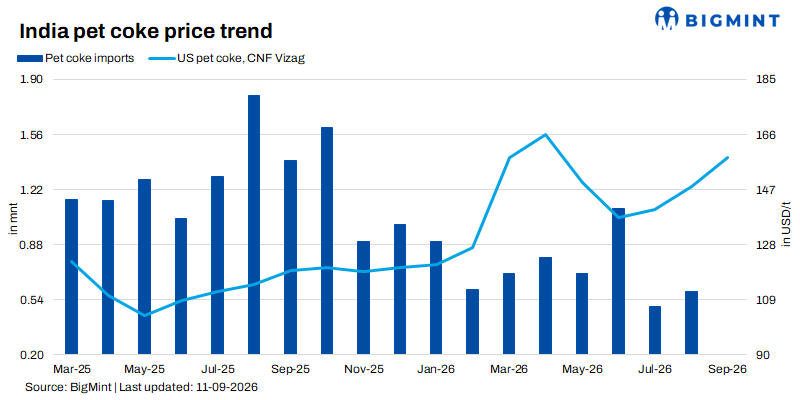
Petcoke consumption during April-August FY27 fell to 6.82 mnt from 8.84 mnt a year earlier, while imports during April-July declined to 2.20 mnt from 3.82 mnt.
August imports were approximately 0.6 mnt, versus 1.8 mnt in August 2025.
The decline should not be read simply as weaker cement demand. Tight seaborne availability and higher prices have forced producers to draw on inventories, consume more domestic petcoke and increase coal substitution where technically possible.
India offers move towards $160/t
BigMint market feedback shows imported petcoke values moving firmly higher.

Buyer behaviour is revealing.
Nuvoco Vistas indicated offers around $160/t but had previously secured material closer to $140/t and was also consuming domestic petcoke. Ramco Cements indicated comfort using US NAPP coal when petcoke moved into the mid-$150s. Orient Cement described petcoke as very firm and was waiting for a correction because US coal had also risen.
By 10 September, JK Lakshmi was hearing imported petcoke above $160/t while noting that US coal was also difficult to source.
This demonstrates that cement companies are treating petcoke and NAPP as part of the same fuel-arbitrage decision.
NAPP no longer offers easy relief
NAPP remains attractive because of its high calorific value and sulphur characteristics, which allow it to substitute petcoke in suitable cement kilns.
But its economics have deteriorated.
US East Coast-to-India freight was around $52/t in early September, while market feedback suggests some US suppliers are discussing around $115/t FOB for Q1 2027, with limited forward availability.
Indian portside stocks are also falling rapidly.

Combined stocks have fallen nearly 48% in two weeks. Yet scarcity has not generated aggressive restocking because ex-wharf prices have moved towards INR 17,000-18,000/t.
ILB coal offers some relief, with recent Indian indications around INR 13,000-13,500/t, but lower CV and different sulphur and ash characteristics mean it cannot replace NAPP or petcoke for every user.
Post-monsoon buying could become the next test
The Indian retail market is relatively subdued during the monsoon, but inventories are already declining.
That creates a potential mismatch.
If cement and industrial fuel demand recovers from October while NAPP stocks remain depleted, buyers could return just as US prompt availability tightens.
The same applies to petcoke. India may need to compete more aggressively with other global consumers precisely when domestic refinery supply remains constrained and international cargo availability is limited.
BigMint view
The key feature of the current market is that US thermal coal and petcoke are no longer giving Indian cement producers an obvious escape from one another.
Normally, expensive petcoke encourages switching towards NAPP. Expensive coal can push users back towards petcoke. Today, both markets are firm.
US coal production is declining while steam coal exports rise. Petcoke remains highly dependent on international demand and carries only a modest refinery-stock buffer. Meanwhile, Indian NAPP stocks have almost halved in two weeks.
India still represents important underlying demand, but cement buyers are showing strong price discipline by drawing down inventories, using domestic petcoke and optimising coal blends instead of accepting every higher offer.
The critical period is likely to come after the monsoon.
If industrial demand rebounds while NAPP stocks remain low and petcoke availability stays tight, Indian cement producers could be forced back into both markets simultaneously.
At that point, the issue will no longer simply be petcoke versus coal. It will be a broader competition for a limited pool of high-CV US fuel supply.
Leave a Reply