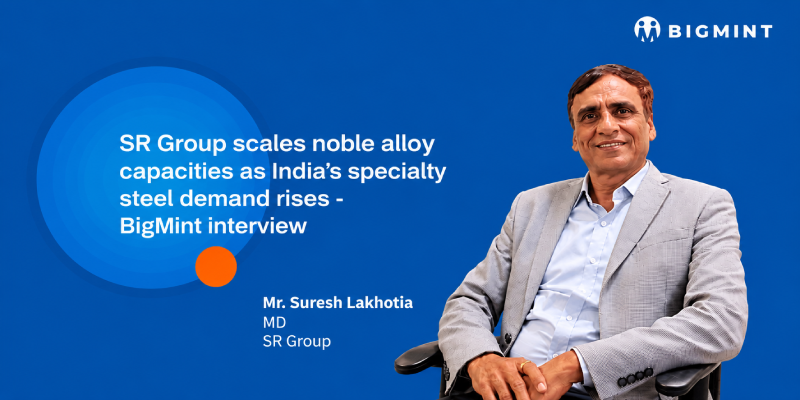
- Ferro molybdenum capacity to double to 3,600 t/year on rising demand
- Exports, value addition, technology to drive next phase of growth
As India’s steel industry moves towards higher-strength, specialised and value-added steel grades, noble ferro alloys are expected to play an increasingly important role in meeting evolving quality requirements. SR Group is strengthening its presence in this segment through capacity expansion, technology adoption, and a growing focus on global markets.
In this interview, Suresh Lakhotia, Managing Director, SR Group, who completes 50 years in this business in 2026, shares his views on his entrepreneurial journey, the group’s growth vision, noble ferro-alloy capacity expansion, ferro molybdenum and ferro vanadium demand, export opportunities, raw-material security, pricing trends and the outlook for the Indian ferro-alloys industry. His journey spans from founding Shree Ram Lime Products in 1991 to building a diversified group serving the steel, paper, aluminium, and chemical industries.
As you complete 50 years in the noble ferro alloys business, what have been the most defining milestones and biggest lessons from your entrepreneurial journey?
Ans: Looking back at 50 years, the journey has been shaped by important decisions, challenges, and relationships.
I began my professional journey in 1976 with Bihar Alloys Steel Ltd., working across marketing, planning, and procurement. Those 12 years gave me a strong foundation in understanding business, customers and the importance of integrity.
In 1991, I founded Shree Ram Lime Products with a single lime plant in Borunda, Rajasthan, which gradually expanded to Dausa, Hospet, Pune, and Visakhapatnam. A major milestone came in 2007 when we established our Pune manufacturing base and entered ferro molybdenum, followed by low-carbon ferro chrome and ferro vanadium. Today, our products reach customers across India and markets including Oman, Japan, Korea and the US, with further expansion into Europe.
Our current product portfolio includes ferro alloys (including ferro molybdenum, ferro vanadium, fluxes (fluorspar powder, lumps, and briquettes), and allied minerals and chemicals (calcined/hydrated lime, calcined dolomite, dolomite stone powder, and amorphous graphite).
The biggest lesson I have learned is that business is ultimately about trust. Integrity, long-term relationships, adaptability and innovation remain timeless. The next chapter is about strengthening our manufacturing capabilities, expanding our global footprint and creating long-term value across the metals and ferro-alloys ecosystem.

Looking ahead, what is your vision for SR Group over the next decade, particularly for its noble alloys business and global presence?
Ans: Our vision is to position SR Group as a strong, technology-driven and globally competitive player in the minerals, fluxes and noble ferro-alloys value chain.
For noble alloys, we will focus on value-added and specialised products, stronger manufacturing capabilities, process technology and consistent quality. Our aim is to become a reliable technical and supply-chain partner to steelmakers.
We already serve Oman, Japan, Korea, and the US and are expanding into Europe. We want to demonstrate that Indian manufacturers can compete globally on quality, technology, consistency and reliability. Innovation and efficient management of the entire value chain — from raw materials to logistics — will remain key priorities.
Our ambition is to build the group towards INR 2,031 crore turnover by 2031, with success measured not just by turnover but also by customer quality, manufacturing strength and global reach. In summary, our vision is value addition, technology, globalisation and sustainable growth.
What role will noble alloys play in SR Group’s future growth, and are there plans for capacity expansion or new products?
Ans: Noble alloys will be a key part of SR Group’s next phase of growth, driven by rising demand for specialised and higher-performance steel grades.
Our ferro molybdenum capacity is currently 1,800 t/year, which we plan to expand to 3,600 t/year with zero-pollution technology. Ferro vanadium production is being increased from 20 t/month to 50 t/month.
We are also starting low-carbon ferro chrome production with an initial capacity of 100 t/year.
On product development, we are working on aluminium-based products and casting fluxes for the steel and foundry industries. Our focus is not just higher capacity, but consistent quality, reliable supply, value addition and technology. These initiatives will strengthen our domestic and international presence.
SR Group already serves export markets and is looking to expand its international presence. How important will exports be in the company’s next phase of growth?
Ans: Exports will be a key growth driver for SR Group over the next decade. We already serve Oman, Japan, Korea and the USA and are expanding into Europe, where we have also started export operations.
Global customers expect consistent quality, precise specifications, reliable supply and timely delivery. Our focus is therefore on building capabilities to compete on these parameters. We aim to position SR Group as a globally competitive Indian supplier of value-added minerals, fluxes and ferro alloys, with noble alloys becoming an important part of our international portfolio.
Our manufacturing, mining and logistics capabilities provide a strong foundation for this expansion. Ultimately, we want international customers to associate SR Group with quality, dependable supply and long-term partnership.
Ferro molybdenum prices have remained firm recently. What are the key factors driving the market, and how sustainable are current price levels?
Ans: Ferro molybdenum prices are being supported by raw material availability, production economics, steel demand and the supply-demand balance. The key factor is the availability and cost of molybdenum raw materials, while demand from alloy and speciality steel segments remains important.
Although current firmness has fundamental support, ferro-alloy markets are cyclical, and prices can change quickly with shifts in supply and demand. Producers should focus on managing volatility through efficient production, consistent sourcing, inventory discipline and strong customer relationships.
We remain positive about long-term ferro molybdenum fundamentals, supported by specialised and high-performance steels, although some price volatility should be expected.
How do you see global molybdenum prices and raw-material costs evolving over the next six months, and what could this mean for India?
Ans: Predicting six months ahead in molybdenum is difficult, but we expect the market to remain stable over the next three months. Key factors will be concentrate availability, Chinese production and demand, global steel consumption and downstream buying activity.
For Indian producers, this reinforces the importance of efficiency, value addition and securing raw materials effectively, along with maintaining consistent ferro molybdenum quality.
How do you see demand for ferro molybdenum growing in India, particularly from the stainless and speciality steel sectors?
Ans: Current Indian ferro molybdenum demand is around 2,500-3,000 t/month, and we expect it to reach around 4,000 t/month next financial year, supported by rising stainless steel consumption. This supports our planned capacity expansion from 1,800 t/year to 3,600 t/year, positioning us for growth in India’s stainless, alloy and speciality steel sectors as well as international markets.
What is your outlook for the Indian ferro vanadium market, and what will be the key drivers of future demand?
Ans: I am positive about the long-term outlook for ferro vanadium in India. Demand will be driven by both steel production growth and the shift towards higher-strength, value-added and specialised steels. Infrastructure, automotive, engineering and forging growth will further support demand.
Our ferro vanadium production is currently 20 t/month and is expected to increase to 50 t/month. Supply security will also become increasingly important, with customers seeking consistent chemistry, tight specifications, reliable deliveries and competitive pricing.
Overall, I see ferro vanadium as a structural growth story, supported by India’s transition towards higher-strength and specialised steel grades.
Can India become more self-reliant in noble ferro alloys? What are the biggest challenges and opportunities for domestic producers?
Ans: Yes, self-reliance is the end goal, and we are seeing a gradual shift through backward integration in raw material processing and distribution. The biggest challenge is raw-material security, along with India’s exposure to USD movements. We mitigate this through advance dollar booking for price predictability and increasing export orders.
India should look beyond import substitution. With the right combination of raw-material security, technology, scale, quality and cost competitiveness, we can build a strong export-oriented noble ferro-alloys industry. With India’s growing steel and manufacturing base, developing the supporting alloy and raw-material industries will be critical to achieving greater self-reliance.
Leave a Reply