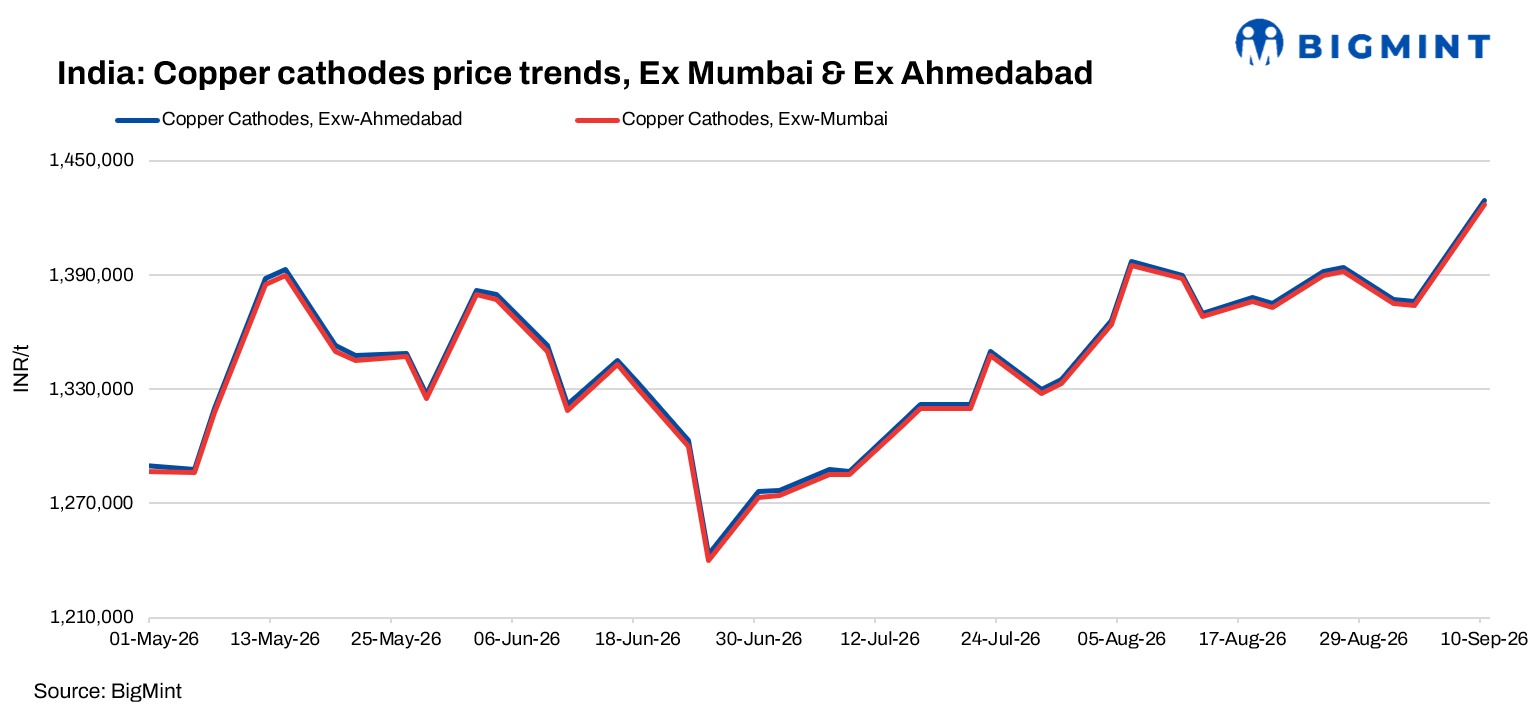
- Cathode prices in western India rises as LME copper reaches record high
- Indian cathode copper production falls 1.5% m-o-m in June to 64,000 t
Copper cathode prices in western India rose w-o-w as global and domestic copper benchmarks strengthened. LME copper reached a record high of $14,768/t on September 9. Higher MCX futures and domestic replacement values also lifted Indian prices.
According to BigMint’s assessment, domestic cathode prices increased by around 3.86% w-o-w. Ex-Mumbai prices rose to around INR 1,427,000/t from INR 1,374,000/t a week earlier, while ex-Ahmedabad prices increased to INR 1,429,000/t from INR 1,376,000/t. while MCX copper futures also moved higher, with prices rising to around INR 1,426,650/t from INR 1,375,100/t a week earlier, marking an increase of INR 51,550/t, or 3.75% w-o-w.
However, market participants said buying interest remained relatively muted. Buyers have been reluctant to chase the rally and are relying on inventories accumulated during earlier purchases. Consequently, most transactions have been limited to immediate requirements.
Japanese cathode premiums ease as price rally slows buying
Japanese cathode premiums for delivery to India have also eased. Sellers reported premiums at around $300/t, down from levels above $400/t earlier. Some May deals were concluded at around $270/t.
Trading activity has resumed following the recent festival period, but market liquidity remains limited because of a wide bid-offer gap. Sellers are using the latest LME rally to justify higher offers, while buyers remain hesitant to commit to fresh volumes amid expectations of a potential price correction.
Visible copper availability also remains a key market factor. On-warrant LME copper stocks increased 1.8% w-o-w to 237,725 t from 233,500 t. However, stocks continue to move on and off warrant. Market participants are closely tracking these flows amid tariff-related trade uncertainty and changing regional supply patterns.
Indian copper production declines in June
India’s cathode copper production fell 1.5% m-o-m to 64,000 t in June 2026 from 65,000 t in May. Lower output from Hindalco and Sesa Sterlite drove the decline. Kutch Copper, however, increased production during the month.
Domestic producers continue to expand capacity despite tight feedstock availability. Hindalco plans a 300,000 t expansion at its Dahej smelter. It is also developing a 50,000 t e-waste recycling facility. Kutch Copper is ramping up its 500,000 t/y Mundra facility and plans to double capacity. Vedanta reported record FY26 cathode production of 170,000 t, up 15% y-o-y.
The current production trend offers limited relief to domestic cathode availability. New capacity should improve supply over the longer term. However, gradual ramp-ups and tight global concentrate availability may limit the immediate impact. Domestic prices are therefore likely to remain sensitive to global benchmarks, replacement costs and spot availability.

Global concentrate shortage tightens pressure on smelters
The global copper market continues to face a structural concentrate shortage. Mine supply is lagging behind the rapid expansion in smelting capacity. As a result, the imported copper concentrate TC index fell to a record low on September 4, highlighting severe feedstock tightness.
The supply gap has widened in recent years. Global mine production grew at less than 2% CAGR over the past five years. Refining capacity, meanwhile, increased by around 2.53% between 2020 and 2025. China’s refining capacity grew even faster at 8.92% CAGR, further increasing competition for concentrate.
Physical supply is also tightening. China’s concentrate imports fell around 9% y-o-y during January-June. Smelters’ raw-material coverage has declined to 15-20 days, compared with the usual 25-30 days.
The supply outlook has also weakened. The ICSG cut its 2026 global mine production growth forecast to 1.6% from 2.3%. Chilean copper production also fell 9.4% y-o-y in July.
For Indian refiners, tighter concentrate supplies could increase competition for raw materials. This may encourage greater use of alternative feedstocks and long-term supply arrangements.
Outlook
Indian copper cathode prices are likely to remain firm but volatile in the near term. Record LME prices and tight concentrate supplies continue to support domestic replacement costs. However, high prices are limiting spot buying and encouraging consumers to use existing stocks.
Premium Copper scrap availability could provide another source of support. Premium-grade scrap is moving toward western markets and other Asian destinations. This could tighten availability for Indian consumers that rely on secondary raw materials.
As a result, some producers may shift towards copper cathode as an alternative feedstock. This could increase cathode consumption and provide additional support to domestic demand.
Overall, global supply constraints and feedstock shortages should keep prices elevated. However, cautious buying could limit further gains in the short term. A correction in LME copper could narrow domestic replacement values and bring buyers back into the market.
Leave a Reply