- Long products gain on higher scrap replacement costs
- Flat prices remain rangebound amid moderate buying
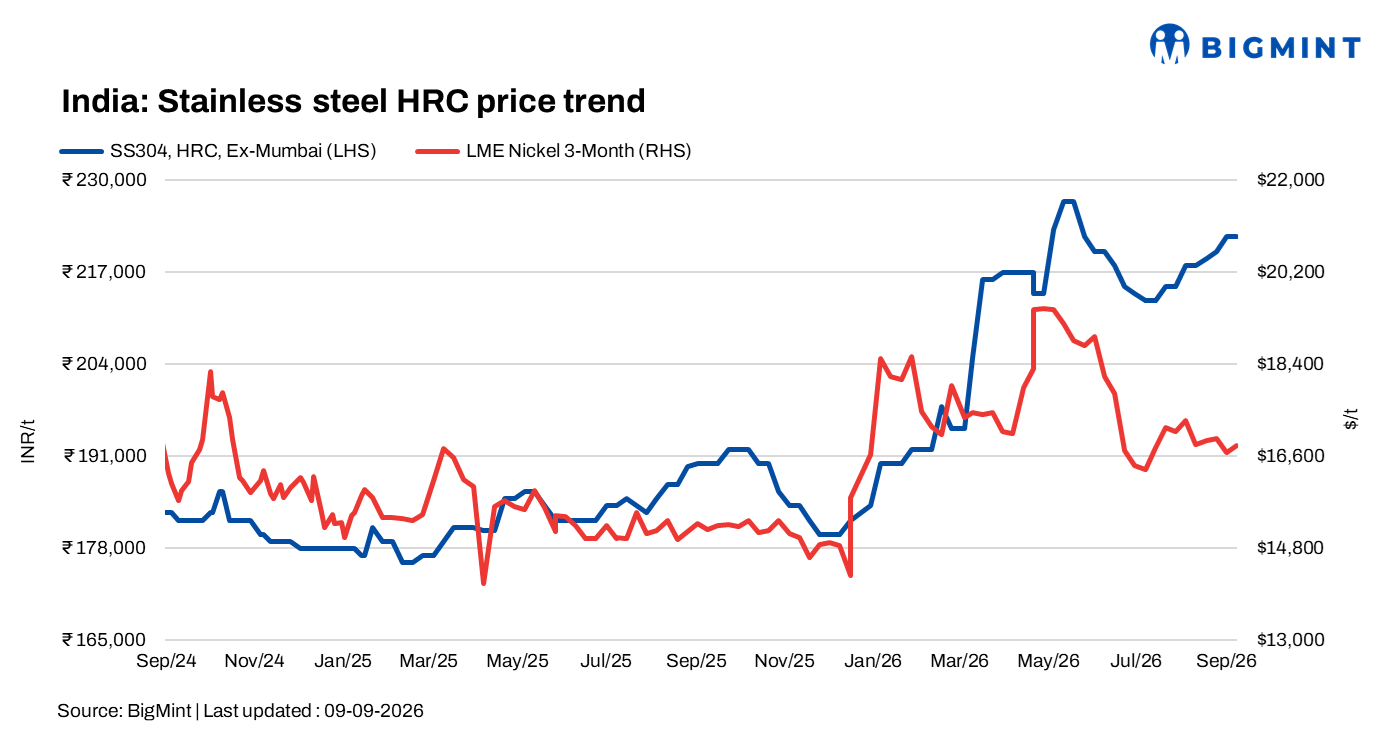
India’s stainless steel finished market remained supported in the week ended 9 September 2026, as tight scrap availability and firm supplier offers kept raw material replacement costs elevated. This continued to support mill price levels, with long products recording further gains while flat prices remained unchanged. Demand, however, was moderate as buyers remained cautious ahead of the festive season.
Finished flats remain rangebound
The flat products market was largely stable during the week, with moderate demand and limited import availability keeping domestic prices rangebound. Domestic material remained relatively competitive amid logistical challenges affecting imports.
BigMint’s benchmark assessment for 304 HR coils remained unchanged w-o-w at INR 222,000/t exw-Mumbai, while 316 HR coils held at INR 433,000/t exw-Mumbai. 304 CRC was assessed at INR 226,000/t and 316 CRC at INR 440,000/t, both unchanged w-o-w.
Despite stable benchmarks, market sentiment remained positive. A distributor source said demand for HRC and CRC was good and expected prices to edge higher, suggesting that current offers could face upward pressure if raw material costs remain elevated.
Long products move higher
Long products recorded broader price gains during the week, with wire rod showing the strongest increase. Mills continued to face elevated scrap replacement costs, which supported higher offers even as buyers remained selective.
BigMint’s benchmark assessment for 304 black bars increased by INR 4,000/t w-o-w to INR 204,000/t exw-Mumbai, while 316 black bars rose by INR 3,000/t to INR 366,000/t.
304 bright bars increased by INR 1,000/t to INR 227,000/t, while 316 bright bars rose by INR 1,000/t to INR 391,000/t. Wire rod prices strengthened further, with 304 wire rod up INR 4,000/t to INR 202,000/t and 316 wire rod increasing by INR 8,000/t to INR 363,000/t.
A steel mill representative said prices were increasing despite slow demand and were likely to remain under pressure from the upcoming festive season. The source added that firm scrap costs were being reflected in finished steel prices, while the mill had yet to offer material for exports.
Bright bar exports remain subdued
India’s stainless steel bright bar export market remained largely stable in the assessment week ended 8 September. Overseas buying interest continued to be limited amid geopolitical tensions, trade uncertainties, elevated freight costs and evolving CBAM requirements.
BigMint assessed 304 bright bars at $2,370/t FOB Nhava Sheva and 316 bright bars at $4,320/t FOB Nhava Sheva, with prices largely unchanged from the previous week.
Exporters remained cautious on fresh offers, with weak overseas enquiries limiting the scope for further price increases despite firm domestic replacement costs.
Global market trends mixed
Asian stainless steel prices declined for the second consecutive week as weaker Indonesian NPI prices and lower nickel futures weighed on sentiment. Indonesian NPI containing 10-14% nickel was reported at $144-146/Ni unit FOB, while Chinese 304 CRC declined to RMB 14,050-14,150/t.
Asian 304 CRC was assessed at $2,080-2,110/t CIF, while HRC stood at $1,990-2,000/t CIF. Sufficient inventories and cautious downstream buying continued to pressure prices, although expectations of improved post-summer demand could provide some support.
Japan remained an exception, with the Nagoya stainless steel market trending higher. Distributors continued to pass on higher mill costs, while demand for stainless steel plates and bar products provided additional support. Market participants expect the upward trend to continue as higher prices gradually filter through the distribution chain.
Meanwhile, Malaysia initiated an anti-dumping investigation on cold-rolled stainless steel products originating from or exported from Indonesia on 9 September. The development adds to trade-policy uncertainty in Asia and could influence regional sourcing and stainless steel trade flows.
In Europe, protectionist measures continue to reshape stainless steel trade flows, with Indonesian slabs being imported for further processing rather than entering the region as finished products. The implementation of stricter melt-and-pour traceability requirements from October could further affect this trade route.
Raw material scenario

Outlook
India’s stainless steel market is expected to remain firm but rangebound in the near term. Scrap costs are likely to provide a floor to finished steel prices, while long products may retain relatively stronger momentum following this week’s gains.
At the same time, the festive season is expected to keep purchasing disciplined, limiting the scope for aggressive price increases. Weakness in Asian stainless steel prices and subdued export enquiries could further cap the upside.
Market participants will monitor scrap availability, nickel and ferro molybdenum prices, import economics, distributor bookings and festive-season demand for the next price direction.
Leave a Reply