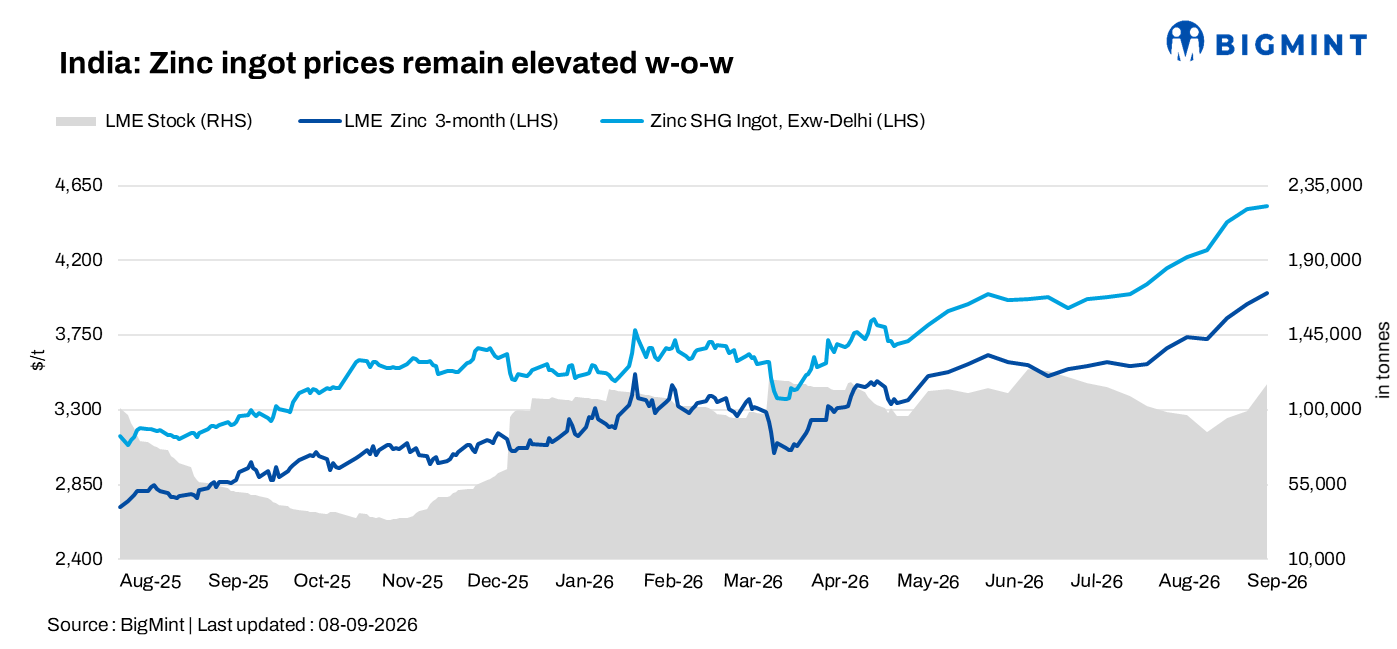
- LME zinc remains stable at around $4,000/t
- Tight imports, higher CIF premiums support prices
India’s zinc ingot (99.995%) prices remained elevated despite weak downstream demand and a recent reduction in HZL’s prices. BigMint’s benchmark assessment stood at INR 430,000/t ex-Delhi on 8 September, firm w-o-w, while Hindustan Zinc Ltd (HZL) reduced its SHG zinc benchmark by INR 4,400/t on 7 September to INR 425,100/t.
LME zinc remained firm at around $4,000/t, while import availability is expected to remain tight. Higher freight costs have pushed indicative CIF premiums for fresh imported material to around $280-290/t, potentially limiting import competitiveness and supporting domestic prices.
Domestic zinc prices remain firm despite HZL cut
Domestic zinc prices remained elevated despite HZL’s latest downward revision.
HZL reduced its benchmark SHG zinc ingot price by INR 4,400/t on 7 September to INR 425,100/t, following another reduction on 3 September.
BigMint’s benchmark assessment stood at INR 430,000/t ex-Delhi on 8 September, while offers were at around INR 434,000-435,000/t at the time of publishing this article.
However, traded volumes remained low as buyers continued to procure mainly against immediate requirements. Market feedback from galvanisers indicates that zinc prices have risen by around INR 75/kg over the past three months, while customer price revisions are generally possible only once every around 15 days.
Higher chemical and electroplating costs have further intensified the pressure, forcing galvanisers to absorb part of the increase and resulting in cash-flow and working-capital stress.
Zinc imports remain tight as CIF premiums rise
India’s zinc import market is expected to remain tight in the near term.
Indicative CIF premiums for fresh imported zinc have risen to around $280-290/t amid higher freight costs. This has made import economics more challenging for Indian buyers while limiting the scope for imported material to provide significant price relief.
South Korean zinc was indicated at around INR 458,000/t in the domestic market, while South Korean zinc on a CFR Nhava Shava basis was reported at around $4,270-4,275/t.
Australian-origin zinc was offered at around INR 470,000/t, remaining significantly above domestic and other imported material.
Weak galvaniser demand intensifies margin pressure
Demand conditions among galvanisers remain weak, with producers facing severe margin compression following the sharp rise in zinc and other input costs.
Multiple OEMs have indicated weak demand, with concerns over lower orders and production in the coming weeks. Galvanisers are currently unable to fully pass on higher costs, while working-capital pressure is increasing as receivables remain stretched.
The situation has been described by market participants as a “death zone” for galvanisers, particularly smaller players. If the pressure persists, producers could consider reducing production or utilisation rates.
Zinc alloy prices remain firm
Zinc alloy prices remained supported by elevated primary zinc costs.
In Delhi, Zamak 3 was heard at around INR 440,000/t, while Zamak 5 was indicated at INR 447,000/t. Zinc PMI prices were reported at around INR 388,000/t.
However, downstream demand remains selective, with buyers largely restricting procurement to immediate requirements.
Coated steel prices increase on higher input costs
India’s coated flat steel prices increased by INR 1,500-2,000/t during the week ended 3 September 2026, with major domestic steel mills announcing hikes of around INR 2,000-2,500/t across coated products.
The increase was primarily driven by a sharp rise in raw material costs. However, demand remained cautious, with buyers largely following a need-based purchasing approach.
BigMint’s benchmark assessment for Mumbai GP coil (0.8 mm/CTL, 120 GSM, IS 277) increased by INR 1,700/t w-o-w to INR 79,700/t ex-Mumbai.
Mumbai PPGI (0.5 mm/CTL, 90 GSM, IS 14246) was assessed at INR 87,000/t ex-Mumbai, up INR 800/t w-o-w, while Mumbai BGL (0.5 mm/CTL, 1220 mm, AZ150) remained stable at INR 90,000/t ex-Mumbai.

Outlook
India’s zinc ingot market is expected to remain firm in the near term, supported by tight import availability, elevated replacement costs, and higher CIF premiums of around $280-290/t.
However, weak downstream demand is increasingly limiting the scope for further gains. Galvanisers are facing severe margin pressure as zinc prices have risen sharply over the past three months, while chemical and electroplating costs are also elevated.
Imported zinc remains relatively expensive, with Korean material indicated at around INR 458,000/t and Australian-origin material at around INR 470,000/t.
While supply-side factors remain supportive, further domestic price movement will depend on import availability, international zinc prices and the ability of downstream consumers to absorb higher costs.
Leave a Reply