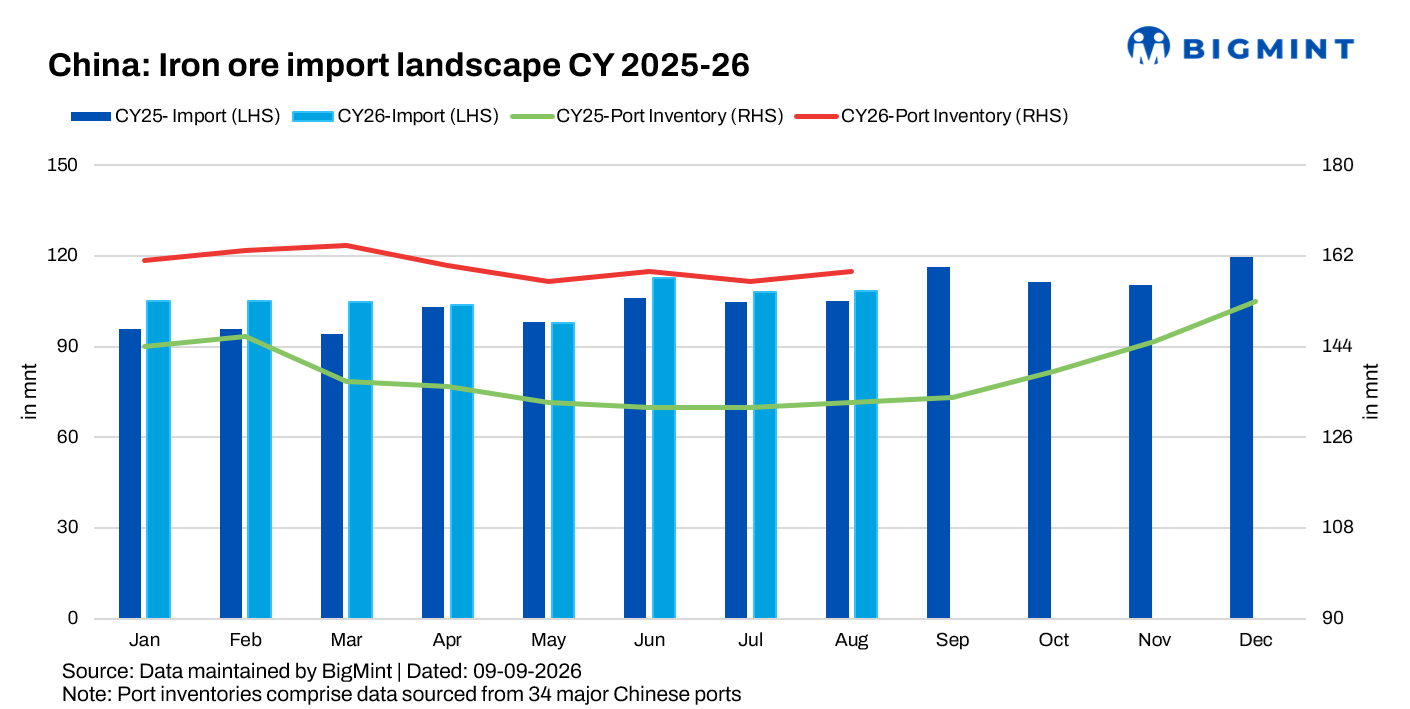
- August imports rise 3.3% y-o-y amid improved seaborne availability
- Jan-Aug imports increase 5.5% y-o-y on lower domestic ore output
China imported 108.54 million tonnes (mnt) of iron ore and concentrate in August 2026, up 3.3% y-o-y and marginally higher by 0.4% m-o-m, according to data from the General Administration of Customs of China (GACC). The volume was above market expectations of around 107-108 mnt. Cumulative imports during January-August reached 845.27 mnt, up 5.5% y-o-y.
The increase was supported by improved seaborne availability and the clearance of cargoes delayed by typhoon-related disruptions in July. However, the rise in imports comes against a softer domestic steel production backdrop, with lower domestic ore output and elevated port inventories keeping the supply side well stocked.
Market scenario
August imports remain above 100 mnt for fourth consecutive month: China’s August iron ore imports remained above 100 mnt for the fourth consecutive month, with the 108.54 mnt volume marking a 3.3% y-o-y increase. Although the m-o-m increase was limited to 0.4%, imports continued to run above year-ago levels.
Typhoons during July and August disrupted vessel unloading and customs clearance at Chinese ports. Some cargoes arriving during July were subsequently cleared in August, contributing to the higher monthly import volume. Improved seaborne availability also supported procurement during the month.
Domestic iron ore production falls 8.7% y-o-y: China’s domestic iron ore production remained under pressure. According to the National Bureau of Statistics (NBS), run-of-mine iron ore production totalled 536.1 mnt during January-July 2026, down 8.7% y-o-y. The decline accelerated from a 7% y-o-y contraction during January-June, with July recording a sharper fall.
Lower domestic availability has increased the importance of imported ore for Chinese mills. This was reflected in cumulative imports, which rose 5.5% y-o-y to 845.27 mnt during January-August, despite growth moderating from 5.9% y-o-y during January-July.
Steel exports provide support to mill operations: China’s steel exports remained firm in August, reaching 10.16 mnt, up 6.8% y-o-y and 0.4% m-o-m. Monthly exports remained above 10 mnt for the fourth consecutive month, providing some support to steel production and associated iron ore consumption.
However, cumulative steel exports during January-August stood at 75.15 mnt, down 3% y-o-y. Steel imports also remained weak, falling 13.2% y-o-y to around 434,000 tonnes in August. Overall, the export market continued to provide support to domestic steel production, although the broader steel demand environment remained relatively steady.
Port inventories remain significantly higher than year-ago levels: Iron ore inventories across 34 major Chinese ports stood at around 159 mnt in August 2026, compared with 133 mnt in August 2025, leaving stocks around 26 mnt, or nearly 20%, higher y-o-y.
The elevated inventory position indicates that Chinese mills and traders have maintained a relatively comfortable supply cushion. This could limit the urgency for aggressive spot procurement in the near term, particularly while crude steel production remains below year-ago levels.
Average iron ore import price falls 5.1% m-o-m: China’s average iron ore import price declined to around $95.5/t in August, down 5.1% m-o-m. The lower average import price offered some relief to mills amid pressure on steelmaking margins.
Despite the decline in import prices, volumes remained higher y-o-y. Lower domestic ore production and continued dependence on overseas supplies therefore remained more important factors supporting imports than price-driven restocking.
Outlook
China’s iron ore imports are expected to remain largely firm m-o-m in September as seaborne availability improves and shipments from Australia and Brazil increase following the easing of weather-related disruptions. Miners are also likely to focus on clearing outstanding volumes towards the end of the quarter, supporting arrivals into China.
Pre-holiday restocking ahead of China’s National Day holiday from 1-7 October could provide additional support to procurement. However, maintenance at some Chinese steel mills is expected to temporarily reduce iron ore consumption and could marginally limit the overall increase in September imports.
With domestic iron ore production remaining lower y-o-y and overseas availability improving, imports are likely to stay above year-ago levels. BigMint expects China’s iron ore imports to increase m-o-m in September, while maintaining positive y-o-y growth.
Leave a Reply