- Scrap prices gain despite cautious market activity
- PSIC changes create operational hurdles for traders
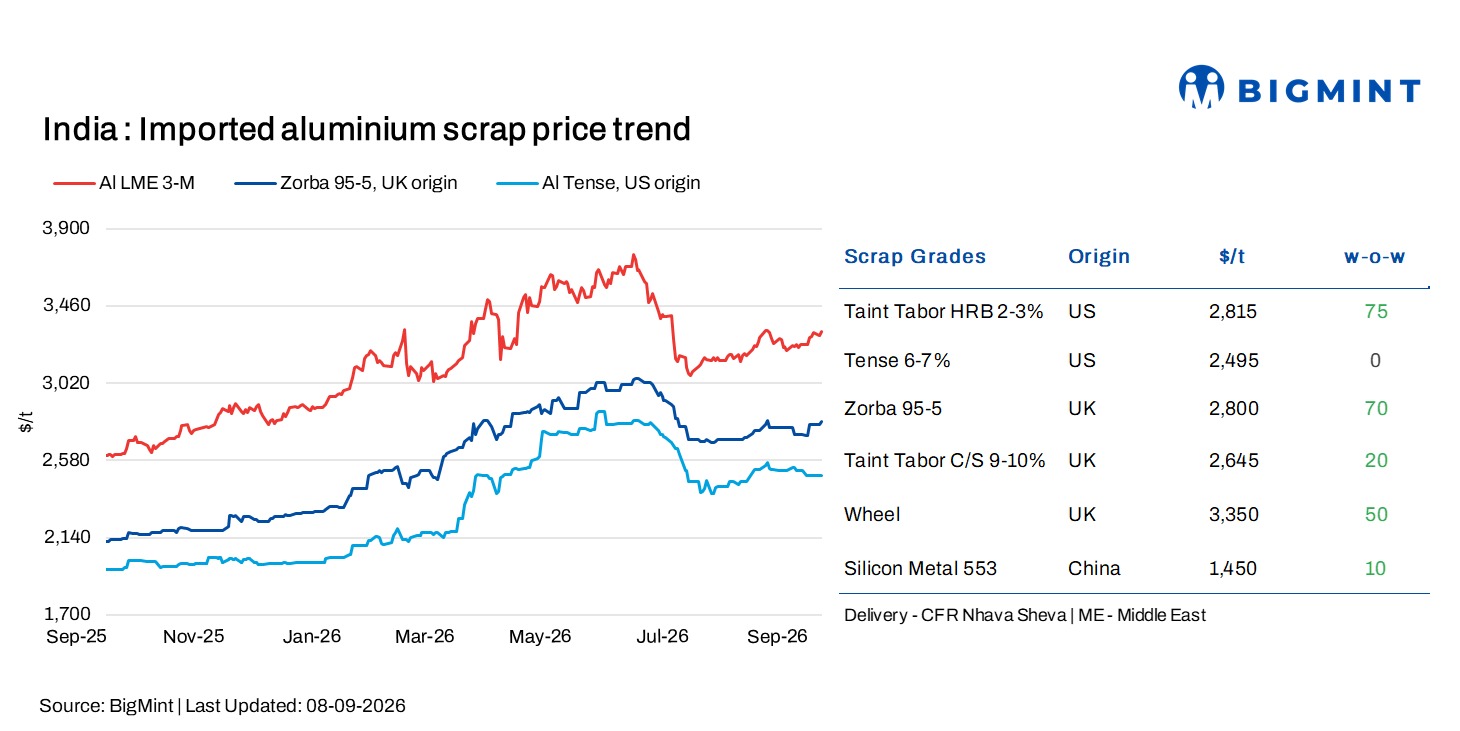
India’s imported aluminium scrap prices rose w-o-w, supported by firmer LME aluminium prices, tighter scrap availability and renewed supply concerns.
According to BigMint’s latest assessment for CFR Nhava Sheva deliveries, US-origin Taint Tabor HRB 2-3% scrap prices increased by $75/t w-o-w to $2,815/t, from $2,740/t. Meanwhile, UK-origin Zorba 95-5 scrap prices rose by $70/t w-o-w to $2,800/t, from $2,730/t, supported by firmer global aluminium prices and tighter availability.
LME aluminium prices rise w-o-w
Three-month aluminium prices on the LME increased by $47/t, or 1.4% w-o-w, to $3,308/t on 7 September, from $3,261/t on 1 September. Prices gained amid renewed supply concerns, tighter physical availability and continued geopolitical risks, while expectations of stronger seasonal demand provided additional support.
Meanwhile, LME aluminium inventories declined by 2,200 t, or 0.9%, to 244,525 t on 7 September, from 246,725 t on 1 September. Stocks remained near multi-year lows, reinforcing concerns over tight exchange availability and providing underlying support to aluminium prices.
Market scenario
The global imported aluminium scrap market remained cautious this week, with trading activity subdued as market participants assessed the impact of the revised PSIC (Pre-Shipment Inspection Certificate) guidelines. A market participant noted that while suppliers are generally providing the mandatory no-war-material certificate, implementation of the revised inspection process remains challenging, particularly the requirement for same-day uploading of inspection photographs and videos when the same contract is loaded simultaneously from multiple yards. Limited availability of approved PSIA agencies in some non-Safe Countries could further complicate shipments and delay clearances.
At the same time, imports from designated Safe Countries, including the US, EU, UK, Australia, New Zealand and Canada, are exempt from PSIC, subject to the prescribed supplier certification and routing through notified ports. However, a market participant highlighted that port-level implementation remains inconsistent, with some ports accepting Safe Country shipments without PSIC while others continue to seek clarification. This ambiguity is creating uncertainty for importers, particularly at major gateways such as Nhava Sheva and Haldia.
Nevertheless, the extension of the Safe Country exemption to ICD/CFS clearances is viewed positively and could gradually revive scrap import enquiries and volumes. After earlier restrictions reduced imports, the relaxation may encourage sourcing from Safe Countries and support both ferrous and non-ferrous scrap flows. However, market participants continue to seek greater clarity from the authorities on implementation and possible relaxation of the revised requirements to ensure smoother and more predictable clearance of shipments.

Meanwhile, domestic aluminium Tense scrap demand is showing early signs of improvement, with market activity picking up and buyers preparing for September requirements. As competitively priced imported ADC12 inventories gradually decline, alloy producers may return to the market for fresh purchases, which could provide further support to domestic scrap demand in the coming weeks.
Outlook
Imported aluminium scrap prices are likely to remain firm in the near term, supported by tight availability, elevated LME prices and ongoing supply-chain uncertainties. However, improved scrap imports from Safe Countries and cautious downstream buying could limit further upside. Domestic Tense demand may strengthen gradually as imported ADC12 inventories decline and September procurement picks up.
Leave a Reply