- Revised PSIC rules create short-term shipment disruptions
- Safe-country exemptions could support scrap import recovery
India’s revised Pre-Shipment Inspection Certificate (PSIC) process has created uncertainty among ferrous and non-ferrous scrap importers, with suppliers reporting difficulties in complying with the new inspection and documentation requirements. While the changes are expected to have a short-term impact on shipments and loading activity, market participants do not expect them to fundamentally reduce scrap demand.
The Directorate General of Foreign Trade (DGFT) introduced changes to the PSIA/PSIC process on 25 August. Under the revised system, the PSIC must be generated and issued on the actual date of inspection, with certificates no longer permitted to be issued retrospectively. The inspection date must also follow a standardised format.
Suppliers face loading disruptions
Several suppliers have temporarily stopped loading cargoes as they assess the implications of the revised process. A UAE based trader commented, “We are facing PSIC problems. We aren’t loading and have stopped all the loadings till we have a clear picture,”.
“The changes could create a short-term disruption, particularly while exporters and inspection agencies adjust to the new requirements. I think this change could have some short-term impact on the market, particularly as suppliers may face temporary disruptions in shipment and loading activity while they assess the new requirements. However, I don’t expect it to fundamentally reduce the market or have a major impact on overall scrap demand in the longer term,” a supplier based in Africa said.
Same-day inspection requirement creates operational challenges
Market participants said, “the revised process could be difficult to implement in practice, particularly for suppliers handling large volumes from multiple yards.”
Under the new system, inspection-related photographs and videos have to be uploaded on the same day as the inspection. Participants said this could become challenging when the same contract is being loaded simultaneously from different yards.
They also pointed to limited availability of approved Pre-Shipment Inspection Agencies (PSIAs) for countries outside the specified safe-country list, potentially creating further delays in inspection and certification.
“There is still ambiguity,” one participant said, adding that some ports are accepting cargoes without PSIC for shipments from safe countries, while others are reportedly taking a different approach.
Safe-country exemption offers some relief
At the same time, a scrap supplier based in the Baltic region welcomed the decision to allow scrap from specified safe countries to be imported without PSIC, subject to prescribed conditions. The exemption covers imports from countries including the US, EU, UK, Australia, New Zealand and Canada, subject to compliance with the applicable requirements. Suppliers are required to certify that the cargo does not contain radioactive material and is free from war material, explosives, arms, ammunition or other hazardous or prohibited material.
Participants said extending the exemption to ICDs could make imports from these origins easier and potentially encourage higher volumes of both ferrous and non-ferrous scrap. “Import from safe countries without PSIC is a very nice decision to implement it on the ICD also and will help to increase import mainly from safe countries,” a market participant said.
Port coverage remains a concern
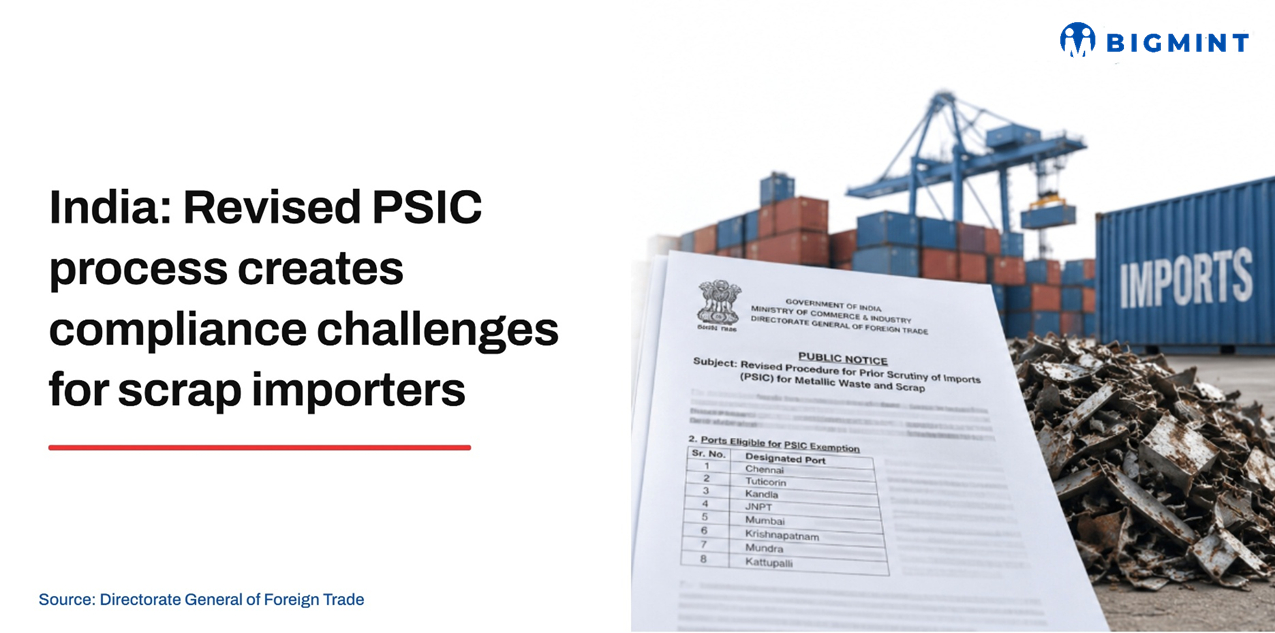
Market participants have also raised concerns over the coverage of designated ports under the exemption framework. The circulated guidance lists designated ports for the PSIC exemption, while participants have questioned the treatment of some important scrap-handling locations.
Nhava Sheva/JNPT is listed among the designated ports in the guidance, while market participants have nevertheless flagged uncertainty regarding the applicability of the exemption across specific ports and clearance routes, particularly where cargo is subsequently moved to ICDs or CFS facilities.
This uncertainty has added to concerns over cargo clearance and could influence suppliers’ decisions on loading until the process is clarified.
Impact on scrap trade
The immediate impact is expected to be more operational than fundamental. Suppliers may delay loading or shipments until inspection procedures become clearer, while importers could face longer lead times and additional compliance-related costs.
The disruption could be more significant for origins that do not qualify for the safe-country exemption, given the limited availability of approved PSIAs and the additional inspection requirements. In contrast, suppliers from exempted countries could become relatively more competitive as buyers seek to minimise compliance risks and shipment delays.
A market participant said the earlier PSIC requirements had already reduced import volumes, and the latest exemption for safe countries could gradually help revive both ferrous and non-ferrous scrap enquiries from these origins.
Outlook
In the near term, revised PSIC requirements may cause loading delays and keep scrap importers cautious until procedures become clearer. Industry participants are seeking clarification from DGFT, particularly on same-day inspections and port/ICD procedures. However, the changes are unlikely to structurally reduce scrap demand, while safe-country exemptions could gradually support a recovery in import enquiries.
Leave a Reply