- Higher input costs lift steelmakers’ replacement costs
- Lower imports, stronger exports tighten domestic availability
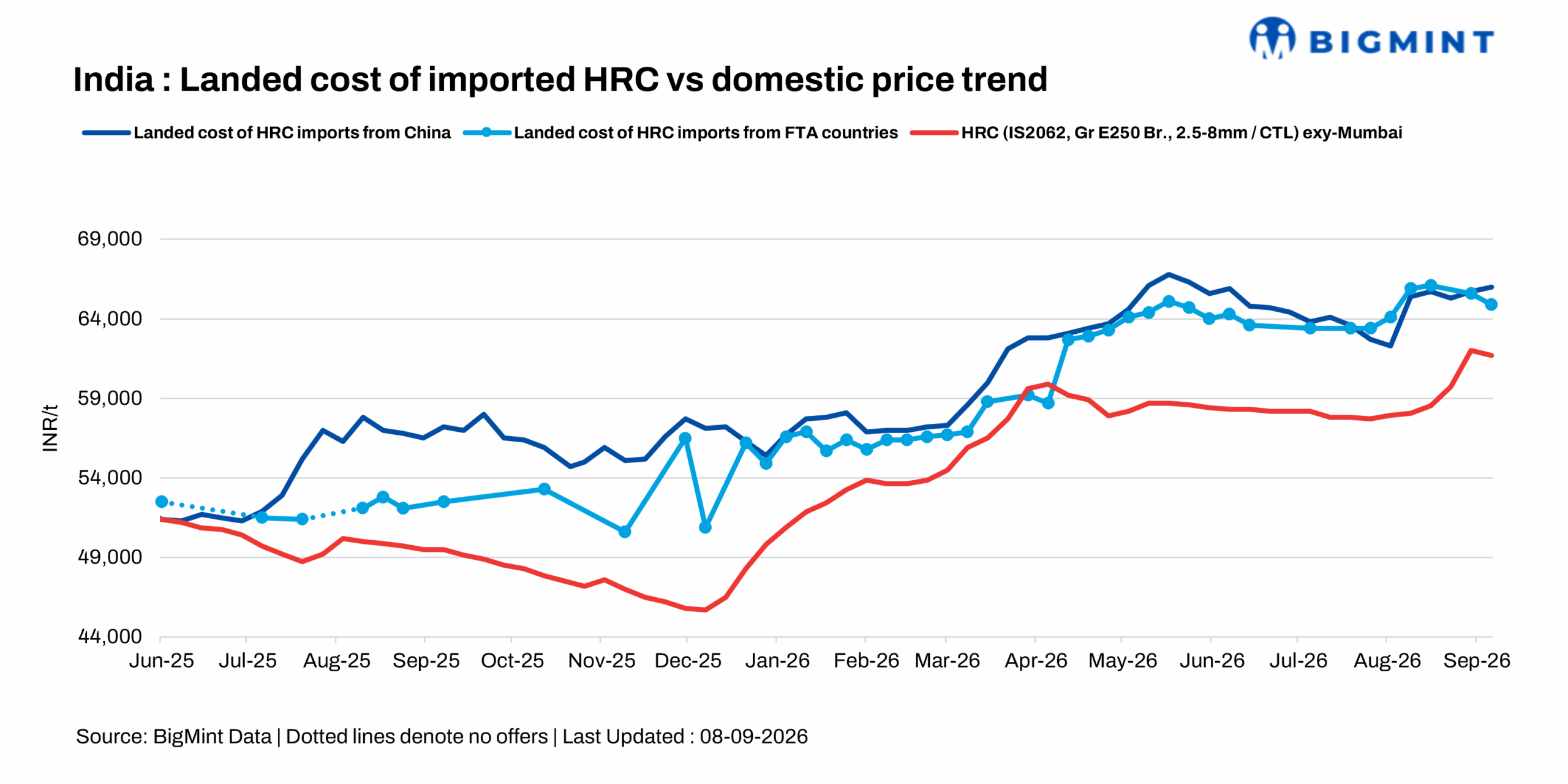
Domestic hot-rolled coil (HRC) prices in India remained below import parity as of 1 September, although the gap narrowed significantly following the sharp price recovery in late August. BigMint’s bi-weekly HRC benchmark stood at INR 61,700/t ex-Mumbai, around INR 3,200-4,300/t below the estimated landed cost of FTA and non-FTA imports at INR 64,900 and 66,000/t .
The narrowing differential reflects a combination of higher raw material costs, tighter domestic spot availability and changes in trade flows. However, the narrowing gap with import parity could limit further domestic price gains unless cost pressures or supply constraints strengthen further.
Import parity provides price ceiling
The FOB price of HRC from non-FTA countries was assessed at around $510/t on 8 September. With freight estimated at around $45/t, the CFR value works out to approximately $555/t.
After adding 7.5% basic customs duty (BCD) and 0.75% cess, the import value rises to around $601/t. At an assumed exchange rate of INR 95/$, this translates to approximately INR 56,825/t.
The 11.5% safeguard duty and 1.15% cess add roughly $75/t, taking the import cost to around $677/t, or approximately INR 64,000/t. After adding port handling charges of around INR 2,000/t, the landed cost of non-FTA HRC is estimated at approximately INR 66,000/t.
For FTA origins, CFR offers were heard at around $590/t. With BCD exempted under the FTA and the 11.5% safeguard duty plus 1.15% cess adding roughly $75/t, the landed cost is estimated at approximately INR 64,900/t.
This places domestic HRC around INR 3,200-4,300/t below import parity for FTA and non-FTA origins, leaving a relatively narrow pricing differential for domestic producers.

Higher costs tighten domestic market
Domestic HRC prices returned to INR 62,000/t in August, the first time since June 2022, as replacement costs increased across the steel value chain.
Iron ore, pellets and coking coal strengthened during August, raising the cost base for steelmakers. At the same time, maintenance shutdowns reduced primary steel availability, while mills tightened allocations to the trader channel.
These supply-side constraints coincided with inventory replenishment by buyers ahead of anticipated price increases, supporting the late-August price movement.
The combination of higher input costs and restricted spot availability therefore provided stronger support to domestic HRC prices than demand alone.
Trade flows tighten balance
The domestic supply-demand balance has also become tighter as imports declined while exports increased sharply. Lower import availability reduced competition from overseas material, while stronger exports diverted more domestic production towards international markets.
Production and consumption continued to grow through the year, but the change in trade flows reduced surplus availability in the domestic market. This helped domestic producers pass through part of the increase in replacement costs despite the broader demand environment.
Limited room for further increase
At INR 61,700/t ex-Mumbai, domestic HRC remains competitive against imported material, but the INR 3,200-4,300/t differential is relatively narrow.
This suggests domestic mills may have limited room to raise prices further without corresponding increases in import parity or domestic replacement costs. Any additional price increase could reduce the cost advantage of domestic material and encourage buyers to reassess import economics.
Outlook
Through September, domestic HRC prices are likely to remain sensitive to raw material costs, mill availability and international HRC offers. Sustained strength in iron ore, pellets and coking coal, together with continued supply restrictions, could support further domestic price increases.
However, if domestic availability improves or international prices soften, the current INR 3,200-4,300/t gap with import parity could constrain further price gains. Buyer procurement activity and fresh import offers will therefore remain key indicators for domestic price direction during September.
Leave a Reply