- Weak hydro generation, expensive gas leave coal carrying incremental demand
- Govt priority to power utilities tightens domestic supply for industrial consumers
Data Deep Dive: India’s electricity market is moving towards a period of substantially higher coal consumption as rapidly rising power demand collides with weak hydro generation and limited gas-fired output.
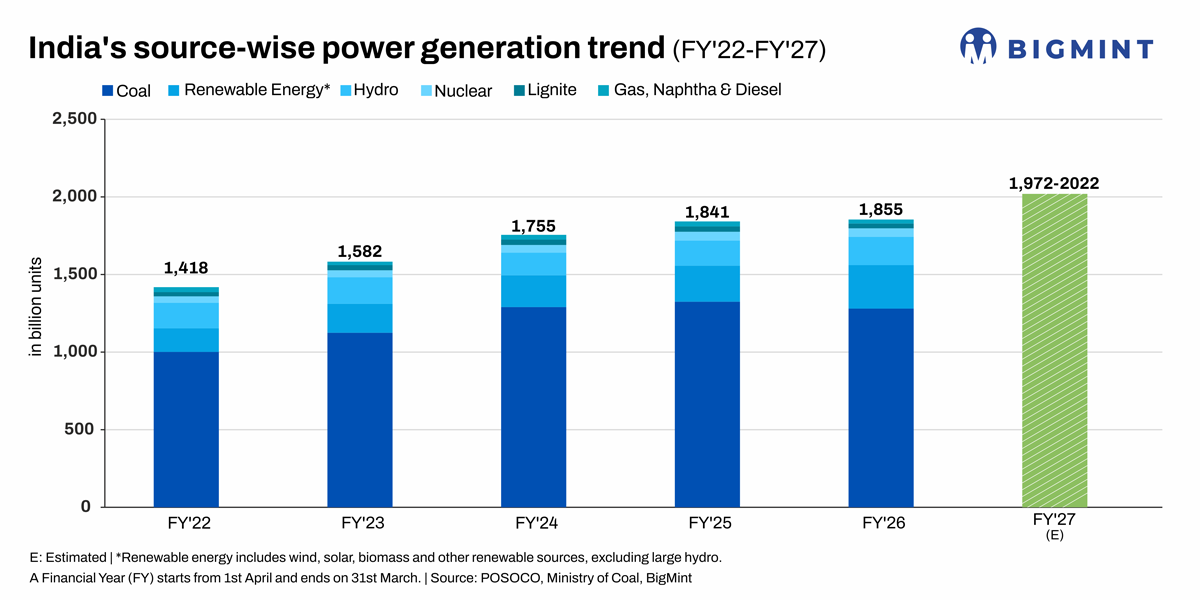
BigMint estimates that coal-fired generation could reach approximately 1,345-1,395 terawatt-hours (TWh) in FY’27, compared with 1,280 TWh in FY’26. At an indicative utility coal-consumption rate of around 0.70 million tonnes (mnt)/TWh, this would translate into power-sector coal demand of approximately 940-975 mnt during the financial year.
The challenge, however, is larger than supplying this underlying consumption.
Power plants also need to rebuild inventories after stocks fell from 37.83 mnt at the beginning of August to 29.12 mnt by 31 August 2026. Restoring inventories to 45 mnt would require almost 16 mnt of net additions above consumption.
India’s domestic coal supply chain may therefore need to deliver close to 960-990 mnt to the utility sector, including both consumption and inventory rebuilding, depending on where coal generation and year-end stocks settle within BigMint’s projected ranges.
This is likely to intensify competition for coal and railway capacity. Power utilities will receive priority, potentially leaving cement plants, sponge-iron producers, captive power generators, and other industrial consumers with weaker access to domestic supplies.
Eventually, the supply crunch could drive a shift towards imports to relieve the pressure — not necessarily because India lacks coal at the national level, but because the domestic system may struggle to move enough coal to every consumer at the required time.
FY’27 power demand outlook points to rising coal burn
India’s electricity demand has reaccelerated sharply after unusually weak generation growth in FY’26. Total generation reached 464.68 TWh during April-June 2026, compared with 453.01 TWh a year earlier. Growth subsequently strengthened, with generation reaching 181.8 TWh in July, up 10.6% y-o-y, and 179.97 TWh in August, up 11.6%.
As such, BigMint projects total generation of approximately 1,972-2,022 TWh in FY’27, representing growth of 6.3-9% over FY26. The midpoint of the range — about 1,997 TWh — would imply growth of approximately 7.7%.
The central question is how this additional electricity will be generated.
Weak hydro removes important source of flexibility
Renewable generation is expanding rapidly, but hydro’s weakness has reduced the ability of non-fossil generation to meet incremental demand and balance variations in solar and wind output.
In August, renewable generation increased 42.1% y-o-y to 35.15 TWh, adding more than 10 TWh of supply. Yet hydro generation fell 16.7% to 21.52 TWh, removing approximately 4.3 TWh compared with August 2025.
As a result, coal generation still rose 11.2% y-o-y to 113.68 TWh, even as renewable generation reached a record level. Coal’s share of total output remained broadly unchanged at approximately 63%.
The weak monsoon is important not only for current hydro generation but also for the months ahead. Lower rainfall and weaker reservoir replenishment can restrict hydro availability during the post-monsoon and dry seasons. Hydro generation may still rise temporarily following catchment rainfall, but a weaker storage position reduces its ability to sustain high output through winter and the approach to summer 2027.

Hydro is also one of the principal flexible resources available to balance the variability of solar and wind. When hydro availability is constrained, the system requires more dispatchable thermal generation during evening hours, overnight periods, and intervals of weak renewable output.
High gas prices limit alternative to coal
Gas-fired generation is also unlikely to provide large-scale substitution. Imported gas has become considerably more expensive amid the West Asian conflict, elevated geopolitical risks, and continuing concerns over LNG production and shipping routes. Indian gas-fired power plants are highly sensitive to delivered fuel prices because electricity produced from imported LNG is generally much more expensive than coal-fired generation.
Gas generation consequently fell 4% y-o-y to just 1.97 TWh in August, accounting for little more than 1% of India’s total electricity output.
India has substantial installed gas-fired capacity, but much of it remains underutilised because of fuel availability and economics. Unless domestic gas supply rises materially or international LNG prices retreat, gas is unlikely to operate at load factors high enough to absorb a meaningful share of incremental electricity demand.
Methodology points to 940-975 mnt of utility coal consumption
BigMint’s FY’27 projection combines actual generation for April-August 2026 with monthly estimates for September 2026-March 2027.
The forecast considers recent electricity-demand momentum, temperature and rainfall conditions, festival seasonality, hydro availability, expected renewable generation, and coal’s continuing role in meeting residual demand.
The coal-generation outlook is converted into fuel requirements using an indicative consumption rate of approximately 0.7 Mnt/TWh. This is consistent with August, when power plants consumed 79.35 mnt to generate 113.68 TWh from coal.
Actual consumption will vary according to domestic and imported coal quality, plant efficiency, blending ratios, and generating-unit load factors.

The potential supply requirement is higher than underlying consumption because deliveries must also rebuild power plant inventories. The precise requirement will depend on the desired stock level and how much further inventories fall before receipts begin exceeding consumption.
Sep-Oct could delay restocking season
The conventional assumption is that electricity demand will begin moderating after summer, allowing power plants to replenish stocks as post-monsoon mining conditions improve.
However, the decline is likely to occur later in 2026. Warmer conditions, weaker rainfall, and the later festival calendar may keep electricity requirements elevated through September and October. BigMint projects September generation of 176-182 TWh and October generation of 170-178 TWh.
Coal-based generation could remain at 116-122 TWh in September and 113-120 TWh in October, implying utility coal consumption of approximately 81-85 mnt and 79-84 mnt, respectively.

Coal generation during September-March could therefore total approximately 786-834 TWh, translating into utility consumption of around 550-582 mnt over these seven months.
The first increase in mine production and dispatch after the monsoon may be absorbed simply by continuing consumption. Substantial stock accumulation may not begin until demand moderates more meaningfully from mid-November.
This would leave a relatively narrow window between mid-November and February in which deliveries must materially exceed consumption before demand begins rising towards summer 2027.
Power sector priority will stretch domestic supply chain
August demonstrates the scale of the emerging challenge. Power plants consumed 79.35 mnt of coal but received only 70.88 mnt, creating a deficit of 8.47 mnt. Receipts were below consumption on 30 of the month’s 31 days.
Inventories consequently fell 23% to 29.12 mnt, while the number of plants classified as critical increased from 30 to 51.
Returning stocks to 40 mnt requires approximately 10.9 mnt of net accumulation. Rebuilding to 45 mnt requires almost 15.9 mnt.
If 16 mnt must be accumulated over four months, utilities need deliveries approximately 4 mnt/month above consumption. If the effective rebuilding window contracts to three months, the required surplus rises above 5 mnt/month.
This is not solely a coal production problem. It is also a question of evacuation, railway capacity, rake turnaround times, and the location of demand relative to mines.

India’s largest coal-producing regions are concentrated in eastern and central India, while considerable demand lies in the north, west, and south. A rake serving a nearby power station can unload and return for another loading much faster than one travelling 1,000-1,500 km.
Long-distance consumers therefore use disproportionately more railway capacity for every tonne received.
As utilities attempt to meet rising consumption and rebuild stocks simultaneously, railway coal logistics will increasingly be directed towards power stations. Maintaining electricity supply will take precedence over supplying discretionary industrial demand.
Non-power consumers face risk of being crowded out
The consequences will extend beyond utilities.
Cement producers, sponge-iron plants, captive power generators, and other industries also depend on domestic coal and railway transportation. If utilities receive increased allocation and logistical priority, non-power consumers could encounter delays in rake placement and deliveries, greater dependence on road or coastal transportation, higher inventory requirements, and rising delivered fuel costs.
India could therefore have adequate coal production at the national level while individual industrial consumers struggle to secure delivered material.
This distinction is particularly important because industrial consumers usually have less policy protection than power generators. When electricity security becomes the priority, the rest of the industry effectively becomes the balancing segment.
Imports could rise without national coal shortage
The likely import response will depend on delivered economics rather than headline domestic production.
For a consumer close to an eastern or central Indian coalfield, low mine-mouth prices provide domestic coal with a significant advantage. That advantage progressively narrows as transportation distances increase.
For distant consumers, the relevant comparison is between the landed cost of domestic coal, including the coal price, rail freight, handling, transit costs, and inventory risk, and the landed cost of imported coal, including the CFR price, port handling, and shorter inland delivery.

This makes western and southern India particularly exposed to a tightening domestic supply chain. Gujarat, Maharashtra, Andhra Pradesh, Karnataka and Tamil Nadu combine substantial coal demand, long distances from major coalfields and access to ports.
If utility restocking absorbs additional railway capacity, coastal industrial consumers have alternatives that many inland plants do not. They can import coal or receive domestic coal through coastal shipping.
Among imports, Indonesian coal has the strongest freight advantage for lower- and mid-CV requirements. South African coal can compete in higher-energy applications, while US and other origins may become relevant depending on price, freight, sulphur, ash and plant specifications.
The trigger for higher imports does not need to be an absolute shortage of Indian coal. Imports can increase because domestic coal is not available to a particular consumer, cannot be transported on time, or becomes less competitive after rail and reliability costs are included.
Summer 2027 to raise stakes
India’s coal sector faces a dual challenge through FY’27 and the subsequent summer of 2027, where utilities must consume 940-975 mnt while simultaneously rebuilding depleted inventories.
BigMint projects coal generation potentially rising to 124-132 TWh in April 2027 and 132-140 TWh in May (within FY’28), but meeting this peak requirement depends entirely on entering March with a robust buffer of 40-50 mnt at power plants rather than a vulnerable 30 mnt, which would leave utilities heavily dependent on uninterrupted daily deliveries at the point when electricity and coal requirements are highest.
Ultimately, India’s challenge is not a lack of coal in the ground, but whether the logistics network can simultaneously deliver to utilities, rebuild stocks, and supply industrial consumers. If it cannot, the next stage of India’s electricity demand surge will increasingly be felt at its ports.
Leave a Reply