- US imports divert metal from European, Asian markets
- LME inventories decline as physical availability tightens
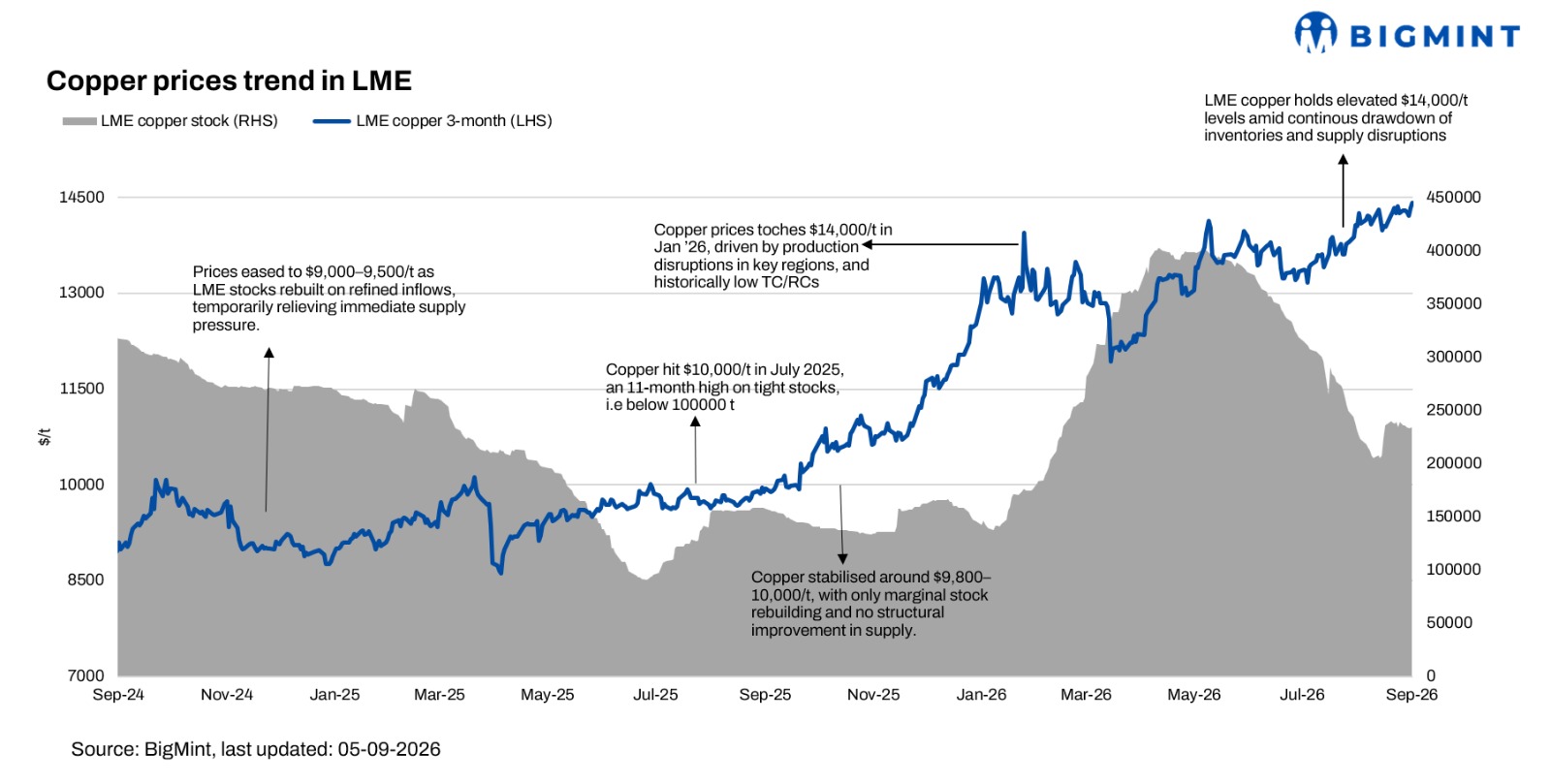
LME copper prices remained near record highs during the week ended 5 September, rising around 0.7% to $14,350/t on 5 September from $14,250/t on 29 August. Prices remained supported by tightening physical availability outside the US, tariff-driven trade flows and persistent concerns over global mine supply.
LME copper stocks declined by around 5,000 tonnes, from 238,700 t on 29 August to 233,700 t on 4 September, indicating continued tightening in exchange-held inventories. The drawdown provided additional support to copper prices as physical availability outside the US remained constrained.
US trade flows tighten regional availability
Copper units continued to flow into the US market ahead of potential trade policy changes, reducing spot availability in Europe and Asia. US imports of refined copper and copper alloys reached a record 225,094 t in July, while COMEX inventories climbed to nearly 694,000 t.
The diversion of metal towards the US has contributed to declining LME inventories and tighter availability in other consuming regions. Falling exchange stocks have reinforced bullish sentiment by highlighting reduced readily available supply.
Mine supply concerns persist
Supply-side concerns also remained prominent. India has revived discussions with Zambia over access to copper assets and long-term concentrate supplies, highlighting growing concerns among consuming countries over future raw material availability.
Global smelters continue to face severe concentrate shortages and historically low treatment charges, increasing pressure across the copper processing chain.
Meanwhile, rising copper theft in Chile has raised concerns over supply-chain reliability and disruptions to mining-related transportation and logistics. While the direct impact on mine output remains limited, continued disruptions could add to supply risks from one of the world’s largest copper-producing countries.
India shifts towards concentrate imports
India’s copper trade showed a shift towards concentrate-based sourcing during H1CY26. Cathode imports remained broadly stable at around 108,600 t, compared with 107,200 t in H1CY25, despite higher domestic production.
Copper concentrate imports increased around 48% y-o-y, while blister and anode imports declined. Domestic semi-finished copper production rose 11.6% y-o-y to 352,000 t, while semi-finished copper imports fell 16% to 232,349 t.
The shift indicates greater reliance on domestic processing as smelters ramp up concentrate consumption.
Domestic demand remains subdued
India’s domestic copper market remained slow during the week as festive celebrations reduced trading activity across major consumption centres. Buyers and traders largely stayed cautious, while fresh bookings and spot transactions remained limited.
Trading activity is expected to improve next week as businesses resume normal operations and buyers return to replenish inventories. However, global supply tightness and continued diversion of metal towards the US are likely to remain important price drivers.
Leave a Reply