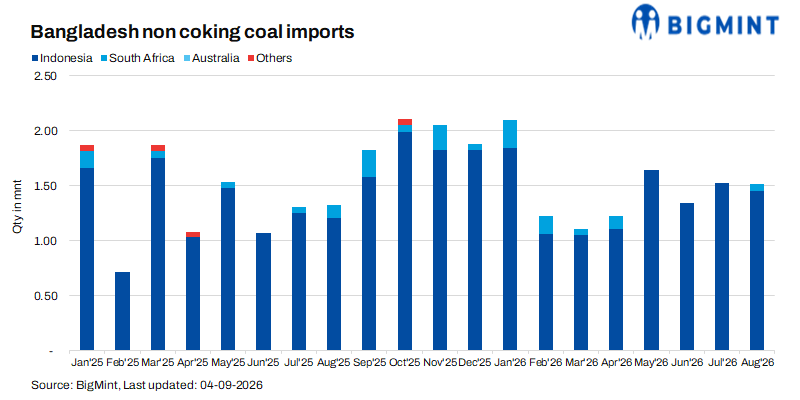
- August imports rise 14% y-o-y to 1.51 mnt
- Indonesia supplies 96%, South African share shrinks
Bangladesh’s non-coking coal imports remained firm at 1.51 mnt in August 2026, broadly unchanged from 1.52 mnt in July but around 14% higher than 1.32 mnt in August 2025, indicating that import demand has strengthened from last year’s levels.
The cumulative trend is also positive. Imports reached 11.65 mnt during January-August 2026, compared with approximately 10.75 mnt during the corresponding period of 2025, an increase of around 8% y-o-y.
More striking than the increase in volumes, however, is the shift in sourcing. Indonesia supplied approximately 1.45 mnt in August, or around 96% of Bangladesh’s imports, strengthening its already dominant position, while South African supply fell sharply from a year earlier.
Imports stabilise around 1.5 mnt
Bangladesh’s monthly coal imports have been volatile during 2026, but the latest data indicate greater stability.

Imports started 2026 strongly at 2.08 mnt in January before falling to 1.11 mnt in March. Volumes subsequently recovered, reaching 1.64 mnt in May before easing to 1.34 mnt in June.
July imports increased to 1.52 mnt and August remained virtually unchanged at 1.51 mnt. The underlying dataset confirms. January-August 2026 imports of 11.65 mnt.
The recent pattern therefore looks less like a sudden August surge and more like import demand settling at a relatively firm level of around 1.5 mnt/month.
Indeed, imports have exceeded year-earlier levels in six of the first eight months of 2026, with March and August’s marginal month-on-month movement providing the main exceptions to an otherwise stronger annual trajectory. The 2025 series shows August imports at 1.32 mnt.
Jan-Aug imports rise around 8% y-o-y
The cumulative comparison strengthens the case that Bangladesh’s coal import requirements have increased in 2026.
Imports during January-August reached 11.65 mnt, around 0.90 mnt above the corresponding 2025 volume of approximately 10.75 mnt.
The increase is important because it shows that August’s 14% y-o-y growth is not simply the result of a favourable monthly comparison. Bangladesh has been importing more coal across 2026 as a whole.
The recent momentum is particularly notable. Combined imports during June-August 2026 reached around 4.37 mnt, compared with approximately 3.69 mnt during the same three months of 2025.
This suggests import demand strengthened during the middle of 2026 despite the considerable month-to-month volatility earlier in the year.
Indonesia captures virtually entire market
The biggest structural feature of Bangladesh’s coal trade remains its overwhelming reliance on Indonesia. Indonesia supplied approximately 1.45 mnt in August 2026, up around 20% y-o-y from 1.21 mnt in August 2025.
Meanwhile, South African shipments moved in the opposite direction, declining sharply by 50% from approximately 0.12 mnt to just 0.06 mnt.
Indonesia consequently increased its share of Bangladesh’s August imports from around 92% in 2025 to approximately 96% in 2026.
The implication is significant: Bangladesh’s higher August imports were not accompanied by greater supply diversification. Instead, virtually all incremental demand was met by additional Indonesian coal.
Indonesian dependence increases
The cumulative source mix tells a similar story. Indonesia supplied 11 mnt during January-August 2026, equivalent to roughly 94% of Bangladesh’s total imports. South Africa contributed only 0.64 mnt.
South African supply was more visible at the beginning of the year, reaching 0.25 mnt in January and 0.16 mnt in February, before becoming increasingly sporadic. No South African volume was recorded in May, June or July, before a modest 0.06 mnt returned in August.
This suggests that South Africa is functioning as a supplementary source rather than a meaningful alternative to Indonesia. Indonesia’s position is therefore becoming more entrenched. Its geographical proximity, large export availability and ability to supply the grades required by Bangladesh continue to make it the country’s natural dominant source.
That concentration also means developments in the Indonesian market potentially have an outsized influence on
Bangladesh’s import costs and availability.
September becomes next test for import momentum
Bangladesh entered September with coal imports running materially ahead of 2025.
August volumes were 14% higher y-o-y, while January-August imports were approximately 8% higher, and July-August volumes remained around 1.5 mnt/month.
There is also a relatively high comparison immediately ahead. Bangladesh imported 1.82 mnt in September 2025, substantially above the preceding August and the highest monthly volume in the available 2025 dataset.
September 2026 will therefore provide a useful test of whether the recent 1.5 mnt/month pace can be sustained or whether imports soften against last year’s stronger base.
For now, the underlying direction is clear: Bangladesh is importing more coal in 2026 than a year earlier, while becoming even more dependent on Indonesia to meet that requirement.
Leave a Reply