- Limited storage capacity prevents farmers from capturing higher prices
- Stronger distribution networks must to reduce regional supply imbalances
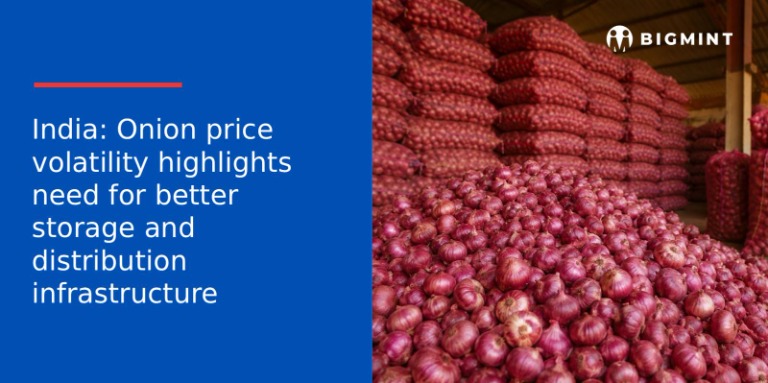
India’s recurring onion price volatility highlights the limitations of short-term market interventions and the need for stronger post-harvest infrastructure. While government measures such as procurement, buffer-stock releases, export policy changes and subsidies aim to balance consumer and farmer interests, inadequate storage and distribution continue to leave growers vulnerable to sharp price fluctuations.
During the recent rabi harvest, Maharashtra onion farmers had argued that the Centre’s procurement price of INR 12.35/kg was insufficient to cover cultivation costs. The procurement price was subsequently raised to as high as INR 26.45/kg, but many growers were unable to benefit from the higher rate. Farmers holding lower-quality produce had reportedly been forced to sell at as little as INR 1/kg, highlighting the impact of inadequate storage and limited access to remunerative markets.
Storage remains key bottleneck for farmer realisation
Onions require specialised storage conditions to preserve quality over several months, particularly during the period between the rabi harvest and arrival of subsequent crops. Without adequate facilities, farmers are often compelled to sell soon after harvest when market arrivals are high and prices are under pressure.
Erratic rainfall during harvesting has further increased quality and storage risks. The reported decline in Maharashtra’s kharif crop, along with storage losses, has added pressure to an already volatile supply cycle. Expanding scientific onion storage facilities closer to producing clusters could allow farmers to stagger sales and reduce distress selling during periods of oversupply.
Efficient movement can reduce regional price disparities
The government’s recent buffer-stock interventions have also highlighted the importance of moving onions efficiently between surplus-producing and deficit-consuming regions. Rail-based movements such as the Kanda Express and road distribution can provide short-term relief, but a more permanent logistics network could improve market integration.
Tamil Nadu’s decision to distribute subsidised onions at INR 35/kg also demonstrates the growing pressure on governments to maintain supplies in consuming regions. However, distributing onions through conventional grain-oriented public distribution systems could result in higher post-harvest losses if storage and handling systems are not adapted to the commodity.
Outlook
Long-term stability in India’s onion market will depend less on repeated short-term interventions and more on improving scientific storage, post-harvest handling, market connectivity and inter-state distribution. A stronger infrastructure network could reduce distress sales by farmers while improving the government’s ability to manage regional shortages without excessive dependence on buffer stocks.
Leave a Reply