- Solar abundance increasingly depressing daytime power prices
- Evening shortages keep coal and storage strategically important
India’s electricity transition is beginning to expose a striking contradiction: the country can simultaneously have too much electricity and not enough of it.
Nearly 11 TWh of potential solar generation was curtailed over the past 15 months, according to government data and research cited by Ember, even as electricity demand has been rising rapidly. The problem is increasingly not the quantity of generation capacity but when and where electricity is available, and whether the grid can move or store it.
BigMint’s analysis of Indian Energy Exchange (IEX) activity during August provides a particularly clear illustration of this emerging imbalance.
IEX reveals a two-speed electricity market
Across August 2026, the Day-Ahead Market’s average market clearing price (MCP) was INR 4.41/kWh.
That monthly number, however, conceals an extraordinary intraday divergence.
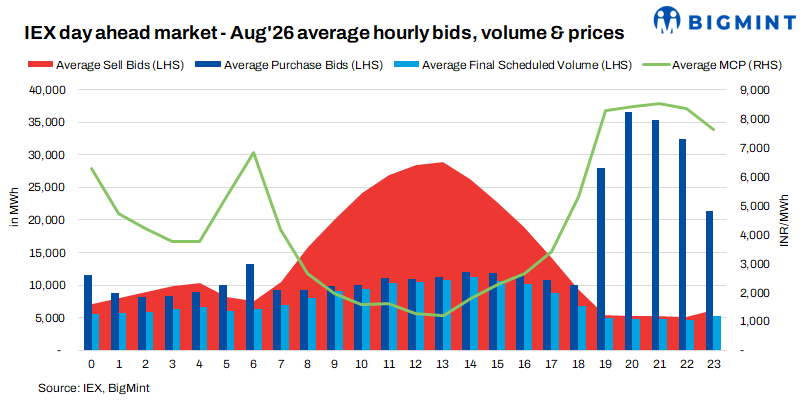
Between roughly 10:00 and 14:00, average sell bids regularly exceeded 24,000-28,000 MWh, while purchase bids remained near 10,000-12,000 MWh. Average prices fell as low as approximately INR 1.20/kWh around 13:00.
Individual trading periods went much lower. On 8 August, MCP fell close to zero during the solar-rich afternoon as sell bids exceeded 34,000 MWh.
After sunset, the picture reversed.
Average purchase bids surged above 30,000 MWh during several evening hours, while sell bids dropped towards 5,000 MWh. Average MCP climbed above INR 8/kWh, with numerous blocks reaching the INR 10/kWh ceiling.
The exchange is effectively placing a price on India’s emerging renewable-integration problem: electricity can be abundant at 1 pm and scarce six hours later.
More solar alone cannot solve the problem
India already has more than 300 GW of clean-power capacity, representing over half of installed electricity capacity, and is targeting 500 GW by 2030. Yet coal continues to provide most actual electricity generation.
This does not necessarily mean renewable deployment is failing.
Rather, installed capacity and dispatchable energy are fundamentally different.
Solar generation is concentrated during a limited part of the day. Without sufficient batteries, pumped storage or transmission capacity, excess afternoon generation cannot simply be transferred into the evening peak.
The geographic concentration compounds the problem. Gujarat and Rajasthan together account for nearly half of India’s solar capacity, creating substantial power flows through western transmission corridors when solar production peaks.
Transmission development has meanwhile reportedly achieved only around 80% of annual construction targets during the past five years.
Building additional solar capacity without equivalent grid and storage infrastructure therefore risks increasing curtailment rather than proportionately reducing thermal generation.
September is making the imbalance even clearer
The first three days of September suggest the problem may be becoming more acute.
IEX purchase bids rose from 506.9 GWh on 1 September to 805.9 GWh on 3 September, while sell bids fell from 390.1 GWh to just 258.7 GWh.
Average MCP consequently climbed from INR 5.96/kWh to INR 7.50/kWh.
On 3 September, the exchange hit the INR 10/kWh ceiling throughout the first eight hourly periods and again from 18:00 onwards.
Yet midday prices remained dramatically lower.
This is important. India is not experiencing a conventional electricity shortage in which generation is inadequate throughout the day. It is increasingly experiencing a flexibility shortage.
There is insufficient ability to shift inexpensive electricity from periods of surplus to periods of scarcity.
Storage becomes the missing link
This is why storage may increasingly become as important to India’s power transition as renewable capacity itself.
India currently has only around 3 GW of battery storage and 7.4 GW of operational pumped storage, while projected storage requirements could reach approximately 74 GW by 2032.
Batteries can absorb electricity during low-price solar hours and discharge it after sunset, simultaneously reducing curtailment and evening scarcity.
The economic signal is already visible on IEX.
Electricity purchased near INR 1-2/kWh during deeply oversupplied daytime periods becomes significantly more valuable when evening power trades near INR 8-10/kWh. Storage economics involve charging losses, capital costs and market constraints, but the widening intraday spread creates an increasingly powerful incentive.
Coal remains the bridge
Until sufficient storage and transmission are built, however, India’s renewable paradox is likely to support rather than eliminate the requirement for dispatchable thermal power.
August renewable generation increased around 42% y-o-y, yet coal-fired generation still rose roughly 11% because electricity demand increased strongly while hydro generation weakened.
This explains why large additions of solar capacity can coexist with high coal burn.
Coal plants cannot simply disappear during the afternoon and return instantaneously after sunset. Thermal units must maintain sufficient operating availability to ramp up as solar generation declines.
That creates a difficult balancing act: running coal plants too strongly during solar hours can contribute to renewable curtailment, while reducing thermal availability too aggressively risks insufficient generation during the evening peak.
BigMint outlook
India’s next electricity challenge is therefore shifting from adding generation capacity to making generation available at the right place and time.
The August IEX curve already resembles the classic renewable-heavy power-market pattern: deep daytime price compression followed by sharp evening scarcity. As solar capacity continues increasing, that divergence could become even more pronounced unless transmission, battery storage and pumped hydro expand rapidly.
For the coal market, the transition is consequently more nuanced than simply assuming every additional solar GW displaces thermal generation.
Renewables will increasingly reduce coal burn during certain hours. But until India can store surplus renewable electricity at scale and deliver it after sunset, coal will remain the principal large-scale insurance policy against evening scarcity.
The paradox is becoming clearer: India does not necessarily need more electricity at every hour.
It needs considerably more ability to move electricity through both geography and time.
Leave a Reply