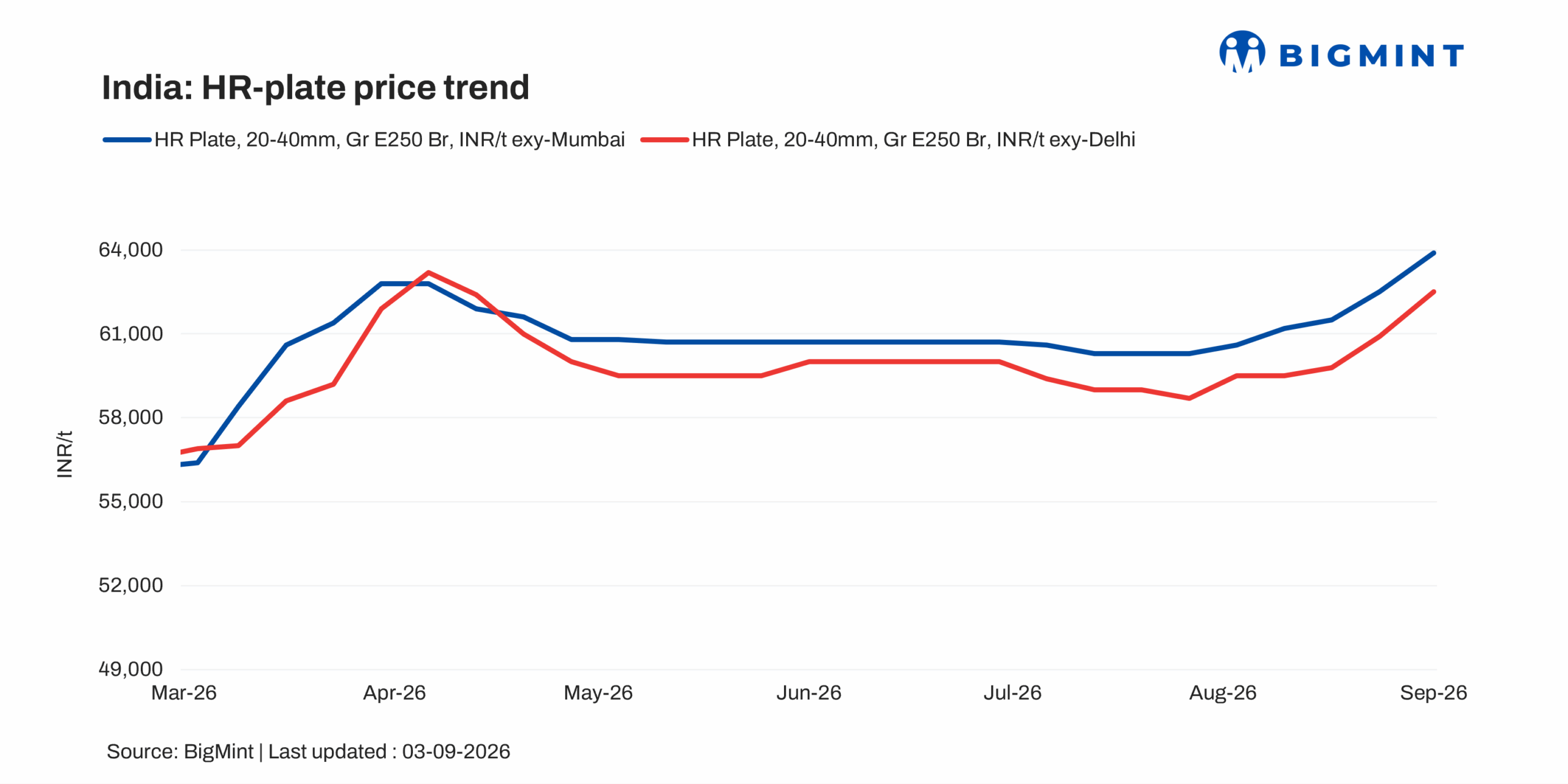
- Stronger mill offers and lean inventories lift HR plates prices
- Rising HRC prices, limited supply strengthen market sentiment
India’s hot-rolled (HR) plate prices increased sharply in the week ended 3 September, supported by moderate-to-good demand, improved buying activity and tighter availability in the trader market. Market sentiment strengthened further after a major domestic mill raised HR plate prices by around INR 1,000/t for new order bookings. The higher offers gradually started reflecting in spot market transactions, giving sellers greater pricing leverage.
BigMint’s assessment for HR plate (IS 2062, Gr E250 Br, 20–40 mm) increased by INR 1,400/t w-o-w to around INR 63,900/t in Mumbai. In Delhi, prices rose by INR 1,600/t w-o-w to INR 62,500/t, tracking the upward movement in the domestic HRC market.

The price increase came amid slower-than-normal material flow into the trader channel. Mills are reportedly supplying only around 80% of ordered volumes, leading to concerns over near-term availability. With expectations of a possible shortage, traders have been keeping inventories leaner and are becoming more cautious about releasing stocks. This tightening supply situation has strengthened sellers’ pricing power and supported HR plate prices despite demand remaining moderate.
Demand outlook turns more positive
Market sentiment is also improving as expectations of stronger project activity and downstream demand build. Whereas, a market participant in West quoted, “The correction is visible across ingots, plates and coils, but this could change as mills anticipate an improvement in demand. We may see demand and prices increase through the next quarter. Holding back supply only adds to mills’ interest costs, so they may be expecting higher prices to recover some of their losses.”
Also, with project activity picking up, demand is expected to improve further. Large end-users, particularly OEMs, are facing delivery delays from manufacturers, which could push them to the spot market to meet immediate requirements. This additional buying could provide further support to prices. Overall, demand is expected to remain good over the next two quarters.
HRC prices lend support to HR plates
India’s HR plate market continued to strengthen as rising HRC prices set a firmer floor for plate prices. BigMint’s HRC benchmark climbed by INR 1,900/t w-o-w to INR 62,000/t ex-Mumbai as of 2 September, reinforcing sellers’ confidence and supporting higher plate offers.
The momentum was further supported by improving demand and rising raw material costs. Controlled dispatches and planned maintenance at mills tightened spot availability, giving sellers greater pricing power.
Meanwhile, buyers stepped up selective restocking ahead of expected price hikes. Stronger CRC-linked demand, lean trader inventories and mills’ focus on automotive and B2B customers added to the firm market tone. With supply remaining limited and demand steady, anticipatory buying provided an additional push to HR plate prices.
Plate imports and exports
HR plate imports stood at 24,391 t as of 21 August, with China accounting for the majority at 19,270 t, followed by South Korea at 4,707 t and Japan at 414 t.
HR plate exports stood at 37,015 t during the same period, remaining higher than imports and indicating a relatively stronger export flow despite limited visibility on destination-wise volumes.
Outlook
HR plate prices are expected to remain on an upward trajectory in the near term, with major mills having already raised offers for early September sales and further revisions being anticipated. Order bookings at mills have reportedly remained closed for nearly 2.5 months, while improving downstream demand is adding to the positive sentiment.
With HRC prices continuing to rise, material availability remaining tight and buying activity expected to improve, the HR plate market is likely to remain volatile with an upward bias. Further price increases could be seen if downstream demand strengthens and mills maintain their current pricing discipline.
Leave a Reply