- Fresh import bookings face resistance at elevated price levels
- Global prices strengthen keeping import replacement costs elevated
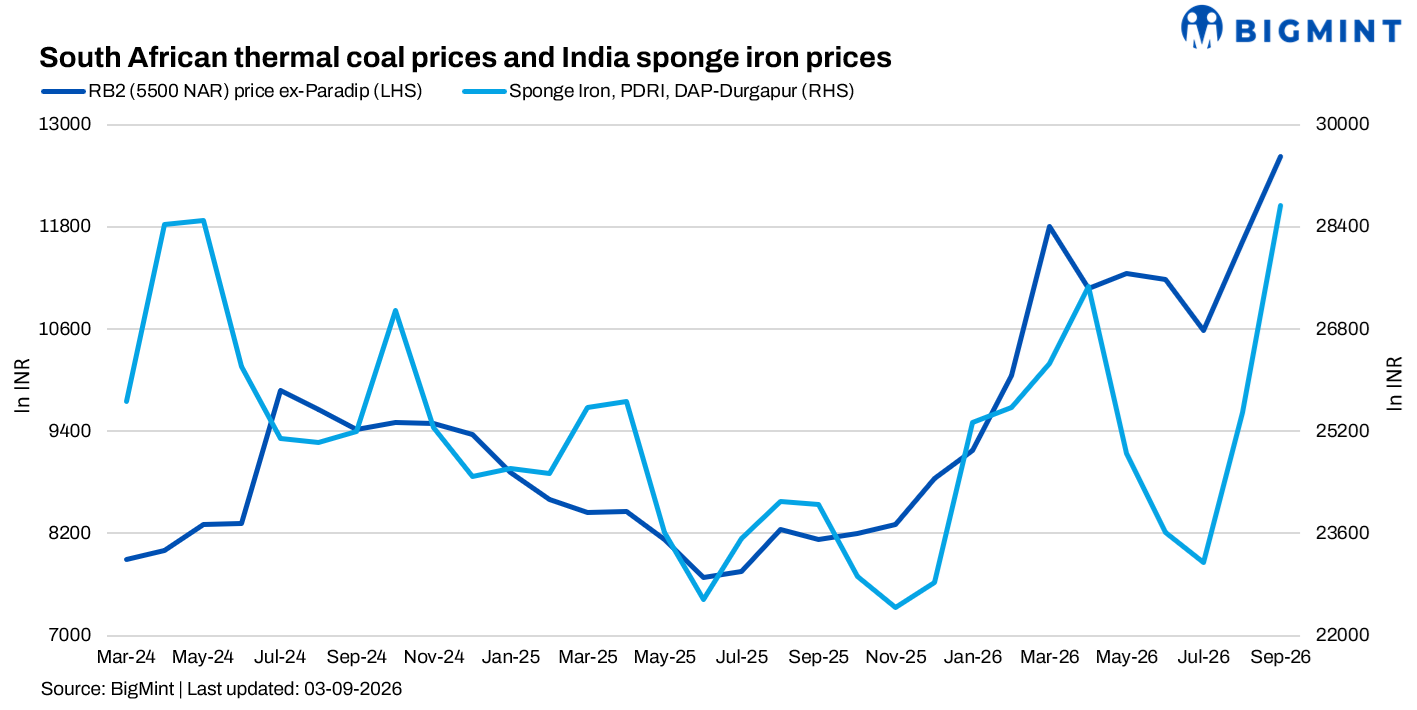
South African thermal coal prices at Indian ports strengthened further during the week. RB2 (5,500 NAR) ex-Paradip increased INR 200/t w-o-w to INR 12,700/t, while ex-Vizag rose INR 100/t to INR 12,600/t. RB3 (4,800 NAR) increased to INR 10,650/t at both Paradip and Vizag, gaining INR 100-150/t w-o-w. Higher international energy costs and tighter replacement economics supported the rise, although importers became hesitant to book fresh cargoes at elevated levels.
Higher international costs support prices
Imported coal prices also strengthened, supported by higher oil and natural gas TTF prices, adding to the broader increase in industrial fuel replacement costs. For South African coal, 5,500 NAR FOB RBCT was heard around $105/t this week, while India-bound offers were heard at around $127-128/t CFR.
Market participants indicated that 5,500 NAR stock deals were being concluded in the mid-INR 12,000/t range. A recent Mangalore transaction was reported at around INR 12,500-12,600/t ex-works, while another 5,000 t RB2 cargo was purchased at around INR 12,300/t.
The sharp rise in replacement costs had started to affect buyer behaviour. While physical material remained available, importers were increasingly hesitant to commit to fresh cargoes at current levels.
Port inventories decline but demand stays selective
Thermal coal inventories at major Indian ports declined 2% w-o-w to 13.40 mnt in week 35, from 13.67 mnt in week 34. Stocks declined at several major ports, although Mundra, Paradip and Tuticorin recorded increases.
The inventory decline indicated stronger evacuation of imported cargoes, but did not point to a broad recovery in import demand. Buyers continued to balance imported coal purchases against domestic availability and rising replacement costs.
Overall, South African coal sentiment remained firm, supported by higher FOB values, international energy costs, domestic supply disruptions and stronger sponge iron prices. However, the sharp increase in replacement costs had widened the gap between seller expectations and buyer acceptance, making fresh import bookings increasingly difficult at prevailing levels.
Tight domestic supplies keeps market supported
Domestic coal prices strengthened further this week as monsoon-related dispatch constraints and tighter availability limited spot supply. The 5,000 GCV grade from Bilaspur rose to INR 7,900/t, up INR 500/t w-o-w, while 4,500 GCV coal increased to INR 5,800/t, up INR 350/t.
The firmness was also reflected in CIL’s e-auctions. The average premium in August rose to 59% over notified prices, compared with 46% during April-August, while SECL’s August allocation recorded an average premium of 81%. Higher auction realisations raised replacement costs for consumers and provided further support to the broader thermal coal market.
Coal India Limited (CIL)’s offered volume for its Single Window Mode Agnostic (SWMA) e-auction declined 16.4% m-o-m to 21.07 million tonnes (mnt) in August 2026, from 25.19 mnt in July, while allocated volumes eased marginally by 1.3% to 8.28 mnt, from 8.39 mnt. Consequently, the allocation ratio improved to 39% in August from 33% in July. The average premium over notified prices also increased significantly to 59% from 41%, indicating stronger competition for available coal and sustained buyer preference for select grades, even as overall auction volumes remained subdued.
Sponge iron demand strengthens coal prices
Sponge iron prices remained firm across major producing regions, supported by higher finished steel realisations and firm coal costs. In Raipur, PDRI prices reached INR 29,050/t, up INR 50/t w-o-w, indicating a marginal weekly gain after sustained strength in domestic coal prices. In Durgapur, PDRI prices increased by INR 1,100/t w-o-w, reflecting stronger buying interest and improved producer realisations.
M-o-m, sponge iron sentiment remained positive as higher coal auction premiums, tighter domestic coal availability and elevated imported coal replacement costs continued to raise input costs, while improved steel market conditions supported producers’ ability to absorb these increases. The regional divergence suggested stronger momentum in eastern India, particularly Durgapur, while Raipur remained comparatively stable. Overall, sponge iron markets stayed firm, with producers supported by downstream demand but facing continued pressure from rising coal costs.
Leave a Reply