- Pellet prices gain on downstream strength
- Karnataka market turns increasingly grade-sensitive
Karnataka iron ore prices remained largely stable during the week, despite a sharp rise in sponge iron and pellet prices. Market activity remained subdued as buyers stayed cautious amid elevated raw material costs, while miners remained reluctant to actively offer material following dispatch-related issues and limited availability of high-grade ore. The divergence between iron ore and downstream prices highlights the growing pressure on sponge iron producers, with the sharp rise in coal prices lifting production costs and limiting their ability to absorb further increases in iron ore prices.
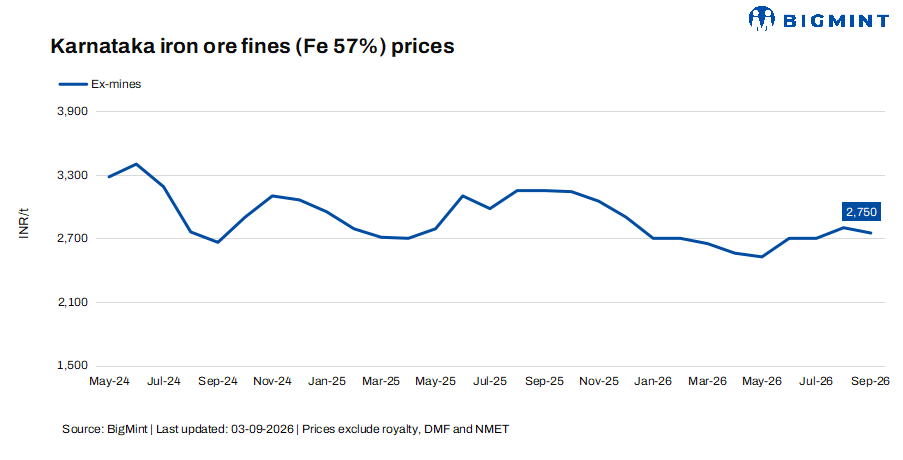
According to BigMint’s latest assessment, Fe 57% iron ore fines prices edged down by INR 50/t ($0.5/t) w-o-w to INR 2,750/t ($30/t) ex-mines. Sponge iron producers are increasingly reluctant to procure low-grade ore as higher coal consumption required to maintain output and chemistry raises their overall production costs. With imported coal prices moving sharply higher, the cost advantage of cheaper low-grade iron ore has diminished, making such material less economical for buyers.
The situation is particularly challenging for sponge iron producers operating on tight margins. Lower Fe ore requires higher fuel consumption during the reduction process, meaning that any savings from purchasing cheaper ore can be offset by additional coal consumption. Consequently, buyers are showing a preference for higher-grade material despite its significantly higher price, while low-grade ore continues to face resistance. This has created a clear quality-driven divide in Karnataka’s iron ore market.
Meanwhile, benchmark Fe 62% iron ore fines prices remained unchanged w-o-w at INR 5,150/t ($54/t) ex-mines. High-grade ore continues to command strong underlying demand owing to limited availability, with only a few miners currently offering suitable material. However, actual trading activity remained muted as buyers faced a mismatch between their quality requirements and prevailing prices. Material available at relatively lower prices often does not meet buyers’ quality specifications, while suitable high-grade ore is being offered at levels that buyers are unwilling to accept unless procurement is urgent.
Dispatch constraints keep auction activity subdued
Auction activity remained virtually inactive during the week, with no major iron ore auction concluded in Karnataka despite firmer downstream sentiment. Market participants indicated that some miners are still focused on dispatching material sold through earlier auctions rather than conducting fresh sales.
A Bellary-based miner told BigMint that around 200,000 t of previously auctioned material is still pending dispatch due to DMG-related and other permission issues. The miner expects dispatches to improve this week and said preparations are underway to accumulate sufficient high-grade material for a fresh auction. The miner also indicated that high-grade material is likely to attract stronger bids once auctioned, given its scarcity, while lower-grade material has already been offered in the market.
The delayed dispatches are adding another layer of tightness to the Karnataka market. While overall iron ore availability is not necessarily constrained across all grades, usable high-grade ore remains scarce, and the inability to promptly move auctioned material is limiting fresh spot availability. Market participants are therefore closely watching upcoming auctions for indications of where benchmark prices could move.
A Bellary-based buyer told BigMint that coal prices have risen sharply, but a corresponding increase in iron ore prices would make sponge iron production increasingly uneconomical. According to the buyer, market activity has slowed as participants who purchased material earlier are waiting for deliveries rather than entering the market at current elevated levels.
This creates a crucial disconnect in the Karnataka market: higher coal prices are supporting sponge iron offers, but they are simultaneously restricting buyers’ ability to absorb higher iron ore prices. As a result, downstream price strength has not translated into an immediate rise in iron ore prices.
Market sentiment remains cautiously positive
Overall domestic market sentiment remains cautiously positive, particularly across sponge iron and pellet markets. The sharp increase in coal prices has created a cost-driven floor under downstream steelmaking raw materials. However, this positive sentiment has not yet translated into stronger iron ore trading activity.
The current market is characterised by stronger replacement costs, scarce high-grade ore, elevated coal prices and limited spot availability, but weak transaction volumes. Buyers are reluctant to chase higher prices, while sellers are unwilling to reduce offers given rising input costs and expectations of firm downstream prices.
Another Bellary-based buyer highlighted that one of NMDC’s mines continues to face dispatch-related issues, while only one auction has taken place during the month. The participant added that availability of high-grade ore remains a key concern.
Market participants are now closely awaiting NMDC’s Kumaraswamy auction, which is expected to provide a clearer price signal for Karnataka’s high-grade iron ore market. The auction outcome will be particularly important in determining whether the current scarcity-driven premium for higher-grade ore can be sustained.
Rationale
- Zero (0) trade via e-auction was recorded for Fe 57% in this publishing window and was not taken into consideration. Hence, the T1 trade category was accorded 0% weightage.
- Sixteen (16) offers and indicative prices were reported, out of which fourteen (14) were considered as T2 trades. These were accorded 100% weightage.
C-DRI prices rise by INR 1,400/t ($15/t) w-o-w in Bellary: The sharpest movement during the week was seen in the downstream sponge iron market. Bellary C-DRI prices increased by INR 1,400/t ($15/t) w-o-w to INR 30,200/t ($319/t), supported primarily by the steep rise in imported coal prices.
The increase in coal costs has significantly raised the conversion cost for sponge iron producers, prompting producers to increase C-DRI offers. However, the sustainability of these higher prices remains uncertain. Several buyers had already secured their requirements at earlier, lower levels and are currently waiting for those supplies to arrive. This has reduced fresh spot buying at elevated prices and could limit the ability of producers to pass on further cost increases.
Bellary pellet prices climb by INR 500/t ($5/t) w-o-w: The sharp increase in sponge iron prices has also spilled over into the pellet market. Bellary pellet prices climbed by INR 500/t ($5/t) w-o-w, as pellet manufacturers raised offers in response to higher sponge iron prices and rising production costs.
However, the increase in pellet offers has not yet translated into significant fresh transactions. Sellers are reportedly well booked, while several buyers had already procured material at earlier, lower prices. Consequently, consumers have largely stayed on the sidelines rather than chase the sharply higher offers.
The pellet market is therefore currently being supported more by cost-push factors and producer pricing power than by a broad-based improvement in spot demand. Higher coal costs are raising sponge iron production costs, higher sponge iron prices are supporting pellet valuations, and pellet producers are attempting to pass on these cost increases. However, downstream buyers remain cautious because of the risk that elevated prices could weaken steel margins and eventually curb raw material procurement.
South African coal gains despite cautious buying: South African thermal coal prices at Indian ports strengthened further during the week. RB2 (5,500 NAR) ex-Paradip increased INR 200/t w-o-w to INR 12,700/t, while ex-Vizag rose INR 100/t to INR 12,600/t. RB3 (4,800 NAR) increased to INR 10,650/t at both Paradip and Vizag, gaining INR 100-150/t w-o-w. Higher international energy costs and tighter replacement economics supported the rise, although importers became hesitant to book fresh cargoes at elevated levels.
Karnataka iron ore sales scenario (28 August- 03 September 2026)

Outlook
High coal costs are limiting buyers’ ability to absorb further iron ore hikes. The NMDC Kumaraswamy auction and pending dispatches will be key price indicators, while subdued buying may keep the broader market range-bound.
Leave a Reply