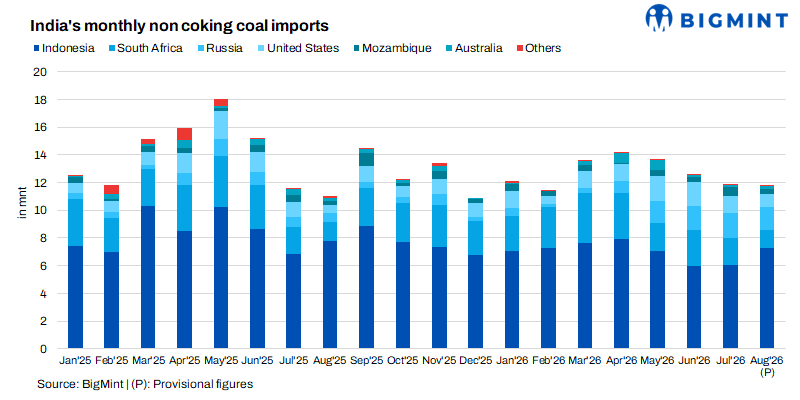
- Non-coking coal imports remain flat y-o-y, at lowest levels since 2022
- Falling power plant stocks may lead to post-monsoon import rebound
India’s coal and coal-product imports are provisionally estimated at around 18.46 mnt in August 2026, with non-coking coal accounting for roughly 11.1 mnt, flat y-o-y. Seaborne purchases remained subdued despite a sharp deterioration in domestic power-plant coal inventories during the month.
The preliminary estimate is based on August vessel movements and includes cargoes classified as sailed as well as vessels already at berth by month-end. Vessels remaining at anchorage or still expected have been excluded, providing a conservative cut-off for estimating imports during the month.
The resulting picture is significant. Rather than responding to tightening domestic coal availability with an immediate surge in overseas purchases, India’s non-coking coal imports remained close to the lowest August level recorded over the past five years.
Total imports estimated at over 18 mnt
Non-coking coal remained the largest component of August imports, followed by coking coal.

The import basket remained diversified, spanning thermal coal, metallurgical coal and coke products, with non-coking and coking coal together accounting for the overwhelming majority of volumes.
The 18.46 mnt estimate is deliberately conservative. Cargoes that were still at anchorage at the end of August have not been included, even though they had physically reached Indian waters. These should instead contribute to subsequent import numbers once they move to berth or complete their port movement.
Non-coking imports remain historically subdued
The more striking trend emerges when August’s provisional non-coking coal imports are placed against the historical series.

At approximately 11.1 mnt, August 2026 non-coking coal imports were broadly flat against August 2025 but around 15% below August 2024, 8% below August 2023 and 28% below August 2022.
The cumulative comparison is even more notable.
January-August 2026 non-coking coal imports are estimated at around 100.4 mnt, nearly 10% below the corresponding period of 2025 and approximately 17% below 2024.
This means that despite the tightening that emerged in India’s domestic coal and power markets during August, the country has so far imported substantially less thermal coal in 2026 than in recent years.
Power-plant stocks fall while imports remain weak
This divergence is particularly important because August saw a sharp deterioration in coal availability at thermal power stations.
Coal consumption consistently exceeded receipts during much of the month, pulling down inventories. Power-plant stocks fell from around 37.6 mnt in end-July to close to 31 mnt by late August, while the number of plants classified as holding critical coal inventories increased sharply.
Yet non-coking coal imports moved in the opposite direction. Imports declined from 12.6 mnt in June to 11.8 mnt in July and approximately 11.1 mnt in August.
The August data therefore do not yet show a major seaborne response to the tightening domestic coal situation.
This may partly reflect timing. Much of the most pronounced deterioration in power-plant inventories occurred during the latter part of August. Any additional international purchases made in response would require time for contracting, loading and transportation before reaching Indian ports.
The more meaningful import response, if one develops, may consequently become visible during September and October.
Indonesia remains the cornerstone of thermal coal supply
Indonesia continued to dominate India’s imported non-coking coal market during August, reflecting its geographical proximity, wide range of coal qualities and established trading relationships with Indian utilities and industrial consumers.
However, the August vessel programme also shows meaningful supply from Russia, South Africa, the US, Australia and Mozambique.
This diversification is important because Indian buyers increasingly evaluate imported coal on a quality-adjusted delivered-cost basis rather than simply comparing headline FOB prices.
Higher-calorific-value coal can compete with lower-grade alternatives despite a higher price per tonne, while freight, port costs, rail transportation and the location of the consuming plant all influence the final economics.
Western and southern consumers remain important
The geographical distribution of August imports reinforces this point.
Western ports including Mundra, Kandla, Hazira, Dahej, Navlakhi, Salaya and Jaigarh, alongside southern ports such as Krishnapatnam, Ennore, Karaikal, Tuticorin, Kakinada and Gangavaram, featured prominently in the month’s vessel programme.
For consumers in these regions, the relevant comparison is often not between international coal and domestic coal at the mine.
Domestic coal produced in eastern and central India may need to travel considerable distances by rail before reaching plants in western or southern India. Freight and logistics can therefore materially alter the delivered-cost comparison. Imported coal consequently retains a structural role for some coastal consumers even when India’s overall domestic coal availability is adequate.
That distinction could become increasingly important if utilities begin rebuilding depleted power-plant inventories simultaneously after the monsoon, increasing demand on the domestic coal transportation system.
Metallurgical coal remains a major import requirement
Coking coal imports are provisionally estimated at around 5.4 mnt in August, accounting for close to 30% of total coal and coal-product imports.
Australian, Russian, US and Mozambican coking coal featured in the August vessel programme, supplying major Indian steel producers.
This highlights an important structural difference between India’s thermal and metallurgical coal markets.
India has considerable ability to substitute imported thermal coal with domestic coal, subject to quality, geography and logistics. The steel sector, however, remains much more structurally dependent on imported metallurgical coal.
The decline in overall coal imports therefore should not be interpreted as a broad retreat from imported coal across all end-use segments.
Sep-Oct becomes key test
Historical import patterns make the next two months particularly important.
India’s September non-coking coal imports stood at:

The four-year September average is around 14.1 mnt, substantially above the provisional August 2026 level of approximately 11.1 mnt.
There is therefore considerable room for imports to recover from current levels without becoming historically exceptional.
The question is whether India’s coal market actually needs that increase.
Domestic production and dispatches should improve as monsoon disruption recedes. But power utilities will simultaneously need to rebuild inventories depleted during July and August. This could increase the amount of coal that needs to move through the domestic logistics system even if underlying power-sector coal consumption moderates.
If domestic production and transportation can rebuild inventories sufficiently quickly, imported thermal coal demand could remain subdued.
If they cannot, western and southern consumers are likely to become particularly important in determining the scale of any seaborne response, given the delivered-cost economics of transporting domestic coal over long distances.
Leave a Reply