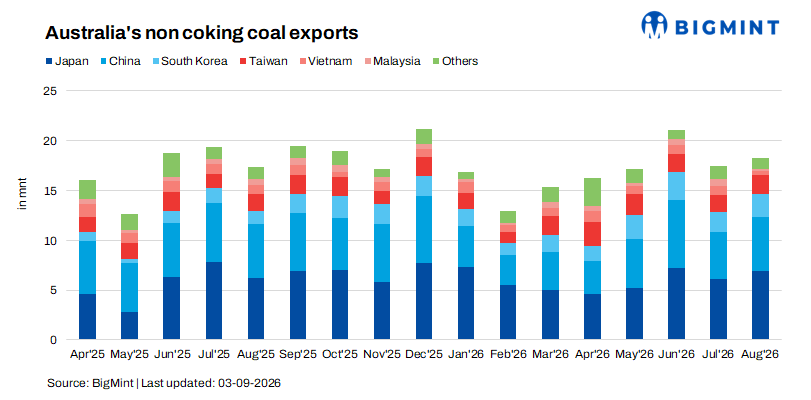
- August exports rebound 7.7% m-o-m after July contraction
- South Korea, Japan offset weaker Chinese and Southeast Asian demand
Australia’s non-coking coal exports increased during Jan-Aug 2026, but unlike coking coal, the recent monthly pattern points to a recovery rather than clear acceleration, with August volumes rebounding from July but remaining below June’s unusually strong level.
Exports reached 134.82 mnt in Jan-Aug 2026, up 4.7% from 128.71 mnt in the corresponding period of 2025.
August shipments stood at 18.25 mnt, 5.1% above 17.36 mnt in August 2025 and 7.7% higher than July’s 16.94 mnt.

June was the strongest month of 2026 at 21.09 mnt, 12.5% above the previous year. July then contracted almost 20% sequentially and fell 12.6% y-o-y.
August reversed part of that decline, recovering by more than 1.3 mnt from July and moving back above year-ago levels. The distinction is important: Australian non-coking coal exports are recovering, but not yet accelerating consistently. August remained 13.5% below June.
South Korea provides demand boost
The destination data reveal a substantial redistribution of Australian thermal coal.
Japan remained the largest buyer, with shipments increasing 7.5% to 48.09 mnt from 44.74 mnt.
The biggest change, however, came from South Korea. Shipments jumped to 15.59 mnt from 8.61 mnt, an increase of 6.98 mnt or around 81%. Taiwan also strengthened considerably, increasing 22.7% to 15.06 mnt.
China moved in the opposite direction. Australian non-coking coal shipments to China declined 11% to 36.34 mnt from 40.82 mnt.

The 6.98 mnt increase in South Korean demand alone exceeded Australia’s total 6.11 mnt increase in Jan-Aug non-coking coal exports. That demonstrates how extensively the market has been redistributed.
China shows opposite trends across coal types
Perhaps the most revealing comparison comes from China.
Australian coking coal shipments to China increased almost 80% in Jan-Aug, while non-coking coal shipments fell 11%.
China’s Australian coal purchasing in 2026 is therefore not a broad-based story. Demand has diverged substantially by coal type. For thermal coal, the reduction in Chinese buying has been absorbed primarily by Australia’s traditional northeast Asian utility markets.
Japan, South Korea and Taiwan together took 78.74 mnt, accounting for well over half of Australian non-coking coal exports.
Southeast Asian demand loses ground
The strength in northeast Asia contrasts with weaker demand further south.
Vietnamese shipments declined 23.5% to 6.96 mnt, while Malaysia fell 21.6% to 3.62 mnt. Thailand was broadly stable. India also remained a relatively small destination at 1.82 mnt, down slightly from 1.97 mnt.
This highlights the fundamental difference between Australia’s two major coal export businesses. India is central to Australian coking coal trade, whereas Australia’s non-coking coal remains overwhelmingly oriented towards northeast Asian power-generation markets.
Newcastle remains thermal coal export engine
Newcastle continued to dominate non-coking coal exports, handling 98.53 mnt in Jan-Aug 2026, up 6.1% y-o-y. That represents close to three-quarters of Australia’s total non-coking coal exports.
Gladstone increased 17% to 12.67 mnt and Brisbane rose 12.3% to 4.11 mnt. DBCT fell 18.2% to 6.2 mnt, while Port Kembla also declined. The geographical concentration reinforces the central role of New South Wales and Newcastle in supplying higher-energy
Australian thermal coal to Asian utilities.
August recovery leaves China as potential swing buyer
The latest data provide a more nuanced outlook than the Jan-Aug increase of 4.7% might suggest.
June was exceptionally strong, July reversed sharply, and August recovered. The sequence of 21.09 mnt, 16.94 mnt and 18.25 mnt therefore points to resilient exports but not yet sustained acceleration.
What is more significant is that Australia has increased exports despite shipping 4.48 mnt less coal to China.
Japan, South Korea and Taiwan have absorbed the difference.
That potentially makes China the swing factor for the remainder of 2026. If Chinese thermal coal buying strengthens while northeast Asian utility demand remains firm, Australia’s export trajectory could move from the current recovery into genuine acceleration.
For now, however, the two Australian coal markets are sending different signals: coking coal exports are showing strengthening late-summer momentum, while non-coking coal exports have recovered from July but have yet to regain their June peak.
Leave a Reply