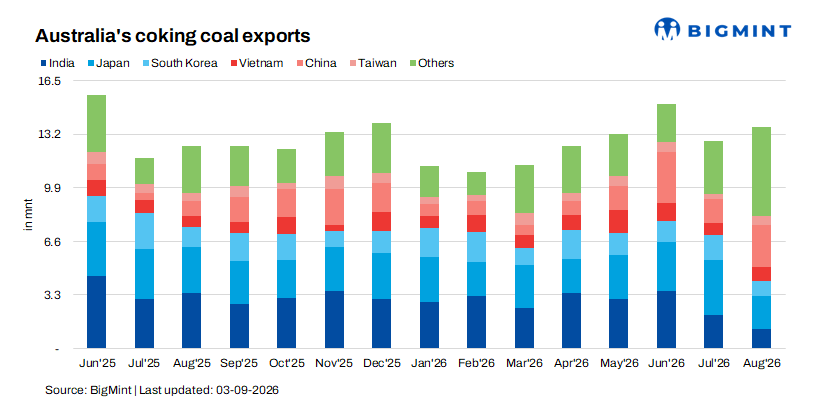
- August exports rise 9.2% y-o-y as momentum rebuilds
- China absorbs tonnes released by weaker Indian demand
Australia’s coking coal exports increased during the first eight months of 2026, but the headline growth understates two significant changes taking place beneath the aggregate numbers: exports regained momentum through July-August, while China emerged as the principal growth market as shipments to India contracted sharply.
Coking coal exports reached 100.03 mnt in January-August 2026, up 3.5% from 96.64 mnt in the corresponding period of 2025. The latest monthly data are more bullish than the cumulative growth rate suggests. August shipments reached 13.61 mnt, up 9.2% from 12.46 mnt in August 2025 and 10.8% from 12.28 mnt in July.

The sequence shows an important change in direction.
June was the strongest month of 2026 at 15.06 mnt of exports, although shipments were 3.5% below June 2025. Volumes then dropped seasonally to 12.28 mnt in July but moved back above year-ago levels. August extended that recovery, increasing both sequentially and y-o-y.
Consequently, while exports have not yet returned to June’s absolute peak, the y-o-y growth rate has accelerated from -3.5% in June to +4.6% in July and +9.2% in August.
That gives the January-August increase of 3.5% a stronger underlying trajectory than the cumulative number alone indicates.
China replaces India as growth engine
The bigger structural change is occurring in destination flows.
India remained Australia’s largest coking coal customer during the review period but shipments fell 18.6% to 21.82 mnt from 26.81 mnt a year earlier. China moved sharply in the opposite direction. Shipments surged to 11.88 mnt from 6.62 mnt, an increase of 5.26 mnt or nearly 80%.
The scale of the redistribution is striking: the 5.26 mnt increase in Chinese purchases more than compensated for the 4.99 mnt reduction in shipments to India.

India’s share of Australian coking coal exports consequently declined from around 27.7% to 21.8%, while China’s share rose from 6.9% to 11.9%.
Japan, meanwhile, increased purchases 5.4% to 20.81 mnt, bringing it much closer to India as an Australian coking coal destination. Vietnam also strengthened, while South Korean shipments declined 10%.
Australia less dependent on Indian demand
The changing destination mix has implications beyond volumes.
India remains strategically important because of its large blast-furnace steel sector and dependence on imported coking coal. But the 2026 flows demonstrate that weaker Indian buying does not necessarily leave Australian tonnes without a market. China has provided the clearest alternative.
This potentially changes the competitive environment for Indian buyers. If Chinese demand remains strong when Indian mills return more aggressively to the market, both could be competing for the same Australian metallurgical coal supply.
The shift therefore strengthens Australia’s ability to arbitrage coking coal between major Asian steelmaking markets, rather than relying disproportionately on Indian demand.
Queensland terminals capture export growth
The port data reinforce the supply picture.
DBCT became the largest coking coal export terminal during Jan-Aug 2026, handling 32.87 mnt, up 9.8% from 29.94 mnt.
Gladstone increased 3% to 31.93 mnt, while Hay Point rose 4.9% to 24.10 mnt. Abbot Point moved against the trend, declining 15.4% to 8.21 mnt.
The expansion therefore remains concentrated across Queensland’s principal metallurgical coal corridors.
August points to firmer second-half momentum
The combination of stronger August exports and changing destination flows is the most significant signal.
Australia exported 3.39 mnt more coking coal during Jan-Aug than a year earlier despite shipments to India falling by almost 5 mnt. That means other markets have absorbed both the lost Indian demand and Australia’s incremental export supply.
At the same time, August exports were 9.2% above last year and 10.8% above July.
If Chinese buying remains elevated and Indian demand recovers after the monsoon, Australia’s coking coal market could therefore enter a more competitive phase.
The question for the remainder of 2026 is no longer simply whether Australian supply can grow. It is increasingly which steelmaking market is prepared to compete most aggressively for those tonnes.
Leave a Reply