- Iron ore, pellets and domestic coal firm up on monsoon supply constraints
- Higher raw material costs lift sponge iron, pig iron and billet prices
- Maintenance shutdowns, healthy bookings enable mills to raise steel prices
Morning Brief: Domestic steel and raw material prices strengthened across most segments in August as monsoon-related supply disruptions tightened raw material availability while higher production costs and improving downstream sentiment supported steel prices. Iron ore, pellets, domestic coal, sponge iron, pig iron and billet all recorded month-on-month gains, while integrated steelmakers raised flat and long steel list prices amid planned maintenance shutdowns and healthy project order books.
The recovery marks a shift from the broad-based correction seen through June and July. Rather than being driven by stronger end-user demand alone, August’s market was shaped by tightening raw material supply, higher replacement costs and expectations of a gradual recovery in construction activity after the monsoon. Healthy project bookings allowed mills to maintain pricing discipline even as spot demand remained seasonally subdued.
Raw material markets tighten
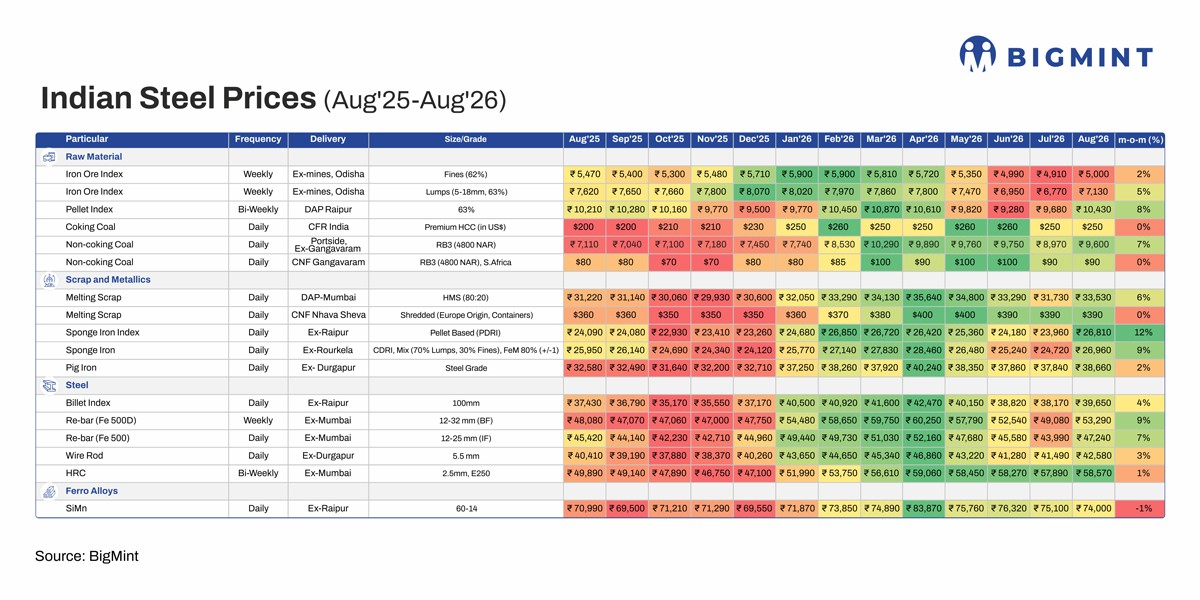
BigMint’s Odisha iron ore fines index (Fe 62%) rose by INR 90/t m-o-m to an average of INR 5,000/t in August, while lump ore prices increased 6% to INR 7,130/t. Persistent rainfall disrupted mining activity and constrained material availability across Odisha, supporting prices despite limited fresh buying from steelmakers. Miner sentiment remained stable during the month, with some sellers reporting marginal price increases.
The market also found support from auction activity. Odisha Mining Corporation (OMC) auctioned 1.83 mnt of iron ore on 19 August, of which 1.16 mnt comprised fines booked at broadly stable average bid levels compared with the previous month. Looking ahead, prices are expected to remain firm through September as monsoon-related supply disruptions continue, although cautious steel demand could limit further gains.
Pellet prices recorded one of the strongest increases across the raw material complex. BigMint’s PELLEX (Fe 63%) rose by INR 750/t m-o-m to INR 10,430/t DAP Raipur, supported by firm demand from sponge iron, pig iron and billet producers, higher iron ore costs and constrained pellet availability. Tight lump ore availability continued to support pellet demand, although resistance from buyers could cap further price increases.
Coal markets also strengthened during the month. BigMint’s domestic portside RB3 non-coking coal index increased 7% m-o-m to INR 9,600/t as rainfall affected production and dispatches. Imported RB3 prices remained unchanged at $90/t CNF Gangavaram. In the metallurgical coal market, BigMint’s premium hard coking coal (PHCC) index was assessed at $280/t CNF Paradip on 27 August, up $15/t week-on-week and the highest level since the index was launched in August 2024.
The rally in coking coal was driven primarily by tightening supply in China. Mysteel’s survey of 523 Chinese coking coal mines showed washed coal inventories falling to their lowest level in more than four years as mine safety inspections, constrained domestic production and stronger procurement reduced available supplies. Russian coal production also weakened, with July output falling to 32.7 mnt, the lowest monthly level of the year. January-July production totalled 249 mnt, down 1.8% y-o-y, while hard coal production declined 2.3%.
Higher input costs lift metallics
Higher raw material costs translated into stronger prices across the metallics chain. BigMint’s sponge iron index (PDRI) increased 12% m-o-m to INR 26,810/t ex-Raipur, while CDRI prices rose 9% to INR 26,960/t ex-Rourkela. Firm pellet demand, higher coal costs and stronger billet production supported the market, while reduced scrap availability continued to encourage secondary producers to use sponge iron as an alternative metallic feed.
Pig iron prices rose 2% m-o-m to INR 38,660/t ex-Durgapur. Higher coking coal and metallurgical coke costs increased blast furnace production costs, while export demand continued to tighten domestic availability. Producers also benefited from improved margins in export markets, allowing prices to remain firm despite seasonally slower domestic buying.
Domestic melting scrap prices recovered 6% m-o-m to INR 33,530/t DAP Mumbai, while imported shredded scrap remained unchanged at $390/t CNF Nhava Sheva. The divergence reflected tighter domestic scrap availability following weaker import arrivals earlier in the year.
Maintenance supports finished steel prices
Finished steel prices also recovered during August as mills passed through higher input costs and tighter supply conditions. Billet prices rose 4% m-o-m to INR 39,650/t ex-Raipur, supported by higher sponge iron costs and improving demand from rerolling mills. Wire rod prices increased 3% to INR 42,580/t. Primary steelmakers increased flat steel list prices by INR 750-1,500/t for early August deliveries, lifting HRC and CRC prices on expectations of stronger post-monsoon demand. BigMint’s HRC index rose 1% m-o-m to INR 58,570/t ex-Mumbai.
Long steel recorded stronger gains. Major producers increased rebar list prices by INR 1,000-2,000/t during early August while BigMint’s BF-route and IF-route rebar indices rose 9% and 7% m-o-m respectively. Planned maintenance shutdowns reduced domestic supply, with one major south India-based PSU steelmaker remaining under maintenance for more than a month and another integrated producer preparing to begin maintenance during August.
The anticipated reduction in production improved market sentiment and encouraged mills to adopt a firmer pricing stance. Market participants expect tighter spot availability to support higher realisations until normal production resumes. Primary producers also continued to report healthy project bookings, with confirmed orders exceeding 300,000 t and order visibility extending beyond one month. Silico manganese was the only major steelmaking input to weaken during the month, easing 1% m-o-m to INR 74,000/t ex-Raipur.
Outlook
Raw material markets are expected to remain firm through September as monsoon-related disruptions continue to constrain iron ore availability, pellet supply remains tight and seaborne coking coal prices stay elevated on Chinese supply concerns.
For steelmakers, higher replacement costs and maintenance-led supply discipline are likely to continue supporting prices in the near term. The next phase of the market will depend on whether post-monsoon construction activity and project execution strengthen sufficiently to sustain the August recovery. Healthy order books suggest underlying demand remains intact, but the pace at which seasonal demand returns will determine whether mills can maintain recent price increases through the second quarter of FY27.
Leave a Reply