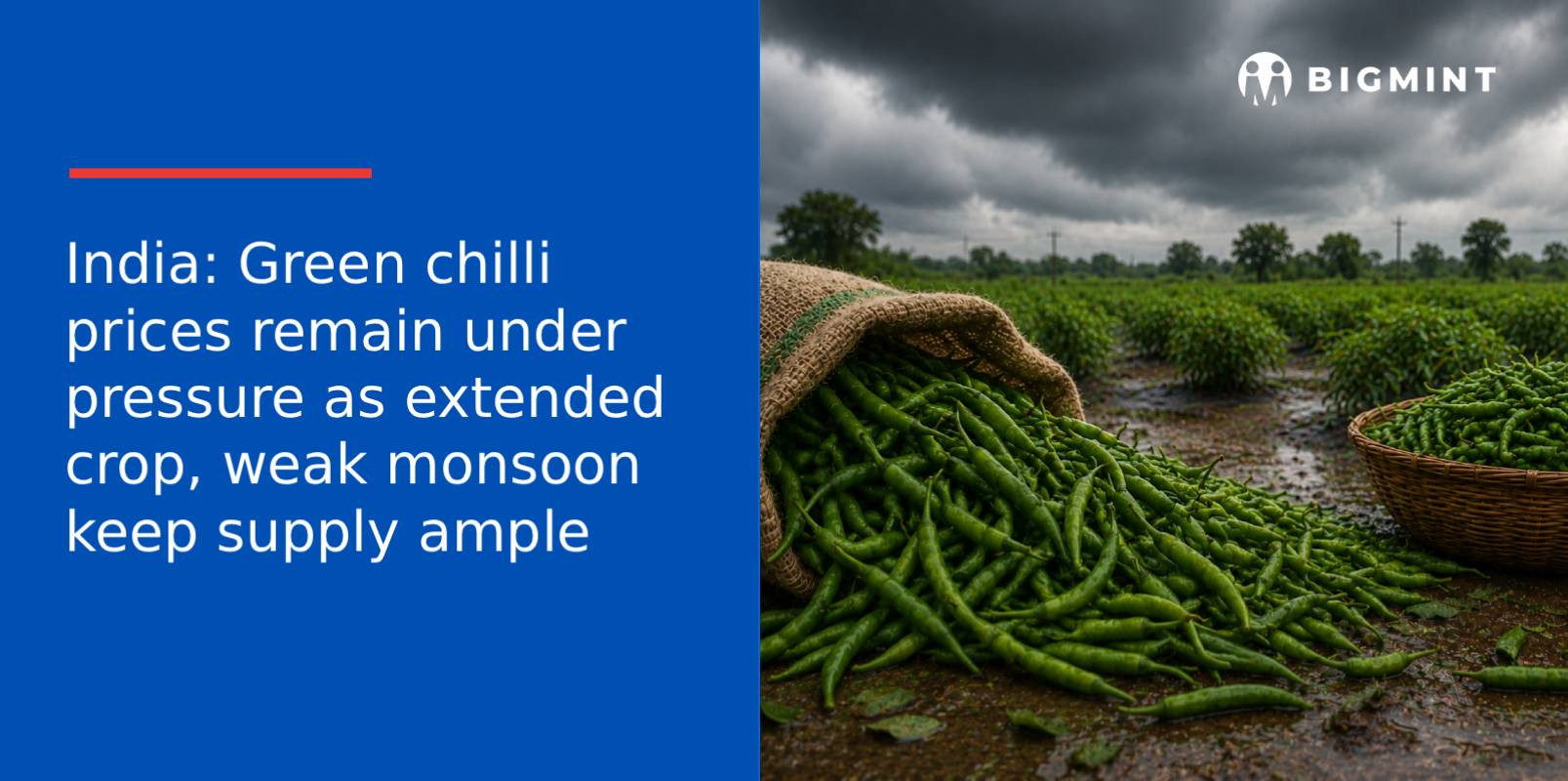
- Weak monsoon extends chilli season in key growing areas
- Sep prices likely to stay soft until local crops wind down
Indian green chilli prices remained under pressure in the week ended 2 September 2026, as weak and uneven monsoon rainfall has allowed summer-planted crops across several states to continue yielding beyond their normal window. This has kept local supplies available and reduced buyers’ dependence on traditional rainy-season producing centres.
Prices
Green chilli mandi prices have eased to around INR 4,300-4,600/quintal (around INR 53-56/kg) in late August, down 3-5% over the past month. Average August 2026 prices stood at around INR 4,829/quintal, about 11% lower y-o-y, despite August normally being a stronger pricing period.
Supply, demand
Normally, good monsoon rainfall brings summer-planted green chilli crops towards the end of their productive cycle, shifting market dependence toward rainy-season origins such as Chikhli/Buldhana in Maharashtra, Madhya Pradesh, Nandurbar and Gondal. This seasonal transition typically helps establish a price floor.
This year, however, the transition has been delayed. India’s monsoon rainfall deficit has widened to around 14% since 1 June, with notable shortfalls in Andhra Pradesh, parts of Bihar, and Punjab. Several chilli-growing areas have avoided the heavy rainfall that would normally end summer crops, allowing local supplies to continue.
Buyers can still source green chillies from their own or neighbouring states, reducing dependence on traditional rainy-season centres and increasing competition between producing regions. There is no clear evidence of a structural decline in domestic demand; current weakness is mainly due to overlapping local and regional crops.
Fundamentals, weather
The market remains supply-heavy rather than demand-weak. Extended crop availability is capping near-term price gains, while nearly half of India’s districts are experiencing rainfall deficits. Over the next 1-2 weeks, rainfall is expected to improve in some areas but remain uneven, with regional deficits persisting.
A belated spell of heavier rainfall in currently dry green chilli-growing areas could finally reduce extended harvests and tighten supplies. Until then, continued local crop availability is likely to keep prices under pressure.
Outlook
Green chilli prices are expected to remain soft-to-sideways through September as overlapping local crops continue to keep markets well supplied. A firmer trend is likely only once local production declines across multiple states, and buyers become more dependent on Maharashtra, Madhya Pradesh, Nandurbar and Gondal. The timing and intensity of rainfall will remain the key factor determining how quickly supplies tighten and prices recover.
Leave a Reply