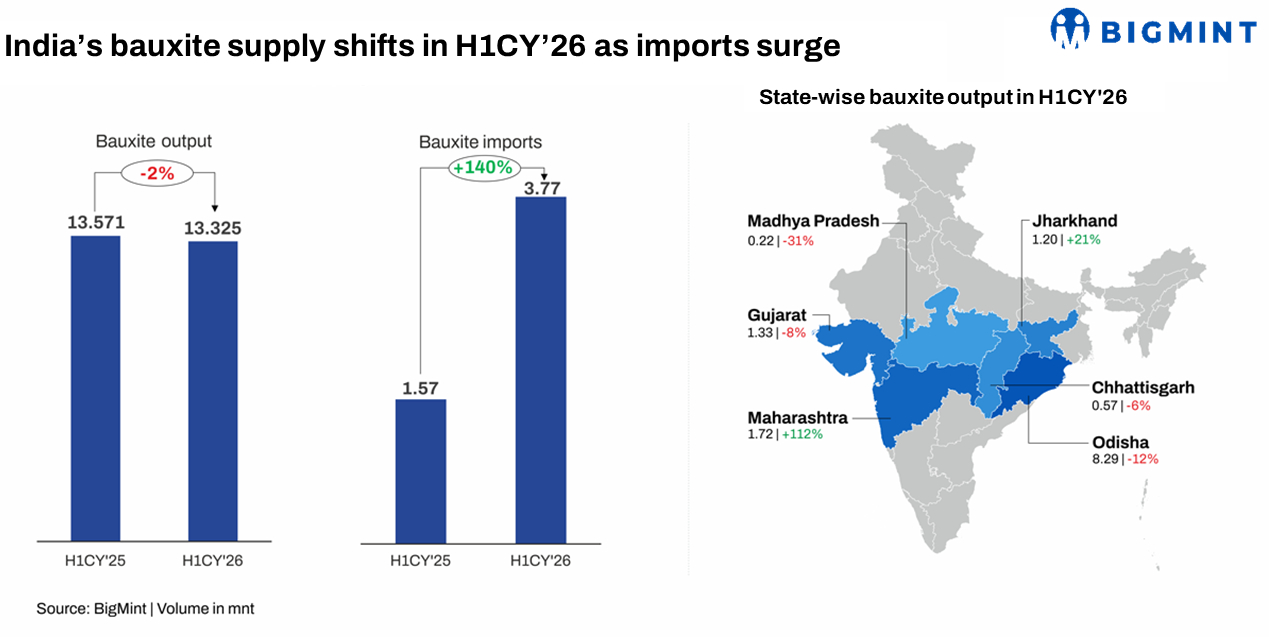
- Output from Odisha, India’s leading producer, declines by 12% y-o-y
- Ore quality, regional transportation dynamics influence sourcing decisions
India’s bauxite market is seeing a divergence between domestic production and imports. Bauxite production stood at 13.33 million tonnes (mnt) in H1CY’26, down 2% from 13.57 mnt in H1CY’25. During the same period, imports jumped 140% to 3.77 mnt, from 1.57 mnt a year earlier.
The sharp increase in imports comes despite India having significant bauxite resources and several new mining projects in the pipeline. The numbers suggest that the issue is not simply the availability of bauxite resources, but how quickly suitable domestic ore can be brought into production and supplied to refineries.
Odisha remains pressure point
The state-wise numbers provide some context to the marginal decline in national production. Odisha, which contributes the bulk of India’s bauxite output, recorded a 12% decline in H1CY’26. Higher production from Maharashtra and Jharkhand partly offset the fall, while some other producing states also recorded lower output.
This matters because Odisha is also where a large part of India’s upcoming bauxite mining capacity is concentrated. The state therefore sits at the centre of both the current production shortfall and the industry’s plans for future supply. For now, however, the new capacity is yet to make a significant contribution to the national production numbers.
Why are imports rising when India has bauxite?
Bauxite availability is not only about the size of the resource base. For an alumina refinery, the quality of the ore matters. Alumina content, reactive silica and other characteristics can affect refinery economics and the suitability of a particular deposit. Location is another factor.
This is particularly relevant for coastal refineries. Imported bauxite can be delivered by sea directly to ports, while domestic ore may need to travel long distances by rail or road. Depending on freight and ore quality, imported material can therefore remain commercially viable even when domestic resources are available.
This has kept imports as a regular part of India’s bauxite supply mix.

India’s bauxite imports have risen from around 3.1 mnt in 2021 to nearly 4.9 mnt in 2025. Guinea has remained the dominant supplier, while Brazil and Sierra Leone have gained importance as producers diversify their sourcing. The 3.77 mnt imported in H1CY’26 means that the pace has remained strong this year as well.
The mine-to-refinery link matters
The difference between available resources and usable supply is also visible in the way India’s large aluminium producers are building their raw material chains.
NALCO excavated a record 7.70 mnt of bauxite in FY’26, supported by its integrated mining and refining operations. It is also developing the 3.5 mnt/year Pottangi bauxite mine in Odisha. Hindalco’s 8.5 mnt/year Baphlimali mine supplies bauxite to its Utkal Alumina refinery, giving the company a direct link between its mining and refining operations.
Such arrangements provide greater visibility over raw material availability. But where domestic mines are still under development, producers have to rely on other sources, including imports. This is becoming more relevant as refinery capacity expands.
New mines could change balance
The next few years could bring a significant increase in domestic bauxite availability.
Vedanta’s Sijimali bauxite mine is planned at around 12 mnt/year and is expected to support the company’s expanding alumina operations. NALCO’s Pottangi mine and the planned expansion of OMC’s Kodingamali mine will add further domestic capacity.
The combined potential is significant. But the market will not see the full benefit immediately.
A bauxite resource has to move through mine development, clearances, infrastructure creation, and production ramp-up before it becomes a reliable source of refinery feedstock. This time lag is important in the current market because refinery requirements are already increasing.
Karlapat shows how producers are looking ahead
The recent auction of the Karlapat bauxite block in Odisha adds another dimension to the story. BALCO won the block at a 175% premium, following strong competition from several major industrial groups. The block contains more than 200 mnt of bauxite resources.
The aggressive bidding comes at a time when aluminium producers are expanding their operations and looking to secure raw materials for the longer term. But, as with other newly allocated blocks, Karlapat will take time to move from resource to actual production. Its significance is therefore more about future supply security than the immediate H1CY’26 balance.
Alumina growth will keep bauxite demand firm

The pressure on bauxite is also coming from the downstream side. In H1CY’26, India’s alumina imports declined 36% to around 0.77 mnt, while exports increased 49% to 2.5 mnt. This reflects stronger domestic alumina production and growing export availability. But higher alumina production also means higher bauxite consumption.
At a typical conversion ratio of around 2.5 tonnes of bauxite for one tonne of alumina, additional refining capacity translates into a significant increase in ore requirements. This creates a timing challenge for the industry. If alumina capacity is commissioned faster than new bauxite mines are ramped up, imports will naturally fill part of the requirement.
Outlook
India’s bauxite story is therefore not simply one of insufficient resources. The country has sizeable reserves, established captive mining operations and a large pipeline of new projects. What is missing is sufficient operational supply at the right time, quality and location.
If projects such as Sijimali, Pottangi and Kodingamali ramp up as planned, domestic bauxite production could move towards 45-50 mnt annually over the coming years. That would substantially improve the domestic supply position. It may not, however, eliminate imports.
As alumina capacity expands, India’s bauxite requirement will also increase. Imports are likely to remain relevant for coastal refineries, specific ore requirements and periods when domestic mines cannot supply enough material.
The H1CY’26 numbers offer a clear indication of where the market stands today: domestic production has barely moved, while the industry’s need for bauxite has increased faster. The next phase will depend on how quickly new mines can bridge that gap. For India’s aluminium industry, the question is no longer just how much bauxite the country has, but how quickly that resource can be turned into reliable refinery feedstock.
Leave a Reply